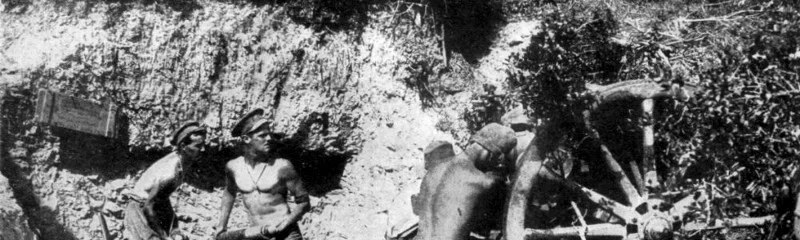
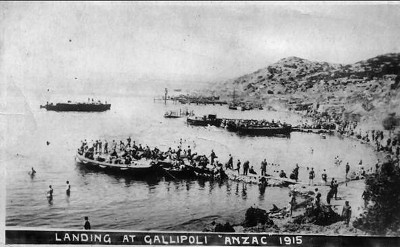
The Battle of Gallipoli was a watershed moment in the history of warfare. Few other battles were initiated with such high strategic hopes that were then dashed so quickly. Its influence carried far beyond the war in which it occurred. Simultaneously, it spurred some observers to proclaim that the amphibious assault was impossible and others, notably then-Captain Earl “Pete” Ellis of the United States Marine Corps, to completely reexamine the amphibious assault in a modern context and design modern forces to accomplish it.
Teaching Tacticians: #Reviewing Naval Tactics
How do you win? Strategists determine what must be done and why. Operational planners devise the when and where. Tacticians are left the most daunting question: How? Though tactical prowess cannot save a poor strategy, the success of both strategy and operational planning frequently ride on tactical achievement. Yet, unlike strategy, tactics are infrequently discussed. Many tactics hide behind layers of classification, and training commands train their students to memorize and execute “proven” “pre-planned responses.” In the exigencies of combat, muscle memory is critical, but discussion of how those tactics were proved is often lost.
These problems are particularly acute for naval tactics. No two navies have fought a major fleet engagement in more than seventy years, and those who would command ships in battle must wait until the twilight years of their careers before they can coordinate multiple units. The U.S. Naval Institute’s new Naval Tactics “wheel book” helps fill a yawning gap.
Unlike much rote tactical training, the book highlights the role of thinking and experimentation, particularly qualitative, historical study.
Edited by Captain Wayne Hughes, USN (ret.), Naval Tactics includes tactical essays from the past 110 years. Hughes highlights directly applicable tactical principles, such as continuing importance of tactical formations, as well as the drivers of tactical change while providing subtle comment on some of the most important challenges facing the U.S. Navy today. Many essays remain as relevant today as they were when written, 30 or more years ago. Unlike much rote tactical training, the book highlights the role of thinking and experimentation, particularly qualitative, historical study.
One might expect that Hughes, an operations researcher, would emphasize quantitative methods in developing and testing new tactics. He argues, however, that tactics require a combination of qualitative and quantitative analysis, or art and science, as he terms them: “The value of science is illustrated by operations analysis and quantitative calculations while the role of art is illustrated by the unique insights of great leaders who could reduce complex considerations into clear and executable battle plans.”[1] The books emphasis on qualitative analysis is striking. Of its thirteen essays, only the oldest, a selection from Bradley Fiske’s “American Naval Policy,” contains any discussion of quantitative calculations.
This imbalance likely targets the intended audience, few of which will have operations analysis experience and many of whom may have no prior tactical education. Even so, it seems significant that as a tactical primer the book focuses on the art rather than the science of tactics, particularly when that art is presented as the stuff of “unique insights of great leaders.” Such insights are as likely the product of preparation and study as of inborn ability. The book’s existence presupposes one can learn to think tactically.
Hughes frequently omits the tactical conduct of a battle from his selections, focusing instead on the preparation for battle or the development of the tactics it would see employed.
In pursuit of that goal, the book clearly emphasizes rigorous historical study in combination with thought experiments. Eight of Hughes’s thirteen elections detail historical battles or the history by which a tactic was developed. Two of the remaining essays (the opening and closing) layout thought experiments. Surprisingly, Hughes frequently omits the tactical conduct of a battle from his selections, focusing instead on the preparation for battle or the development of the tactics it would see employed. This choice emphasizes the contingency of outcomes and further supports the importance of principles of thought.
Ultimately, the commander must be able to act and react in the moment of battle. In the words of Frank Andrews, when “two pieces of war hardware … are roughly on a par, … the victor will be determined only by the outcome of the clash between the minds and the wills of the two opposing commanding officers.”[2] Here, numerical analysis breaks down, for while aggregate probabilities may suggest what generally works, the commander must determine the best course of action for his or her particular situation. Some officers may be born with talent, but for most no substitute exists for practice and study in developing the perspective and judgment required for making tactical decisions.
Without a doubt, combat experience teaches tactical thinking most effectively, but mistakes are costly and opportunities thankfully rare. Exercises provide the next best option. Although, Navy devotes more time to exercises today than it did when Bradley Fisk called for competitive “sham battles” to improve tactical performance over 100 years ago, the chances for practice remain few.[3] Only the study of past battles, the principals they illuminate, and the discussion of the questions they stir, remains as an inexpensive and widely accessible option.
Operators will always highlight experience when finding ways to win, but too often today’s Navy eschews the investment in study that can prepare officers to take full advantage of operational opportunities. The selections and stories in Naval Tactics provide an excellent and engaging place to begin such study.
Erik Sand is an active duty U.S. Navy Surface Warfare Officer stationed at the Pentagon. The views expressed in this article are the author’s alone do not reflect those of the U.S. Navy, the Department of Defense or the U.S. Government.
Have a response or an idea for your own article? Follow the logo below, and you too can contribute to The Bridge:
Enjoy what you just read? Please help spread the word to new readers by sharing it on social media.
Notes:
[1] Wayne P. Hughes Jr., ed., The U.S. Naval Institute on Naval Tactics, U.S. Naval Institute Wheel Books (Annapolis, MD: naval Institute press, 2015), xii.
[2] Hughes, Naval Tactics, 53.
[3] Hughes, Naval Tactics, 108.
Beyond Great Men & Great Wars
Finding Wisdom in the Spaces in Between
In the 1840s, Scottish essayist Thomas Carlyle wrote that “the history of the world is but the biography of great men.”
This statement is a summary of the sharply criticized and deeply problematic Great Man Theory which nonetheless continues to pervade how we teach, and therefore understand, history. Simplistic as the theory is, and despite falling from favor among historians after World War II, history is still largely taught by jumping from great man to great man, major event to major event. AP US History students are shepherded through the dawn of the 20th century, World War I, the Great Depression, and World War II as the highlights of a single historical period (beware, link contains comic sans).
What could be called a military corollary to the Great Man Theory was recently explored by Angry Staff Officer, who used the language of land navigation to note that “when the Army, and by definition those in it, looks at its history, it tends to reflect on its own significant terrain features, i.e., wars.”
The problem, though, is that history does not stop between wars. Indeed, sometimes what wins wars are the reforms that take place in inter-war periods. While it is sometimes tempting to skip over the boring periods, those often contain gems that can help us relate to our own time.
Between major terrain features—great men and great wars—hide the driving forces of history. Angry Staff Officer discovered surprisingly relevant gems on leadership, budgets, and force reductions in “an edition of the now-defunct “Coast Artillery Journal,” of the even more defunct Coast Artillery Corps.”
I once came across an gem in an otherwise “boring” interwar area—1930s congressional committees and hearings—which has only become more interesting with time.
Trick question: What congressional special committee held over 90 hearings, calling more than 200 witnesses, over a two year period, and found very little hard evidence of an actual conspiracy?
.
..
….
…..
……
…….
Nope, not #Benghazi.
While it seems that the Benghazi hearings will never end, modern Congressional Republicans have not entirely eclipsed the dirt-digging of the 1930s. In May 2014, Politico lamented that the “wide-ranging probe,” a series of investigations by several different House and Senate committees, “has already spanned 13 hearings, 25,000 pages of documents and 50 briefings.”
The 1934–36 Special Committee on Investigation of the Munitions Industry, better known as the Nye Committee (named so after its chairman, Republican Senator Gerald Nye of North Dakota) consisted of over 90 hearings conducted over two years, calling on more than 200 witnesses including J. P. Morgan, Jr. and Pierre du Pont. The investigation, which focused on the munitions industry, bidding on government shipbuilding contracts, war profits and the eventual US entry into World War I, ended abruptly in early 1936 when Nye stepped out of bounds and suggested that President Woodrow Wilson had withheld information from Congress as it considered the 1917 declaration of war against Germany.
Although the committee fell short of its aim to nationalize (and thereby reign-in) the arms industry, it fundamentally inspired the Neutrality Acts of 1935, 1936, 1937, and 1939 which delayed American entry into World War II and is largely cited as a core reason the US was unprepared for the war.
In 1961, President Eisenhower summarized the military-industrial complex in his farewell address. Eisenhower, in a powerful and meaningful speech, said that “until the latest of our world conflicts, the United States had no armaments industry” and that the “conjunction of an immense military establishment and a large arms industry” was new to the American experience. He was somewhat wrong. While the arms industry by the 1960s vastly outpaced any period before, as did the the overt participation of the government in arms development, a noting of complex interrelationship between technological progress, the arms industry, and the American military machine can be seen much earlier in the pages of the Nye Committee’s 1936 report.
The report goes beyond merely accusing munitions companies of bribery to note that
…the very quality which in civilian life tends to lead toward progressive civilization, namely the improvements of machinery, has been used by the munitions makers to scare nations into a continued frantic expenditure for the latest improvements in devices of warfare. The constant message of the traveling salesman of the munitions companies to the rest of the world has been that they now had available for sale something new, more dangerous and more deadly than ever before and that the potential enemy was or would be buying it.
The Nye Report paints a complex picture depicting the interplay between war, politics, and business that Eisenhower later called attention to. Eisenhower certainly said it best, but he did not say it first.
Nye Report, 1936: “The committee finds, further, that the constant availability of munitions companies with competitive bribes ready in outstretched hands does not create a situation where the officials involved can, in the nature of things, be as much interested in peace and measures to secure peace as they are in increased armaments.”
Eisenhower, 1961: “In the councils of government, we must guard against the acquisition of unwarranted influence, whether sought or unsought, by the military-industrial complex. The potential for the disastrous rise of misplaced power exists and will persist.”
“…it seems to me that any study of the Munitions Investigation requires first of all a real comprehension of the tempers, tone, spirit of the country at the time…”
Dorthy Detzer, peace activist and ironically, given the large defense industry lobby today, a lobbyist.
Writing about the Nye Committee in 2009 as an undergraduate history student, I became fascinated by a quote from Dorothy Detzer in a letter to historian John E. Wiltz. Detzer, a peace activist rarely mentioned in textbooks alongside the committee was the behind-the-scenes driving force in its creation and ultimate direction. In a 1960 letter to Wiltz, Detzer wrote that “…it seems to me that any study of the Munitions Investigation requires first of all a real comprehension of the tempers, tone, spirit of the country at the time…”
The first World War, at the time called simply the Great War, ended 16 years before the investigation. It was an immediate memory for the American public, who had lived through the war, and served as the temporal grounding point for the investigation. In addition, the Great Depression engendered a broad anti-business sentiment in the public sphere. The Great War and the Great Depression marked the temper and tone of the time, and the spirit was born from the outrage of peace activists and machinations of isolationist politicians who suspected that those who profited from war could very well be interested in it occurring more frequently.
The spirit of 1934 is a small ghost wandering the pages of interwar history, a forgotten child of the “Great War” and the Great Depression. She reminds us that history is not only a cast of great men conducting a series of great wars, but also a multitude of bit parts, played by dickering politicians, lobbyists, and a public swayed by time and temper.
Angry Staff Officer concluded that “it might behoove leaders and historians alike to look away from the dramatic terrain features of history and instead examine some of the paths less trodden.”
He couldn't be more right. You’d be surprised what can be found by looking into defunct journals and old committee reports, and astounded by the lessons we can learn by peering into the shadows of great men and great wars.
Catherine (Katie) Putz is the special projects editor at The Diplomat. She studied American conflict & diplomatic history and then ran off to Kentucky to study international security. She writes about foreign policy, national security, and countries that end in -stan, among other things.
Have a response or an idea for your own article? Follow the logo below, and you too can contribute to The Bridge:
Enjoy what you just read? Please help spread the word to new readers by sharing it on social media.
The Movement that Seeks a State
Though much ink has already been spilled regarding the Islamic State’s theology, it is important to place this group within the wider movement of political Islam that emphasizes Salafism. Salafism has a lengthy history, and has been mustered to support nationalistic insurgencies as well as transnational terrorist networks well before the Soviet invasion of Afghanistan. While the tenets of Salafism are deceptively simple, the implementation of these ideas varies greatly.
To call this simply a religious matter neglects the clear manipulation of religion by some Salafist movements for political purposes. At the same time, to ignore the theological undertones in these movements risks missing key insights. The Islamic State is merely the latest network to appropriate Salafism. Prior to the Arab Spring, Al Qaeda was the most widely known Salafist group advocating anti-establishment upheaval. But it too, was not the first militant Salafist organization or movement. As the the Islamic State will not be the last. Analyzing the ideological underpinnings of these movements is vital to anticipating future challenges and opportunities. While militant Salafism is expanding in the region, there is also an expansion of Iranian supported Shia militias. These trends present a staggering risk for conflict, a fact that Western policymakers seem to want to ignore.
A Baseline of Understanding
Salafism is a religiously based sociopolitical movement that has generated numerous interpretations despite its apparently simple call to live like the first generation of Muslims. Salafists traditionally have been of the “quietist” variety, a term used by Joas Wagemakers to describe the movement’s focus onda’wah, or proselytizing. This quiet focus was adopted because of a perception that society was not yet prepared to return to the idealized sociopolitical practices of Prophet Muhammad’s and his followers. Quietist Salafists have also tended to support Muslim rulers, even autocrats with secular leanings.[1]This support stems from the belief that excommunication, takfir, of a fellow Muslim was such a serious matter that it should only be undertaken when absolutely certain. It was more prudent to point out a sinful act instead of accuse a fellow Muslim of infidelity.[2] These interpretations within Salafism were convenient for Muslim heads of state, providing flexibility with policy as long as some deference was provided to faith.
Sayyid Qutb (Wikicommons)
In response to repression and the perceived failings of secular statecraft, prominent Salafists started to challenge this apolitical interpretation. One of the most influential voices in this was Sayyid Qutb, who argued that Muslim rulers should be opposed, perhaps violently, because they were following secular forms of governance. He referenced back to Ibn Taymiyya, an important scholar during the Mongol era, who justified fighting Mongol invaders in the Arab world because these invaders maintained heretical practices despite converting to Islam. Using any form of worship or governance that was not expressly part of early Islamic teachings is considered by more radical Salafists to be a violation of the unity of God, as the sole spiritual and legal authority.[3] According to Qutb, referencing Ibn Taymiyya, it was acceptable to excommunicate Muslim leaders who replaced God’s legal authority with secular institutions. These ideas were seized upon by fellow Egyptian Ayman al-Zawahiri and the leadership of Al Qaeda. A similar interpretation of excommunication was developed by Ibn Wahhab, who was and remains influential in Saudi Arabia. His focus on apostasy further detailed practices that could also be considered heretical including prayer to saints or the adulation of shrines.[4] Quintan Wiktorowicz speculates that during the anti-Soviet conflict in Afghanistan, these two interpretations of apostasy were shared by Egyptian and Saudi militants, producing the theological beliefs of Al Qaeda.[5] Ibn Taymiyya’s interpretation of God’s sole authority in spiritual and political matters was influential in the anti-colonial rebellions of the nineteenth century in Pashtun lands as well. From these fighters and their theological interpretations, one can draw a direct link to the Deobandi school in Afghanistan and Pakistan as well as the writings of Qutb.[6]
Bin Laden’s command center in Pakistan (Wikicommons)
Salafist militants have also differed over launching defensive versus offensive operations, the targeting of civilians, and the acceptability of suicide attacks. Different groups have referenced different teachings or historical incidents to justify the applicability of their tactics and strategies. As a result of different emphasis on sources, there is a degree of interpretive flexibility in Salafist militancy.[7] Defensive jihad can be waged by a group without full authority over a territory or a people. Offensive jihad, on the other hand, requires the authority of a Caliph.[8] Al Qaeda has interpreted Salafism as justifying attacks against the secular regimes in the Islamic world as well as their enablers — the often cited near and far enemies. While Al Qaeda has an expansive view of acceptable civilian targets, the group has also been critical of too much violence directed against Muslims by militant Salafists.[9] Zawahiri advised the emir of Al Qaeda in Iraq, Abu Musab al-Zarqawi, to minimize casualties among the faithful and build an emirate which could one day potentially become a Caliphate. In Zawahiri’s interpretation of Salafism, targeting Shia was a mistake because the majority of them were innocents merely practicing the faith they had known all their lives. Ultimately, the Caliphate would be critical to uniting all Muslims under one authority and taking offensive actions against neighboring regimes as well as Israel.[10] The fissures between Zarqawi and Al Qaeda that played out during the US occupation of Iraq have ruptured once again. The organization that evolved from Zarqawi’s bloodthirsty rebellion has declared itself a Caliphate and as such demanded the obedience of the entire Muslim world.
Salafists are also learning that they need to find ways of developing popular support in order to increase the chance of success for these projects.
It is important to note before discussing this split in greater detail that militant Salafists are essentially arguing over the implementation of common principles. These factions do not object to the effort toward building Salafist states.[11] Opponents of the so-called Caliphate of the Islamic State argue that it lacks sufficient territory or clerical support to make such a bold declaration. There have been other state-building projects within the broader Salafist movement. No matter the fate of the so-called Islamic State, militant Salafists will continue to strive for the establishment of a state in the future. Salafists are also learning that they need to find ways of developing popular support in order to increase the chance of success for these projects.[12] Some quietists have broken with the apolitical nature of their interpretations and participated in elections. Setbacks for these democratic-Salafists, such as in Egypt, have encouraged more militant interpretations.
The differences between Al Qaeda’s and the Islamic State’s interpretations hinge largely on the scope of takfir. This and other differences have emerged among bin Laden’s network, but at times these differing groups have managed to work together as well. Western analysts must remember this when studying the latest trends within this movement. Zarqawi received funding from bin Laden and approval to open a training camp in Afghanistan. Zarqawi focused on the near enemy at a time when Al Qaeda targeted the far enemy. There have been numerous reports of some differences between the two, but the exact differences may never be known to us. Al Qaeda declared autocrats and institutions to be apostate, while Zarqawi was convinced that the Muslim world needed to be purged, bloodily, of apostate peoples.[13] Zarqawi’s training camps in Afghanistan included many former prisoners from Jordan.[14] His ideological severity seems more like the beliefs held by Abu Musab al-Suri, who thought that Al Qaeda camps lacked sufficient theological training in the late 1980s and early 1990s.[15] Suri, much like Zarqawi, operated in a semi-independent affiliation with Al Qaeda.[16] Al Qaeda saw itself as an anti-establishment Salafist vanguard, whereas Zarqawi saw his organization as fighting for a new establishment.[17]
Abu Musab al-Suri had links to the Muslim Brotherhood in Syria, which rebelled against the Alawite regime and was mercilessly squashed in the 1980s. Suri was trained in Egypt and in Iraq for the fight against Syrian President Hafez al-Assad. Even one of his Iraqi trainers had a direct link to Sayyid Qutb.[18] After the near destruction of the Syrian wing of the Muslim Brotherhood, Suri went to work with a radical propagandist, Abu Qatada. Qatada advocated the killing of rivals and their family members during the bloody conflict in Algeria, the same fight which gave members of Al Qaeda pause for the amount of Muslim bloodshed.[19] Qatada appears to have had ties with Zarqawi as well, as he provided the letter of introduction for Zarqawi in order to schedule a meeting with bin Laden.[20] In Afghanistan, Suri’s reputation was that of an extremist even among the militants. He killed individuals who wished to leave his group and advocated a wide interpretation of takfir, similar to the beliefs held by Zarqawi.[21] At least one follower of Suri, Amer Azizi, joined Zarqawi’s network in Iraq.[22]
Mugshot of Abu Bakr al Baghdadi (Wikicommons)
During the US invasion and occupation of Iraq, Zarqawi came to be one of the most infamous insurgent-terrorist commanders of the conflict. His network, which was merged eventually with the overall Al Qaeda organization, remains active in Iraq and Syria but has undergone a number of changes. The current leader of this network, now calling itself the Islamic State, was declared a Caliph last year. A decade before that title was claimed, he was a Sunni insurgent in an American run jail.[23] Abu Bakr al-Baghdadi, now the so-called Caliph, was a key figure in the jail because he seemed to be able to maintain the peace among different factions, according to a fellow prisoner interviewed by The Guardian.[24] Baghdadi appears to have used his role as a “fixer” in the prison to build a greater power base. He held a PhD is Islamic studies and claimed descent from the Quraysh tribe, the same tribe as the Prophet Muhammad.[25] Prisoners developed more expansive networks in the massive jail and taught one another improved tactics.
A Caliphate Born in Prison
According to a secular Kurd who was a high-ranking member of Iraq’s Interior Ministry, the insurgency was significantly aided by the Syrian government in an attempt to discredit the US. As the insurgency faltered during the Sunni Awakening in 2008, Syrian officials met with the Salafists and coordinated with exiled Iraqi Ba’athist officials. Their machinations were introduced to the country when a series of massive bombings took place in Baghdad in the summer of 2009. Baghdadi rose to lead the descendent organization of Al Qaeda in Iraq in 2010 upon the death of Abu Omar al-Baghdadi, who relied upon the Qurayshi PhD as a courier.[26] Two subsequent events would drastically impact the stability of the region. The US military withdrew from Iraq, leaving Nouri al-Maliki with significant control over the country’s fate, and the Arab Spring encouraged a largely Sunni rebellion against Bashar al-Assad, Hafez’s son.
Prior to the revolt against Bashar al-Assad, Salafism did not have many adherents in Syria. The fighting in the 1980s against the first Assad resulted in many deaths and the Muslim Brotherhood in Syria was ostracized.[27] A marginalized segment of the Sunni population would find Salafism appealing as the uprising spread in the wake of the Arab Spring. This segment was not closely tied to pro-government clerics, and was searching for an ideological justification for fighting back against the government’s increasingly brutal crackdown on dissidents. These presented opportunities for the first Salafist militant groups in the country, including Jabhat al-Nusra and Ahrar al-Sham. More moderate members of the opposition were hoping to replicate the “Libyan model,” seeking international assistance in toppling the autocrat. When that assistance failed to materialize, Salafism and militancy were available as an alternative.[28] Jabhat al-Nusra was initially criticized for its use of violence, but soon adapted to gain more popular support among the opposition movements. Al Qaeda linked clerics endorsed this faction as the best Salafist militant group as well.[29] Jabhat al-Nusra seemed to be following Al Qaeda’s methodology by supporting other radical groups within a broader movement governed by consensus.[30] As Jabhat al-Nusra gained prominence, the Islamic State of Iraq announced that it was the force behind the group and attempted to assert control over the organization.[31]
At the end of 2013 and in the beginning of 2014, other rebel groups began to attack the Islamic State in western Syria, forcing the group to focus on the eastern part of the country adjacent to Iraq.[32] At the same time, the Syrian regime also began to focus more on the rivals to the Islamic State, providing an opportunity for Baghdadi’s group to consolidate in the East.[33] The Islamic State went so far as to kill the leader of Jabhat al-Nusra in Raqqa in December 2013.[34] In an attempt to unify Salafist groups in Syria, Zawahiri designated a long-time Al Qaeda associate as a mediator in the dispute. Abu Khalid al-Suri had a lengthy career with Salafist militancy and spent much of that time with Abu Musab al-Suri. As their noms de guerre indicate, both men were from Syria. Abu Khalid was a top commander in Ahrar al-Sham and may have been viewed by Zawahiri as a potential honest broker in the dispute.
The Islamic State’s history in Iraq demonstrates a willingness to assassinate rivals in order to consolidate power.
As Aron Lund points out, Abu Khalid had a more “nuanced” relationship with Al Qaeda than some reports indicate. His long affiliation with Abu Musab, including a stint rebelling against Hafez al-Assad in the 1980s, indicates that he was in fact not a part of Al Qaeda but would have worked alongside the group on numerous occasions. Both Abu Khalid and Abu Musab had ties with the Madrid 2004 bombing cell. His role in Ahrar al-Sham, and potentially his ties to Al Qaeda, had been minimized with an alternate nom de guerre prior to his designation as a mediator among militants.[35] Nonetheless, Abu Khalid was a bona fide Salafist militant and terrorist committed to a largely compatible interpretation of Salafism as that held by Al Qaeda. He along with another commander were killed in early 2014. Ahrar al-Sham has accused the Islamic State of orchestrating the attacks, although there has been no claim of responsibility. The Islamic State’s history in Iraq demonstrates a willingness to assassinate rivals in order to consolidate power.
Finding Allies
Iraqi Security Forces (ISF) have long had a dubious relationship with Shia militias.[36] These militias, long supported by Iran, were responsible for death squads that killed thousands of Sunnis during the US occupation.[37] As the US withdrew from Iraq, Maliki sought to monopolize control of the security establishment. Politically motivated prosecutions were leveled against prominent Sunni officials in the government, forcing some to flee.[38] The government also would not integrate the militias from the Sunni Awakening, which had fought against Al Qaeda in Iraq, into the state’s security apparatus. However, even some of the most terrible Shia militias were integrated into the government’s security forces. Demonstrations were held in response to these policies in Sunni regions of Iraq. In the spring of 2013, government forces killed demonstrators in Hawija. Sunni politicians that remained involved with the central government immediately lost standing within their communities. Increasing sectarian violence in 2013 provided an opportunity for the Islamic State to reassert its control in Sunni areas of Iraq.[39] Initially, the Islamic State would work with other insurgent groups, but after government forces were routed the Islamic State would consolidate power either by expelling rivals or killing them.[40]
By establishing a Caliphate, the Islamic State was attempting to demand obedience from all Muslims in the world.
As the conflict in Iraq escalated, Maliki portrayed the clash in sectarian terms, even going so far as to suggest that the direction of the qibla shift from Mecca to Karbala.[41] This statement is impossible to overemphasize. The Prime Minister of Iraq was advocating a shift in the focus of daily prayer to an important city in Shia Islam. The Islamic State, with a unified territory along the borders of Syria and Iraq, asserted that it was now a Caliphate. By establishing a Caliphate, the Islamic State was attempting to demand obedience from all Muslims in the world. The Caliphate likely was also a strategically timed declaration in the ongoing conflict within Salafist militant groups as well as a way to continue attracting recruits. Increasingly radicalized actions and rhetoric within the region have also likely influenced this decision. This state-building project had been tried by the followers of Zarqawi before.
Some within the Islamic State thought claim of statehood in 2006 was too premature, attempting to overcome battlefield weakness with a proclamation they were not yet ready to realize.[42] The Islamic State gained a significant infusion of fighters after the declaration of a Caliphate.[43] The group has also emphasized the provision of social services within territory it controls, indicating that the group has learned from its first state-building efforts in 2006 and 2007.[44] The Islamic State is also trying to recruit and utilize more skilled individuals as it takes over state institutions in areas it controls.[45] The Islamic State invests the most resources in strategically important areas where it believes it can maintain control.
The Islamic State uses its extreme interpretations of takfir and Salafism to justify the group’s brutality. New recruits are quizzed in theology, but not all recruits join the group for religious reasons.[46] Sharia training is part of the organizations indoctrination process, and those that question the brutality of the group are re-educated in the specific interpretations the group has derived from religion and history.[47] More senior members of the organization focus on strategic works from militant Islam including Abu Bakr Naji’sManagement of Savagery. Naji viewed politics as essential to the militant movement, and stressed the need to communicate Sharia-based justifications through propaganda. He wrote that this was the means through which a movement could build a state.[48]
The Islamic State stresses particularly “arcane” episodes from the earliest days of Islam, often using obscure punishments that are then broadcast by its extensive propaganda machine.[49] Hassan Hassan has noted that if a Salafist were to seek out explanations for such brutality, supporters of the Islamic State would be more willing to discuss the underlying logic and the particular episodes the group is seeking to emulate. In a way, the Islamic State projects its shared ideological history on all militant Salafists with the most brutal version of the movement. It dares these militants to accept the logic of the so-called Caliphate, which would necessitate joining the movement. While graphic punishments are a means of terrifying the population into obeying the Caliphate, they also serve as a propaganda message to Salafists around the world, demonstrating that the punishments and the system of governance from the first generation of Islam are once again in place.[50]
Abu Khalid al-Suri, who was likely assassinated in early 2014 by the Islamic State, is one example of so-called Afghan Arabs, militants who participated in the anti-Soviet conflict, operating in Syria.[51] The older generation of militants making their way to Syria may have presented the Islamic State with a challenge to their vision of exclusive political authority. The Islamic State also recently released an issue of Dabiq, its occasional online magazine, which accused Al Qaeda of deviating from Salafism with its embrace of Deobandi Islam and the Taliban. The article, with the title “Al Qaeda of Waziristan,” was written by an apparent former member of Al Qaeda, accused fighters in Asia of practices that would seem questionable to some militant Salafists. The publication also accused Al Qaeda of sending adherents to Syria in order to assert control over the Islamic State and Jabhat al-Nusra. In this issue ofDabiq, the sixth edition from the terrorist group, bin Laden’s hesitation to declare Muslim leaders apostates is also referenced.[52] Interestingly, in this issue of Dabiq it is Zarqawi who convinces bin Laden to declare the rulers of Saudi Arabia and their armies to be apostates. In some versions of this story, it was Abu Musab al-Suri who advocated declaring the Saudi royal family apostates a decade before this alleged discussion.[53] The former Al Qaeda militant also includes the rulers of Muslim autocracies and their entire armies to be apostates. This is an expansive version of takfir including potentially hundreds of thousands of Muslims as targets for excommunication and death, something Al Qaeda has always sought to avoid but the Islamic State seems willing to attempt.
The Situation as it Stands
While the Islamic State has increasingly been attacked by Western and regional powers, it is unlikely that the Sunni insurgencies in both Syria and Iraq will end peacefully in the near future. Another version of the Sunni Awakening is unlikely while Iraqi politics remain sectarian and polarized, and while Iraqi Security Forces operate alongside Shia militias as they have done in 2014 and 2015.[54] The newest Interior Minister in Iraq is a member of the Badr Organization, a group led by Hadi Al-Amiri. Amiri is a former death squad commander who had a fondness for drilling Sunni skulls. Badr had sought to place Amiri in this important security post, but settled on a compromise.[55] It is doubtful that this compromise will engender much optimism from the Sunni community. The Islamic State represents a joining of the Syrian and Iraqi conflict among Sunnis and at the same time this has occurred among Shia militants. Shia militants from Syria have traveled to fight the Islamic State and other Sunni factions in Iraq.[56] Iran has been deeply involved in supporting Shia militias as has Lebanese Hezbollah. The Islamic State’s broad interpretation of takfir and their willingness to kill innocent Shia encourages extremism among the Shia communities of Iraq and Syria. A vicious cycle of sectarian violence appears to be prevailing in the region.
Salafism has appealed to opposition groups across a broad stretch of the Islamic world. In the North Caucasus much like in Syria, Salafism emerged as a unifying force even though it had little previous influence in the region. In that region of the world, local Islamic authorities were also seen as corrupt and beholden to the regime, with Salafism offering a sociopolitical order and a unifying ideology to replace those in power. Also as in Syria, repression from the ruling elites and an influx of Salafist-terrorists hardened the rebellion into one with extremist religious overtones.[57] Now, fighters from the North Caucasus as well as Afghanistan and Pakistan have joined their Arab coreligionists to fight the autocrats of the Middle East.
Despite Salafism’s apparent simple sociopolitical program, there have been three main interpretation within the Salafists movement: Quietist, Democratic, and Militant. Quietists have focused on preparing society for a return to an idealized form of governance. The democratic-Salafists, sought to gain power through elections. With the fall of Egyptian President Mohamed Morsi, this segment of the movement has hit a significant setback. However, the involvement with elections indicates that innovation within Salafism can occur. More ominously, however, militant Salafists are also innovating new methods of state-building as well as broader definitions of excommunication. Understanding the ideology behind these movements is critical to addressing potential challenges to peace and stability. It should also be noted that Salafist militancy seems to be more radicalized, especially with Iran gaining greater influence in the Middle East. As Quintan Wiktorowicz has observed, there has been an “erosion of critical restraints used to limit warfare and violence in classical Islam” that helped Islam to reach its highest cultural contributions.[58] The militant factions within the movement have attempted state-building and this is likely to continue. Prominent thinkers in this movement have studied successful insurgencies from around the world as well.[59] The autocrats of the Middle East now face a significant challenge against the legitimacy and integrity of their states. There is a danger that the militant faction of Salafism will improve upon state-building and create further challenges for us all.
Chris Zeitz is a veteran of military intelligence within the U.S. Army who served one year in Afghanistan. While in the Army, he also attended the Defense Language School in Monterey and studied Modern Standard Arabic. He is currently pursuing a Master’s degree in Diplomacy from Norwich University. The opinions expressed are his alone and do not reflect those of the U.S. Army, the Department of Defense, or the U.S. Government.
Have a response or an idea for your own article? Follow the logo below, and you too can contribute to The Bridge:
Enjoy what you just read? Please help spread the word to new readers by sharing it on social media.
Notes:
[1] Waagemakers, J. (2015, January 27). “Jihadi — Salafi Views of the Islamic State,” Monkey Cage Blog of the Washington Post, Accessed from:http://www.washingtonpost.com/blogs/monkey-cage/wp/2015/01/27/jihadi-salafi-views-of-the-islamic-state/
[2] Wiktorowicz, Q. (2005). “A Genealogy of Radical Islam,” Studies in Conflict & Terrorism, 28, p. 77.
[3] Wiktorowicz, p. 78–80.
[4] Wiktorowicz,, p. 81
[5] Wiktorowicz,, p. 83
[6] Wiktorowicz, p. 78; Roy, O. (1990). Islam and Resistance in Afghanistan. Cambridge: Cambridge University Press, p. 56–67
[7] Wiktorowicz,, p. 76
[8] Wiktorowicz,, p. 83–84
[9] Wiktorowicz,, p. 89
[10] Wright, L. (2006, September 11). “The Master Plan: For the New Theorists of Jihad, Al Qaeda Is Just the Beginning,” The New Yorker, Accessed from:http://www.newyorker.com/magazine/2006/09/11/the-master-plan
[11] Wagemakers, J.
[12] Wagemakers, J.
[13] Zelin, A. (2014). “The War between ISIS and al-Qaeda for Supremacy of the Global Jihadist Movement,” The Washington Institute for Near East Policy, p. 2–3 Accessed from: http://www.washingtoninstitute.org/policy-analysis/view/the-war-between-isis-and-al-qaeda-for-supremacy-of-the-global-jihadist; Wright
[14] Zelin, p. 2
[15] Wright
[16] Cruickshank, P. & Hage Ali, M. (2007). “Abu Musab Al Suri: Architect of the New Al Qaeda,” Studies in Conflict & Terrorism, 30, p. 2
[17] al-‘Ubaiydi, M., Lahoud, N., Milton, D. & Price, B. (2014) “The Group that Calls Itself a State: Under-standing the Evolution and Challenges of the Islamic State, Combating Terrorism Center at West Point, p. 3 Accessed from:https://www.ctc.usma.edu/posts/the-group-that-calls-itself-a-state-understanding-the-evolution-and-challenges-of-the-islamic-state
[18] Cruickshank & Hage Ali, p. 3
[19] Cruickshank & Hage Ali, p. 4
[20] Lister, C. (2014), “Profiling the Islamic State,” Brookings Doha Center Analysis Paper, p. 6 Accessed from:http://www.brookings.edu/research/reports2/2014/12/profiling-islamic-state-lister
[21] Cruickshank & Hage Ali, p. 7
[22] Cruickshank & Hage Ali, p. 9–11
[23] Chulov, M. (2014, December 11). “ISIS: The Inside Story,” The Guardian, Accessed from:http://www.theguardian.com/world/2014/dec/11/-sp-isis-the-inside-storyon February 9, 2015.
[24] Chulov
[25] Chulov
[26] Chulov
[27] International Crisis Group. (2012, October 12), “Tentative Jihad: Syria’s Fundamentalist Opposition,” Middle East Report No. 131, p. 4. Accessed from: http://www.crisisgroup.org/en/publication-type/media-releases/2012/mena/syria-tentative-jihad-syria-s-fundamentalist-opposition.aspx; Schanzer, J. & Tahiroglu, M. (2014). “Bordering on Terrorism: Turkey’s Syria Policy and the Rise of the Islamic State,” p. 8–9 Foundation for Defense of Democracies, Accessed from:http://defenddemocracy.org/media-hit/schanzer-jonathan-bordering-on-terrorism
[28] ICG p. 1–7
[29] ICG, p. 11–13
[30] Caris, C. & Reynolds, S. (2014). “ISIS Governance in Syria,” Middle East Security Report No. 22, Institute for the Study of War, p. 10 Accessed from:http://www.understandingwar.org/report/isis-governance-syria
[31] al-‘Ubaiydi, M., Lahoud, N., Milton, D. & Price, B. p. 16; Lister, p. 13
[32] al-‘Ubaiydi, M., Lahoud, N., Milton, D. & Price, B. p. 21; Lister, p. 13–14
[33] al-‘Ubaiydi, M., Lahoud, N., Milton, D. & Price, B. p. 24–25
[34] al-‘Ubaiydi, M., Lahoud, N., Milton, D. & Price, B. p. 17
[35] Lund, A. (2014, February 24) “Who and What Was Abu Khalid al-Suri Part I,” Carnegie Endowment for International Peace, Accessed from:http://carnegieendowment.org/2014/02/24/who-and-what-was-abu-khalid-al-suri-part-i
[36] al-‘Ubaiydi, M., Lahoud, N., Milton, D. & Price, B. p. 22–71
[37] Morris, L. (2014, October 18). “Appointment of Iraq’s New Interior Minister Opens Door to Militia and Iranian Influence,” Washington Post, Accessed from: http://www.washingtonpost.com/world/appointment-of-iraqs-new-interior-minister-opens-door-to-militia-and-iranian-influence/2014/10/18/f6f2a347-d38c-4743-902a-254a169ca274_story.html
[38] Visser, R. (2014). “Iraq’s New Government and the Question of Sunni Inclusion,” CTC Sentinel, 7 (9), p. 14–16.
[39] Adnan, S. & Reese, A. (2014). “Beyond the Islamic Insurgency: Iraq’s Sunni Insurgency,” Middle East Security Report No. 24, Institute for the Study of War, p. 4, 10–13 Accessed from:http://www.understandingwar.org/report/beyond-islamic-state-iraqs-sunni-insurgency
[40] Adnan, S. & Reese, A. p. 16–17
[41] al-‘Ubaiydi, M., Lahoud, N., Milton, D. & Price, B. p. 23
[42] al-‘Ubaiydi, M., Lahoud, N., Milton, D. & Price, B. p. 19
[43] al-‘Ubaiydi, M., Lahoud, N., Milton, D. & Price, B. p. 43
[44] al-‘Ubaiydi, M., Lahoud, N., Milton, D. & Price, B. p. 65–67
[45] al-‘Ubaiydi, M., Lahoud, N., Milton, D. & Price, B. p. 75
[46] Hassan, H. (2015, January 24). “The Secret World of ISIS Training Camps — Ruled by Sacred Texts and the Sword,” The Guardian, Accessed from: http://www.theguardian.com/world/2015/jan/25/inside-isis-training-camps
[47] Hassan, H
[48] Wright, L. (2006, September 11). “The Master Plan: For the New Theorists of Jihad, Al Qaeda Is Just the Beginning,” The New Yorker, Accessed from: http://www.newyorker.com/magazine/2006/09/11/the-master-plan
[49] Hassan, H
[50] al-‘Ubaiydi, M., Lahoud, N., Milton, D. & Price, B. p. 70
[51] Lund, A. (2014, February 25) “Who and What Was Abu Khalid al-Suri Part II,” Carnegie Endowment for International Peace, Accessed from:http://carnegieendowment.org/syriaincrisis/?fa=54634
[52] Joscelyn, T. (2015, January 5). “The Islamic State’s Curious Cover Story,” Long War Journal, Accessed from:http://www.longwarjournal.org/archives/2015/01/al_qaeda_defector_fe.php
[53] Cruickshank, P. & Hage Ali, M. p. 2
[54] al-‘Ubaiydi, M., Lahoud, N., Milton, D. & Price, B., p. 79
[55] Morris, L. (2014, October 18). “Appointment of Iraq’s New Interior Minister Opens Door to Militia and Iranian Influence,” Washington Post, Accessed from: http://www.washingtonpost.com/world/appointment-of-iraqs-new-interior-minister-opens-door-to-militia-and-iranian-influence/2014/10/18/f6f2a347-d38c-4743-902a-254a169ca274_story.html
[56] Smyth, P. (2015). “The Shiite Jihad in Syria and Its Regional Effects,” Policy Focus 138, The Washington Institute for Near East Policy, p. 2 Accessed from: http://www.washingtoninstitute.org/policy-analysis/view/the-shiite-jihad-in-syria-and-its-regional-effects
[57] Souleimanov, E. (2011). “The Caucasus Emirate: Genealogy of an Islamist Insurgency,” Middle East Policy, 18 (4), p. 159–162
[58] Wiktorowicz,, p. 94
[59] Ryan, M. (2013, September 22). “What Al Qaeda Learned from Mao,” The Boston Globe, Accessed from:http://www.bostonglobe.com/ideas/2013/09/21/what-qaeda-learned-from-mao/E7Ga91ZVktjgiyWC90nJ6M/story.html

#Reviewing ISIL's Playbook
A Look at Managing Savagery:
The Most Critical Stage Through Which the Uma will Pass
ISIL has a textbook. Its actions thus far have so closely followed this textbook, it is astounding. The textbook is translated into English, and not particularly difficult to read and understand. Suspend your disbelief. Maybe ISIL is more than a random group of irreverent murderous thugs taking advantage of ungoverned space. Maybe the counter-ISIL strategy is lacking.
Managing Savagery: The Most Critical Stage Through Which the Uma Will Pass was written by Islamic strategist Abu Bakr Naji in 2004, translated in 2006 by William McCants who is a leading scholar of militant Islam. It describes a three phase approach to establishing an Islamic state. The theory behind ISIL’s entrenchment in Iraq and Syria is accurately described in the decisive operation, managing savagery. But don’t be misled by the terminology. “Savage” refers to non-Muslims and moderate Muslims. The violence ISIL displays is an effort to “manage” the “savages.” It is a disciplined program to establish Salafism, and its members are not undisciplined criminals any more than the Nazi Gestapo in the 1930s, or Stalin’s security apparatchiks in the 1950s.
The book is highly prescriptive, more Jominian than Clauswitzian, and equally brilliant. The author describes a version of mission command under the heading “art of management” providing guidance for who should lead, how to make decisions, how to delegate authorities, when to engage in combat, when to use violence against a population, Sharia law and justice, and how to gain and maintain the initiative. He describes formidable obstacles to establishing an Islamic state and what to do about them, such as: countering infiltration of adversaries, countering Western messaging, increasing the lack of administrative cadres, how to minimize members changing loyalties, and how to reverse the decreasing numbers of “true believers.”
The three phased approach bears striking similarity to US operational doctrine, which begins with shaping operations, then decisive combat operations, and then transition to peace.
It is not a coincidence that Americans now characterize themselves as “war weary,” because they are victims of a deliberate strategy of exhaustion.
The first phase, according to the author, is “vexation and exhaustion.” It can be compared to the colonial American Continental Army’s approach to combat against the British Empire in the 1700s, or any number of successful asymmetric conflicts throughout the centuries. In such cases, the weaker opponent must wear down the stronger opponent until it can achieve some level of parity. The author provides a number of historic examples, all of which seem to pit Islamic warriors against non-believers. The most compelling is the Soviet occupation of Afghanistan, where the Mujahedeen successfully wore down the Red Army. The book describes setting strategic “traps” for Americans in Iraq, causing the US to plunge further and further into an inescapable quagmire. It is not a coincidence that Americans now characterize themselves as “war weary,” because they are victims of a deliberate strategy of exhaustion.
This strategy is in fact an extension of Usama Bin Laden’s strategy of limited warfare employed by Al Qaeda. Abu Bakr Naji assumed that pulling Americans deeper into the Iraq war would eventually lead to the collapse of the United States because he inaccurately attributed the collapse of the Soviet Union to Mujahedeen operations in Afghanistan. Therefore, its strategy of exhaustion against the US was only partially successful. Although it succeeded in making Americans war weary, it has yet to achieve its desired goal, which is the collapse of the United States.
The second phase of establishing an Islamic state, “managing savagery,” is the decisive operation and best describes current ISIL efforts. The focus of the second phase is to remove elements it believes as cancerous to a pure Islamic society. Although Western media sources tend to characterize ISIL’s penchant for dramatic executions as irrational, the source of its violent behavior is rational because it follows a logical purpose motivated by a combination of fear, honor, and interest. Although brutal and abhorrent, it is rational in the same sense that the Rwanda Genocide in 1994, or Nazi extermination of Jews, followed a logic and purpose. Garnering very little attention in Western media, ISIL also forces the population to continue working; requiring bakeries and administrative offices to remain open. It patrols the streets to ensure markets and retail stores are not mobbed or looted. It appoints local villagers as leaders. It establishes a school system to “properly educate” the next generation of Salafi Muslims. It establishes courts and a system of justice, beginning with a public square in which public executions may be conducted. Compared to Nouri Al Maliki’s Iraq, or Bashir Al Asad’s Syria, much of the Sunni population find ISIL governance more attractive.[1]
The third phase focuses on expanding the Islamic state and provides guidance on establishing affiliations, franchises, and alliances. The book even explains which countries and regions are ripe for an Islamic revolution. Particularly noteworthy, the author rejects the boundaries of existing Middle Eastern countries as western colonial fabrications. When he refers to “Syria” for example, he is referring to a population that likely spans into Turkey and Iraq. His theory of expansion seems to be theoretically similar to the Marxist expansion of communism, in the sense that a global revolution establishing a pure Salafi Islamic state is inevitable.
Overall, the strategy described in Managing Savagery: The Most Critical Stage Through Which the Uma will Pass is a brilliant and artful theory of achieving a very difficult end state with extremely limited means. Since it is the strategy of our adversary, this conclusion may be difficult to accept. Even more difficult to accept is the necessity to re-think the counter-ISIL strategy in the context of ISIL’s text book. Specifically, will the counter-ISIL strategy destroy ISIL, or feed into the establishment of an Islamic state? If the strategy is similar to Communist expansion, would a closer study of George Kennan’s containment strategy outlined in his “Long Telegram” be more appropriate? In a region where Western democracy is not understood and largely rejected, what alternatives to Assad and Maliki can the U.S. provide that ISIL is not providing?
Harry York is a strategic planner in the Pentagon. He holds a Master’s Degree from the Army School of Advanced Military Studies and a Bachelor’s Degree in Russian from the University of Washington. He has multiple deployments to both Iraq and Afghanistan as both an aviator and an operational planner. The views expressed here are the author’s alone and do not reflect those of the Department of Defense, or the U.S. Government.
Have a response or an idea for your own article? Follow the logo below, and you too can contribute to The Bridge:
Enjoy what you just read? Please help spread the word to new readers by sharing it on social media.
Notes:
[i] Mr. Hassan Hassan, co-author of the best selling book ISIS: The Army of Terror and whose home town is in ISIL held Syria, stated in a Pentagon lecture on 11 March 2015, “Some people like that ISIL establishes law and order. Sunni populations do not want Shia militias operating on their soil, even to “free” them from ISIL. Therefore, ISIL is gaining support despite military defeats. It is strategically winning in part because there is no sustainable governance replacing it, and moderates are becoming weaker. In addition, no one says what will replace ISIL. Some say ISIL is crumbling (referencing a Washington Post Article by Liz Sly), but it is not.
When It's Personal #Profession
I teach an undergraduate course on International Relations at an online university popular with military students. During one of my classes, two of the students, one a former Reconnaissance Marine and the other an Army Explosive Ordinance Disposal (EOD) technician, had a lengthy discussion about their frustration with US foreign policy. Both of these students had spent a considerable amount of time in Iraq, both in forward combat positions. The EOD technician was especially upset with the rise of the “Islamic State” in Iraq over the past year. I routinely encourage my students to talk about their military experiences, which they do. Most of the time they share some interesting perspectives, but this student truly caught my attention when he discussed his perceptions of Iraq. He said, “the loss of life is exactly why I’m frustrated watching every city I spent time in crumble beneath the weight of ISIS. It is the most severe tragedy I have ever had to endure.”
…the loss of life is exactly why I’m frustrated watching every city I spent time in crumble beneath the weight of ISIS. It is the most severe tragedy I have ever had to endure.
In response, the Marine student replied, “I separated myself very quickly from our actions and their success…They were given the tools to make it happen and it is up to them. Ultimately I do not care if the cities and nations I fought in crumble to the ground, as it is not my responsibility to keep them safe. My responsibilities were tied to accomplishing the given mission and bringing back my Marines, that was it.”
My responsibilities were tied to accomplishing the given mission and bringing back my Marines, that was it.
While the EOD technician feels deeply frustrated about US foreign policy for personal reasons, namely the loss of life, the Marine has been able to distance himself from recent events. For him, the mission ended when he left Iraq, and he feels nothing personal about the situation taking place on the ground now.
The dialogue between these two young men resonated with me quite deeply. I think their conversation precisely reflects two distinct ways of assessing a wartime experience: one professionally and one personally. Much like them, I have often questioned my own interest in our foreign policy in Iraq: is it professional or is it personal? I spent time in Baghdad during the surge and witnessed hundreds of reconstruction, reconciliation, and good-will projects in the country. I have quite a few professional contacts that are either Iraqi or have worked in Iraq. My PhD course work focuses on Iraqi politics, and I have a serious academic interest in the history of the country. Yet, as an academic, I have a duty to remain objective and impartial in my analysis of the political situation.
Despite this professional stance, I do feel personally responsible for mistakes our government has made. When I saw how swiftly the Islamic State took Mosul and sections of Anbar province last year, I was not only horrified and disgusted, but I also felt disillusioned, and I felt like my very own mission in the country had failed. Not only that, I was profoundly disturbed with how we treated Iraqis that came to the aid of the U.S. military during the surge. For instance, without the Sons of Iraq, the momentum from the surge probably would not have turned the tide on Al Qaeda so quickly. Yet, we abandoned our moral obligation to help these young men, and instead used them for political collateral. After six years, it is very hard for me, as an American, to look these people in the eye. Perhaps its the lurid and visceral nature of war that distinguishes it from most professions, and those situations can feel so deeply personal.
So, did my personal responsibility for the situation end when I left Iraq? For me, it did not. Although, I do think that for most people this is a very good way of coping with their wartime experiences. If I happened to be in a different profession, then yes, perhaps I would have the same mentality as my Marine student. For instance, if I was an active duty serviceman, I would likely distance myself, mentally, from the events that took place in Iraq, especially the ones that were beyond my control. Personal feelings can cloud judgment and rational decision-making. It is difficult to remain objective, and having personal feelings can make it even more difficult to “move on” from a negative situation. When faced with negative situations in the workplace, it is best to keep it professional, and accept responsibility where responsibility is due. When the mission is over, put it to rest, because thinking about past events is highly unlikely to change them.
…I’ve still made a conscious decision to take personal responsibility for what I see as a great failure in American foreign policy and decision-making.
Yet, despite this, I’ve still made a conscious decision to take personal responsibility for what I see as a great failure in US foreign policy and decision-making. I believe this is the responsibility I bear as an American that was involved in the conflict. And, while it is a tragedy, I also see it as a chance to learn. I think most people going to be split on how to approach this subject, and I would be very curious as to what others think about it. My own thought is that the true professional must constantly balance their obligations to their employer or service against their personal experience, knowing that a certain amount of empathy and ownership is required in order to process wartime events in a way that is both humane and just.
Diane Maye is a former Air Force officer, defense industry professional, and academic. She is a PhD candidate in Political Science at George Mason University. The views expressed in this article are those of the author. This post was inspired by Tyrell Mayfield who, speaking on his own experiences in Afghanistan stated, “I’m personally vested, which is different than a professional obligation.”
Have a response or an idea for your own article? Follow the logo below, and you too can contribute to The Bridge:
Enjoy what you just read? Please help spread the word to new readers by sharing it on social media.
A Time to Leave
You missed your chance to go to war, so now what?
A young captain was considering his options. As a lieutenant he deployed in support of a relatively small campaign at the time, and did not see much action. Soon after his nation launched a much larger campaign in another country that instantly became the United States’ main effort. His West Point classmates were jockeying for positions on the front lines and staffs of the various commands so as not to miss the big moment. Dutifully he sought a position where he hoped to prove himself in the crucible of war. The gods of war had other plans for the young officer, as he found himself relegated to a backwater post performing administrative duties in support of the war, but far away from the action. Now a captain, he pitted his career in the army to date against the offers of employment and advancement in the civilian world and found the army came up short. He decided to leave.
Another young captain had spent months training and preparing himself and his unit for combat, but the big day never came. He graduated from West Point with plenty of time to deploy overseas and lead soldiers in battle. But it seemed that every time he thought he was about to go, the deployment shifted to the right. The last time, major combat operations ended and his unit fell off the patch chart entirely. It was wholly counter intuitive that a soldier who was willing and eager to go to war would be denied the chance and it ate him up inside. He faced a shrinking force, slashed budgets, and a nation eager to forget the trials of war and bring the nation back to a peacetime mentality, shirking any further overseas adventurism. The captain had a decision to make.
The third and final young officer had spent his time at the academy as the war was winding down. He often considered his future service, and the rising discontent with the government’s handling of the situation. Upon his commission, the war was over for America but he still resolved to give the army his best effort. This in the face of incredible adversity, as a generation of combat leaders dominated the ranks and the force struggled to transform itself despite opposition from both the inside and outside. The army was coming off what many believed to be an unequivocal loss and morale was incredibly low as the best and brightest left for greener pastures or burnt out early and left holding feelings of bitter resentment. His uneventful lieutenant years led to uneventful captain years as he moved from one type of unit to the next. Throughout it all, this captain remained determined to excel, though why sometimes seemed a mystery.
These young officers have much in common. The early parts of their careers saw bitter disappointment as the wars in which their nation was engaged drew to a close, with none of them having taken part. They entered a force faced with budget cuts, sagging morale, questionable civilian support, and in desperate need of transformative change. No doubt each in his own way looked the uncertain future with trepidation and apprehension. Each in his own way navigated through years of boredom and frustration all the while consciously or unconsciously having experiences that shaped and molded them. What none of them could have known, especially as they navigated through their early years was that eventually they would be called upon to guide the military and serve as a rallying point for the nation through periods of extraordinary crisis and uncertainty.
“General William Tecumseh Sherman, 1865” by Mathew Brady (1823–1896) — recolored by COLORIZEDHISTORY // Harry Warnecke’s victory portrait of Dwight Eisenhower, right after the end of World War II. © 2012 Daily News, LP. // “GEN Petraeus Aug 2011 Photo” by Monica A. King; DoD photographer — US Military.
The careers of William Tecumseh Sherman, Dwight D. Eisenhower, and David H. Petraeus were forged in the fires of wars that were unimaginable to many of their generations, and for posterity. Yet none of them reached the pinnacle of their (military) success until late in their careers, well beyond the average wear out date for officers with no combat experience hailing from a what had been a peacetime army. Fortunately, we will never know what would have happened if Petraeus had let his ambition wane, if Eisenhower had let his resentment overcome him, or if Sherman had decided to remain a private citizen. Similarly no officer who has commissioned in the last few years will know what they can become if they decide to quit simply because they feel their glory years have already passed them by.
No doubt many recently commissioned officers and recently enlisted soldiers wonder what the future holds for them. A new entry into the military today was somewhere between preschool and elementary when the events of 9/11 happened — the memory of that day is fading with each passing generation. The face(s) of Al-Qaeda have been captured, killed, or driven underground with their ruin being spread across information outlets worldwide to make them seem akin to the boogie man. America has fought long, bloody wars in strange lands, withdrawn, and shown little appetite for further adventurism, even in the face of heinous acts of brutality and blatant aggression by new enemies. Domestically the political process seems broke as the legislative and executive branches attempt to score cheap political points off one another. All the while pundits, politicians, and private citizens have lamented the handling of the conflicts, the lack of strategy, and have decried America’s supposedly waning influence.
To men like William Tecumseh Sherman, Dwight D. Eisenhower, and David H. Petraeus this all must be familiar. Each grew up and came to thrive in similar climates of adversity and discontent. Perhaps if each had been told when they were a junior officer that one day they would lead armies and have a nation depend on them they would have scoffed in disbelief, dismissing it as the application of hot air to an under-inflated ego. Regardless, each continued to contribute to the profession of arms as best they could under the circumstances (even Sherman, who did leave the service, but was never far or long from it). They drove themselves to excel academically and professionally, they found mentors, they read and wrote, and they studied and later championed methods of warfare previously ignored or disparaged by the regular army. When given the reins each saw their wars for what they were, and tailored their approaches to achieve victory.
But first they made the decision to serve when all the chips seemed down and the deck stacked against them. They were not omniscient, they could not have foreseen the role they would each play — even then they could have rejected that role and let slip the baton to more willing hands. Yet they persevered, and did not quit on the army even when the army seemed to quit on them.
Young leaders today who feel they have missed the big game, or did not get their fair share of playing time should consider carefully what they would be leaving behind. Each of the services are embarking on exciting periods of evolution, as they try to define their places in the future and develop new doctrines and innovative techniques to match. And rest assured, there will be another chance — there will be a time when America sends her sons and daughters into battle again. America is still preeminent, and its obstacles are many and its enemies implacable. Who is going to lead into the next century? Who are you going to emulate — who is the next Sherman, Eisenhower, or Petraeaus? Maybe it’s you.
Don’t quit and find out.
Nathan Wike is an officer in the U.S. Army, and an associate member of the Military Writer’s Guild. The opinions expressed are his alone, and do not reflect those of the U.S. Army, the Department of Defense, or the U.S. Government.
Have a response or an idea for your own article? Follow the logo below, and you too can contribute to The Bridge:
Enjoy what you just read? Please help spread the word to new readers by sharing it on social media.
Preparing for the #FutureOfWar
While it can be said with some confidence that freedom and democracy practiced by an active and educated citizenry provides a solid foundation for the enduring success of any state, America should be wary of using these ideals as measures of an entity’s immediate threat to its security (depending, of course, on the actions of said entity at any given time) or as a mandate for certain types of action against any entity.
New Deal, New Strategy
The Iran Deal Heralds a Grand Strategic Decision
This past week saw the announcement of a putatively historic diplomatic agreement between the U.S. and Iran over the dismantling of the latter’s nuclear program. More precisely, the deal is a framework for a more comprehensive settlement, which will require U.S. Congressional approval (and which will provoke a storm of questions and debate, following the Senate Republicans’ well-publicized letter regarding their constitutional role).
In principle, however, the deal offers a face-saving exit from a more-than-decade-long confrontation between the U.S. and Iran over nuclear enrichment: Iran will eliminate a large portion of its stockpile of enriched uranium, dismantle most of its enrichment centrifuges, and suspend most of its enrichment program for 15 years, a verification regime (to be determined) will ensure that this takes place, and the U.S. will preside over the lifting of sanctions, theoretically subject to Iranian compliance.
The hostages disembark Freedom One, an Air Force Boeing C-137 Stratoliner aircraft, upon their arrival at the base.
Many experts — including non-Democrats — have touted the deal as a way out of the morass of Middle Eastern political rivalry in which the U.S. has been entangled since the first Gulf War. George Friedman, president of the geopolitical intelligence firm Stratfor, has argued in a recent book that the U.S. should seek a long-term rapprochement with Iran, rather as it did when President Nixon reopened relations with China, since their larger interests (including containing Sunni jihadism) overlap. This was echoed by (now former) Stratfor chief geopolitical analyst and prolific author Robert Kaplan, who argued recently that not only are the U.S. and Iran on the same side against ISIS, but that the U.S. needs a new relationship with Iran if it is to complete its “strategic pivot” to the Pacific.
If it were only that simple
However, the deal has drawn criticism, and not only from partisan quarters. In addition to opposition from Republicans, moderate voices have also pointed out serious flaws in the arrangement. The always-thoughtful John Schindler has summed up the objections quite nicely: the arrangement is unverifiable, the lifting of sanctions is permanent while Iranian compliance is temporary, and Iran has few incentives not to seek any opportunity to build a working nuclear weapon, along with ample political and ideological reasons for doing so. As a reader who responded to Kaplan’s arguments in a letter to the editor of The Atlantic noted (see Dave Esrig’s comment in the middle of the page), those hoping for a “Nixon in China” moment with Iran may have been doomed to disappointment, since Iran, compared to China during the 1970’s, does not appear as eager for an end to its conflict with the U.S. Even Iran expert Kenneth Pollack, a proponent of a nuclear deal with Iran, has noted recently that an agreement preventing an Iranian nuclear test may be the best that the U.S. can do, since Iran might prefer to stop short of such a test and settle for a “breakout window.” (Full disclosure: I studied under Kenneth Pollack at Georgetown some years ago. He will not necessarily endorse what I write here.) In other words, to quote Schindler’s article again, the U.S. “just gave Iran exactly what they wanted.” Or, more precisely, it gave it what it was probably going to take anyway.
Iran is perhaps the only state in the region (apart from Israel) that has the money, manpower, and will to fight that is needed to keep ISIS in check.
These criticisms are undeniably valid. As Pollack himself noted last year, the experience of three decades of undeclared war has depleted trust between the U.S. and Iran to the point where a deal is difficult to take at face value. Moreover, the rise of ISIS since the November 2013 temporary nuclear agreement has altered the political environment in ways that are not often remarked upon. Put simply, Iran is perhaps the only state in the region (apart from Israel) that has the money, manpower, and will to fight that is needed to keep ISIS in check. Being Shi’ite (as well as non-Arab), Iran must oppose the Sunni fundamentalist ISIS: although it is often noted that Iran keeps in touch with Sunni jihadists and sometimes uses them for its purposes, it cannot provide more than token political or material support to the larger Sunni jihadist movement, since fundamentally, they are on opposite sides of a sectarian war. No other regional state except Israel is in this position; no other regional state at all has the resources and regional influence to backstop the militias that are fighting ISIS from Iraqi Kurdistan to Baghdad to Syria to Lebanon. This is the case despite (indeed, because of) Iran’s longstanding policy of fighting against U.S. forces in Iraq, which created a triangular war in which Iran, the U.S., and Sunni jihadists are all opposed to each other — insofar as Iran wants the U.S. permanently out of Iraq, it has to take the lead in both backing its own side and ensuring that the Sunni jihadists do not make too much progress. Because of Iran’s role in containing ISIS, as long as preventing ISIS from attacking the U.S. or achieving its political goal of uniting a major chunk of the Islamic world under its rule remains the U.S.’ top regional priority, the U.S. cannot attack Iran, nor can it weaken Iran substantively; indeed, anything that in any way ties Iran’s hands works against the U.S.’ regional strategy at the moment. Until ISIS is defeated, this will not change.
Iran has warned that its armies are ready to face ISIS should they come close to their borders [file photo of Iranian Revolutionary Guards]
The effects on U.S. negotiations with Iran are predictable. In part because it is difficult to imagine a more damaging sanctions regime than the one already in place, and in part because of the nature of the U.S.-Iran relationship to begin with, the only meaningful leverage the U.S. can apply to Iran at the negotiating table is the threat of force majeure — either a U.S. strike on Iran’s nuclear facilities, or a broader war in which the U.S. would seek the overthrow of the Iranian regime altogether. Offering to pay Iran to suspend its nuclear program, as with the infamous North Korean Agreed Framework, can be presumed to be a dead letter — there would be little incentive for Iran not to pocket the goods and clandestinely proceed apace. Sticks must accompany carrots if negotiating is not to turn into begging. In the wake of the Iraq War, U.S. threats of major war against Iran rang hollow for years, but they retained a kind of surface plausibility: absent a deal, the U.S. might just be insane or desperate enough to do whatever it takes to solve the problem. Now that the U.S. is working as hard as it can to contain ISIS within the heartland of the ancient Caliphate that the latter seeks to reestablish, it cannot afford to demolish ISIS’ main enemy. Iran therefore has little to fear from the U.S. and less incentive to abide by a deal. (Or even to make one. The fact that the U.S. has recently humiliated itself by setting a deadline for making a deal, while Iran felt no such pressure, speaks for itself.)
…the U.S. twin goals of counterterrorism and counterproliferation work against each other in the Middle East.
Unsolvable dilemmas
However, there is an insoluble policy dilemma at work. As I have written before, the U.S. twin goals of counterterrorism and counterproliferation work against each other in the Middle East. Counterterrorism — really, countering the global Sunni jihadist movement in any of its serial forms — requires the U.S. to adopt a number of policies. It must support and strengthen established states (which, ipso facto, cannot abide more than a minimum of internal violence from organizations dedicated to their overthrow), support ethnoreligious constituencies that are immune to co-option by the Sunni jihadist movement (particularly the region’s Iranian-backed Shi’a communities, but also other groups), and, where practicable, avoid putting its troops where jihadists can score easy victories by targeting them. All of the above require cooperation not only with Iran, but with a host of other regional actors, many of them malodorous. (This includes, as U.S. policy makers have recently discovered, Syria’s ‘Assad, since Syria’s Sunnis were vulnerable to cooption by ISIS in a way that its other ethnic groups are not.) It also, sooner or later, puts the U.S. in the position of, at minimum, having to distance itself from Saudi Arabia, whose founding religious ideology, Wahabism, is an extreme form of the Salafism that motivates Al Qaeda and ISIS, and which, since the rise of Al Qaeda, has benefited from foreign wars that can draw off Saudi extremists who might otherwise attack home soil.
Iraq, previously, provided this outlet; the war against ISIS is merely a continuation of that conflict. At maximum, countering Sunni jihadism requires politically opposing Saudi Arabia, ultimately by waging a proxy war against it. (Saudi Arabia is widely accused of supporting ISIS via “private” contributions to Islamic charities and aggressive proselytization of Wahabism.) Counter intuitively, countering Sunni jihadism even strains the U.S.-Israel relationship, since Israel has always feared states more than terrorists and since Israel’s primary adversary is Iran while its sometime partner against Iran is Saudi Arabia.
The U.S. is on the verge of batting zero for two where this dilemma is concerned….the U.S. must now make the best of what few options it has left. It is in light of all this that we must assess the Iranian nuclear deal.
Counterproliferation, on the other hand, requires just the opposite. Because, for those who seek them, nuclear weapons are the ultimate security guarantee, and because the dismantling of a nuclear program is so difficult to verify, it is very difficult to disincentivize their production once a state decides to have an arsenal. This necessitates that the U.S. be open to the policy of waging war against would-be proliferators (or threatening war, which amounts to the same thing), often with incomplete evidence of their own activity — witness the neverending controversy over whether it was worthwhile to oust Saddam Hussein, who had no nuclear program butappeared to, and who did possess raw uranium ore. Such wars are not only bloody and expensive, but also disruptive: as in Iraq, they create ungoverned spaces where Sunni jihadists can first take refuge and then take power. On the other hand, smashing would-be proliferators is in line with Israeli policy goals and therefore helps, rather than hinders, U.S.-Israeli cooperation. Such wars and threats of wars also work to the advantage of Saudi Arabia, in the same way that countering ISIS and its predecessors has worked against Saudi policy goals, and also because they (ideally) eliminate potential nuclear threat close by.
The U.S. is on the verge of batting zero for two where this dilemma is concerned. Having destroyed Iraq, it created a vacuum that is now controlled by ISIS and used as a staging area for attacks that will probably one day seek to destroy Jordan in preparation for assaults on Jerusalem and Mecca. On the other hand, having avoided going after Iran when it had the chance, the U.S. is now in no position to stop Iran from obtaining a nuclear arsenal, and, in turn, creating the potential for a regional arms race. Almost all of this involves choices already made; the U.S. must now make the best of what few options it has left.
Uneasy ground to walk on
It is in light of all this that we must assess the Iranian nuclear deal. A few points now seem obvious, points that do not fit easily into the dominant narratives surrounding the issue.
…the U.S. must pick not only its policies, but its problems.
First, counterterrorism really does reign supreme. The U.S. has more to fear, for its purposes, from Sunni jihadists than it has from Iran, and for that reason it will need to abstain, at the very least, from getting in Iran’s way as it kills them off. This may or may not make a deal on Iran’s nuclear program desirable, but it does argue for tabling the issue one way or the other.
Secondly, for that reason, the critics who noted that an Iranian deal would herald the end of U.S. counterproliferation policy in the Middle East are right. The U.S. does not have the money, the troops, or the political will to continue enforcing the nonproliferation regime in the Middle East. It does not have the money because of its economic slowdown and demographic problem: if the U.S. is to avoid serious fiscal problems in the coming decade, it will have to adjust its domestic spending programs, and it is not possible for either party to take a serious position on this while pouring funds into a Middle Eastern war of choice. (To this day, a politically devastating but substantively irrelevant talking point against entitlement reform in the U.S. has been that the U.S. had a trillion dollars to throw away on Iraq, but cannot find the money to pay for Social Security and Medicare.) It does not have the troops because enemies are arising in other quarters. Not only will the U.S. sooner or later have to complete the “strategic pivot,” as Kaplan notes in the above-cited article, but the U.S. will also need troops to deter Russian aggression against vulnerable NATO members such as the Baltic states. It will also need to cease relying on Russia for logistical support to operations in near-inaccessible parts of the greater Middle East, for obvious reasons. Given all this, tying the U.S. down in a Middle Eastern land war should not be considered an option at this point. As for political will, the U.S.’ political polarization of late is well-known, and until it can be solved it will pay to adjust expectations accordingly. For all these reasons, the U.S. will have to take whatever deal it can get that will allow it to leave the Middle East to its own devices, and make do with the resulting consequences.
Thirdly, the U.S. is in the midst of a smaller policy pivot within the Persian Gulf. Assuming it does not deviate from its goal of rolling back ISIS in any way possible, and assuming it needs Iran’s help for these purposes, the U.S. will eventually back away from its relationship with Saudi Arabia even as it seeks a new relationship with Iran. The U.S., to paraphrase Lord Palmerston, does not have friends in the Middle East, only interests — and Saudi Arabia’s goals are no longer those of the U.S.
And fourth: the U.S. will have a different relationship with Iran from here on. Not only will the U.S. have to adjust its policy to deal with ISIS, but it will have to adjust its policy to deal with the wider geopolitical situation. With the U.S. once again in a confrontation with Russia, it will have to start treating Middle Eastern issues as relatively peripheral once again, and for that reason it will have to begin treating its Middle East goals as a means to a larger end rather than an end in itself. In the Cold War, the U.S. pursued relationships of convenience with Middle Eastern states to prevent them from falling completely into the Soviet Union’s orbit. The Iranian deal could be the first step toward something similar. Although Iran is seen as falling into Russia’s political orbit of late, this is in part due to U.S. opposition to it, while, conversely, and as noted, the U.S. has increasingly little to gain from rigid adherence to the regional partners it does have. Separating Iran from Russia — not by making it an ally, but by making it unaligned — should be a U.S. policy goal at this point. The model is Nasser’s Egypt during the Cold War, which was emphatically not pro-U.S. but was kept from being unambiguously pro-Soviet. An Iranian nuclear deal will open up opportunities in this area. U.S. expectations should be modest: Iran will not necessarily do what the U.S. wants, but the U.S. can prevent it from becoming too much of a thorn in the U.S.’ side as it confronts Russia.
Finally, there will be more to do on broader policy questions. Partnering with Iran against ISIS will only work if the U.S. is willing to put considerable political and military muscle behind that effort, even allowing for a prohibition on introducing U.S. ground forces. Attempting to separate Iran from Russia will only be worthwhile if the U.S. deems protecting its NATO allies to be important and does what it takes to do so. There will be regional political fallout in the Gulf which the U.S. will have to manage, often aggressively. In other words, this is only the beginning.
However, the U.S. must pick not only its policies, but its problems. The U.S. has an opportunity to walk away from a resource-sapping Middle East counterproliferation policy, and it is advisable to take it. There does not seem to be much of an alternative.
Martin Skold is currently pursuing his PhD at the University of St. Andrews, with a dissertation focused on the strategy of long-term security competition between states.
Have a response or an idea for your own article? Follow the logo below, and you too can contribute to The Bridge:
Enjoy what you just read? Please help spread the word to new readers by sharing it on social media.
Human Fog, Human Friction, Human Chance
Clausewitz, in his seminal work On War, introduced the concepts of fog, friction, and chance. If, as Clausewitz claimed, warfare is an extension of politics by other means, and if man is a political animal, then logic concludes war at its very foundation is a uniquely human phenomenon full of these three elements. Moreover, fog, friction, and chance are critical to the centrality of violence in warfare. Fog is the uncertainty in war, friction is the countless minor incidents that make the simple very difficult, and chance is the unpredictable circumstances that consistently occur in war.
When national leaders argue for the use of land power, and the nation follows suit by employing ground forces to resolve a crisis or conflict, they are employing the most unpredictable weapon in the strategic arsenal: the human. As strategic planners and leaders make the argument for using land power to solve our nation’s problems, they have a responsibility to mention the risks land power entails. Moreover, employing “boots on the ground” should no more be recognized as a solution to the challenges born of fog, friction, and chance in warfare than the latest precision-guided munition or cyber gadget developed by the Defense Advanced Research Projects Agency.
The commitment of ground forces is the ultimate expression of national will; it commits time, blood, and treasure, and every measure should be considered to ensure it is not the first, nor the last resort, but the correct resort.
As described in the recently-published Army Operating Concept, American military power is indeed joint power. The decision to employ joint power should reflect the consideration of a number of factors, to include the national interest at stake (which may also include the interests of our partners) and the political risk involved. Limited ends further constrain limited means. The commitment of ground forces is the ultimate expression of national will; it commits time, blood, and treasure, and every measure should be considered to ensure it is not the first, nor the last resort, but the correct resort. Indeed, it is paramount to understand that once the nation commits major land forces to execute decisive operations, a commitment to follow on phases of an operation is sure to follow.
Moreover, when committing land forces to a conflict, one should understand that the commitment and expense might last for decades. It may be in the form of physical presence such as Iraq, Kosovo, Germany, or Japan, or in expenditures. With regard to the latter, the Department of Veterans Affairs is still providing benefits 65 years after the end of the Second World War. Battles may last days and weeks, but Post Traumatic Stress and other battle-related physical and psychological maladies will last a lifetime.
Indeed, not only does the employment of land power not guarantee a successful outcome any more than launching Tomahawk Land Attack Missiles from afar, introducing humans into the conflict carries with it its own risks to the conflict and to the nation. With every additional boot on the ground, the fog, friction, and chance in warfare increase. Humans are unpredictable.
Ultimately, the placement of soldiers or marines on the ground does not eliminate the fog of warfare.
As we can see from the past thirteen years of conflict in Iraq and Afghanistan, when the United States puts hundreds of thousands of soldiers on the ground, outcomes at the three levels of war (tactical, operational, and strategic) become all the more unpredictable. Precision-guided close air support can be strike the wrong target and kill people attending a wedding or a funeral if that’s where its directed, just as soldiers can fire at a non-threat car approaching a checkpoint or following too closely to a convoy. Ultimately, the placement of soldiers or marines on the ground does not eliminate the fog of warfare. Moreover, as witnessed in our recent conflicts when precision-guided munitions following ground-based laser designation engage the wrong target, the problem is as much a land power issue as it is an air power issue.
According to Human Rights Watch, over the past decade in Afghanistan, instances of civilian and Afghan Security Force casualties from allied aircraft were often the outcome of allied air power responding on behalf friendly troops in contact.[1] The fog of battle applies to both air and land power in these situations; distinguishing between the two creates a false dichotomy. In other words, humans on the ground, operating with the fog and friction of warfare can lead to the terrible outcomes often attributed to air power alone.
Humans are fallible, and never more so than in war. Fallibility, however, is not always limited to the dichotomy between those who earn the Medal of Honor and war criminals.
Not only does the fog of warfare remain thick when humans are sent into conflict, but the friction created by actions of ground forces remains unmitigated. It seems war crimes occur on every battlefield, so believing every American soldier who deploys to combat will fight in an ethical manner is delusional. When making the decision to employ “boots on the ground,” leadership should honestly acknowledge the risk of war crimes, and in today’s age of social media recognize these incidents are easily broadcast for the world to see. Each of these incidents adds to the friction we must overcome to achieve our strategic objectives. Contemporary examples of this include Abu Ghraib, Nasoor Square, and Yusifiyah. For every Dakota Meyer or William Swenson, we have a Steven Green or Robert Bales whose tactical actions have dire strategic consequences. Humans are fallible, and never more so than in war. Fallibility, however, is not always limited to the dichotomy between those who earn the Medal of Honor and war criminals. Fallibility is not always a conscientious choice in war. When choosing the “boots on the ground” option as a solution to our national problems, morally ambiguous actions that lead to the scenarios of Khosrow Sofia and Tarok Kolache tend to occur.[2]
Additionally, the employment of combat power today requires more than just soldiers and marines on the ground. Under the current U.S. way of warfare, land power and the employment of forces to control land over sustained periods of time demands the use of contractors and private military firms. Again, when leadership discusses the number of “boots on the ground,” they must acknowledge these individuals. From an adversary or foreign nation point of view, the distinction between a contractor and soldier is irrelevant. S/he is a person on the ground advancing U.S. foreign policy. Moreover, when the U.S. conducts coalition operations, we assume the fog, friction, and chance that partner nation members bring into the conflict. Not only should these numbers count, but they are a factor in the overall fog, friction, and chance on the battlefield. Indeed, war crime incidents over the past fifteen years have also included contractors. Nasoor Square, Abu Ghraib, and the sexual trafficking incidents in Bosnia conducted by Dyncorps employees are but a few examples. Humans making the wrong tactical decisions in warfare often contribute in aggregate to strategic consequences. Sometimes these are a result of true malevolent intent. In other cases, these situations arise pursuant to the human condition of cognitive frailty, but regardless both exhibit the truth in the fog, friction, and chance.
War is absurd. Most everything that occurs in combat is absurd. Despite the absurdity of war, the decision to wage it must remain subordinate to rational policy. Rational policy should consider all that occurs when humans are placed into combat, regardless of where they fight in the air, land, or sea.
War is absurd. Most everything that occurs in combat is absurd. Despite the absurdity of war, the decision to wage it must remain subordinate to rational policy. Rational policy should consider all that occurs when humans are placed into combat, regardless of where they fight in the air, land, or sea. The more humans that are thrown into combat the more fallible souls there are in the conflict. The decisions of individuals involved in combat operations create fog, friction, and chance. The most accurate books on warfare are not the memoirs of retired generals such as Tommy Franks, but the fictional novels like The Naked and the Dead and Slaughterhouse Five. Each of us in combat is subject to our own faults and the baggage we carry with us into the combat zone that no amount of training will ever solve. Fallible humans create the chances for absurd scenes, be it a general officer in charge of a prison claiming she had no influence on what happened there, or the execution of a soldier for stealing a teapot in the midst of a city of ruin. War can bring out the very best, and simultaneously, the very worst in humans. The nation that opts for the use of land power in war should be prepared for both.
The employment of land forces is indeed the strongest and loudest commitment the U.S. can make to our partners and allies, and is essential when an enemy must be destroyed or a regime overthrown.
The employment of land forces is indeed the strongest and loudest commitment the U.S. can make to our partners and allies, and is essential when an enemy must be destroyed or a regime overthrown. But we must be cautious in our advancement of ideas pertaining to land power, especially that “boots on the ground” is any more a panacea to our nation’s problems than air strikes, precision-guided munitions, or even economic sanctions. No specific element of national or military power has universal application. The use of land forces should be measured against the nation’s interests and policy ends, and balanced in complement with what can be used from other domains and services. We should take good measure to know and understand that fog, friction, and chance do not end when you put boots on the ground; in fact, doing so can increase these elements, paradoxically complicating the crisis. This is not to create a dichotomy between land forces and other forms of power, but there should be a recognition that the use of land power may not apply universally, and that when it is applied it has a real cost exacerbated by fog, friction, and chance.
Strategic thinkers from Rear Admiral J.C. Wylie to Lieutenant General (retired) Daniel Bolger generally agree that to control an area or a population, you need a human on the ground with a gun. This control carries with it a compelling argument for the use of land forces. However, controlling the land or population of a foreign nation rarely lasts forever in the modern world. As Bolger wrote in his recent book, in a prolonged conflict, the home team tends to win. When Israeli Defense Forces invaded Lebanon in 1982 to root out terrorism, the subsequent occupation lasted 18 years. This period of occupation would see the rise and institutionalization of Hezbollah, an organization now solidly in control of parts of Lebanon. Moreover, the commitment of land forces by Israel created a “Catch-22.” Each instance of relative peace and calm meant ground forces were effective and required to stay to maintain security. Each instance of violence meant ground forces were required to quell the disorder. The decision to apply ground forces to a problem should consider the risk of becoming a self-licking ice cream cone. This type of experience is not unique to the State of Israel.
…the use of land forces is always messy, and should never become a panacea for American strategic thought.
The U.S. has committed land power on numerous occasions over the past century. At times, land power, as a part of all elements of national power, was committed properly. Examples here include both World Wars and Operation Desert Storm. Juxtaposed against these examples are Vietnam, and Operation Iraqi Freedom. Land power can bring a quick and decisive end to a conflict, but incurs a risk of rapid escalation of a conflict creating the conditions for long-term quagmire at great cost to the nation. Recently, the United States has employed land forces to combat Ebola in West Africa and to reassure our Polish and other NATO allies when Russia invaded Ukraine. In both circumstances, land power was essential to advance American interests. On the other hand, some have argued for an increase in American land forces to combat the Islamic State in the Levant (ISIL).
When President Obama defined his strategy to the nation of relying on coalition air strikes and the specific commitment of Special Forces, some criticized the strategy for not employing a decisive number of “boots on the ground” to crush ISIL. Moreover, some asserted the President did not understand the nature of warfare. But those same pundits must acknowledge the use of land forces is always messy, and should never become a panacea for American strategic thought. If the past thirteen years of war has taught policy makers anything, it is that the use land forces is the ultimate expression of political will, and placing men and women in the unforgiving and unpredictable circumstances of war is never without tradeoffs, including great cost.
Daniel Sukman is a strategist in the US Army, a Military Fellow at the Project for International Peace & Security (PIPS), and a member of the Military Writers Guild. The views expressed in this article are those of the author and do not reflect those of the U.S. Army, the DoD, or the U.S. Government.
Have a response or an idea for your own article? Follow the logo below, and you too can contribute to The Bridge:
Enjoy what you just read? Please help spread the word to new readers by sharing it on social media.
Notes:
[1] “Troops in Contact” Airstrikes and Civilian Deaths in Afghanistan.” Human Rights Watch. September 2008. Accessed 17 December 2014.http://www.hrw.org/sites/default/files/reports/afghanistan0908web_0.pdf
[2] Joshua Foust. 2011. “How Short-Term Thinking is Causing Long-Term Failure in Afghanistan.” The Atlantic. Accessed 16 December 2014.http://www.theatlantic.com/international/archive/2011/01/how-short-term-thinking-is-causing-long-term-failure-in-afghanistan/70048/?single_page=true
Text YES to 1775 to Enlist ARMY
Marketing to and Enlisting the iGeneration
Word War II Era Recruiting Poster
Plenty of ink has been spilled in the debate on whether the US Army has/is/will ‘bleed’ talent due to a supposed end of the “Long War” and its subsequent reduction in personnel strength. An arguably more important topic in the talent management genre is talent acquisition.
The Secretary of Defense has wasted no time in declaring personnel strength and getting the right people in the right position a priority. In his second month he has already made specific recommendations for upending the infamous military bureaucratic personnel system. It finally seems that an appetite and environment has developed for change. The question was recently posed of how to take the US Army up to a million soldiers in a short period of time. The far more urgent issue in need of serious strategy review is how to find the 60,000 Regular Army and 17,000 Reserve accessions needed this fiscal year. If you read much in current defense news you have probably heard the “70% of young people don’t qualify for military service” line bandied about. According to the commanding general of US Army Recruiting Command, that 30% qualified percentage will shrink to20% by the year 2020. These are immensely troubling stats about the available supply for a volunteer force because whether our best and brightest are leaving now or in twenty years the Army still need to replace them.
“A country possessing 12 millions of people ought surely be able to at all times to possess itself of an army of 6,000 men obtained upon principles of fare contract; if this can not be effected then it will be better to rely on some other means of defense, rather than resort to the expedient of obtaining a discontented and besotted soldiery.”
--Secretary of War John Eaton, 1830
The US Army Recruiting Command was given the mission of enlisting 60,000 Regular Army Soldiers and 17,300 Army Reserve Soldiers this fiscal year. This amount is not historically high, but it will be a struggle due to self-imposed factors such as stricter tattoo policies, and known factors like lower propensity for service and the use and/or abuse of prescription drugs. A common refrain recruiters hear is, “I thought the Army was cutting people, why are you recruiting?” That is a good question considering the Recruiting Command is operating in a vacuum where the official desired end strength numbers for this year and for the next decade are unknown. The US Army is currently aiming at 490,000, which appears to be more of a political compromise between the current strength of 498,000 and 450,000 that has been mentioned as a poker chip against sequestration. The national political, budgetary, and strategic jockeying continues, but down at the “tactical” talent acquisition level it would be helpful to know if recruiters are achieving the accessions mission or missing it by a mile.
There are three conflicting factors in the manning of our force. Supply, demand, and the Army’s interaction between the two…
There are three conflicting factors in the manning of our force. Supply, demand, and the Army’s interaction between the two, with recruiters as the face to the public and Training and Doctrine Command as the back office. The target recruit population for our armed forces is 17–24 year olds. That demographic is currently coming out of the Millennial Generation (using 1980–2000 as the year groups). The millennials have done much of the heavy lifting in the Global War On Terrorism and cover the age ranges that encompass basic trainees to freshly minted majors. With the current maximum enlistment age of 34, Generation X is just about off the hook for national defense. There are plenty of anecdotal generalizations about millennials, but an MTV study called “No Collar Workers” really distills it perfectly:
- 79% of millennials think they should be allowed to wear jeans to work at least sometimes.
- 93% of millennials say they want a job where they can be themselves at work.
- 81% of millennials think they should be allowed to make their own hours at work.
- 70% of millennials also said that they need “me time” on the job.
- 50% said they would “rather have no job than a job they hate.”
Unfortunately, when it comes to talent acquisition, we can only fish from one pond. The opinions and desires listed speak to the lack of desire for someone to sign up to sweep the motor pool with a fresh haircut every Monday morning. The difference between Generation Y (millennials) and Baby Boomers is quite dramatic. The Boomers developed most of our enlistment/commissioning criteria, policies, and systems still in effect today, as well as filling the ranks for the beginning of our All-Volunteer Force. Generation X (1965–1984) might have chafed under the regimented ‘Cold War Era’ exigencies of service but the societal effect of the Information Age is a new phenomenon unique to late millenials and the teenage iGeneration.
The next factor is demand. The US Army determines the “quality” of an applicant primarily using two criteria: possession of a high school diploma and scoring a 50 or higher on the ASVAB, which makes them an “A”. An applicant with a different form of high school equivalency diploma (such as a GED) and/or scores a 49 or lower is considered a “B”. The total proportion of “B” quality enlistments that a military branch can approve in a fiscal year is limited by 10 US Code § 520. The ASVAB gives a score based on how an applicant scores in reference to other test takers. So an applicant that received a 50 scored better than 50% of the test taking population. This is why the highest score is a 99, because the test operates in whole percentages and you can only score higher than 99% of test takers. Due to our requirements under US Code, the majority of our enlistees must score above a 50, having outperformed 50% of their peers. By nature of the way the ASVAB is scored, we eliminate 49% of our test takers from being considered a quality applicant without any relation to whether or not this year’s cohort of almost 50s might actually have the cognitive ability to perform the tasks assigned.
Another constriction is comparing current ASVAB scores with previous years which hides a dramatic educational and cognitive attainment issue. There are competing scientific and social theories for whether IQ is increasing or decreasing over time. Comparing IQ score averages over multiple generations compares dramatically different types of required information. But simply relying on the secondary school output of graduates does not create a standard or general level of expected cognitive ability. For example, according to Columbia University 60% of community college freshmen need remedial courses to make up for the skills they did not develop in high school. In 2012, the average SAT test takers scoring well enough to indicate success in college was the lowest in 40 years. Students are quantifiably performing lower than previous year groups and, coupled with cities like Chicago that are quite happy with a recently risen 70% graduation rate, the available population of recruits just gets smaller and smaller.
Current guidelines also demand things like a Body Mass Index of 24% or less for the largest target age cohort. This narrows the field when the CDC reports“Childhood obesity has more than doubled in children and quadrupled in adolescents in the past 30 years.” Also, the Army has the ever-popular, newly weaponized AR 670–1 which established arbitrary tattoo size and location rules, like limiting visible tattoos to four or less. This is challenging in that the Pew Research Center states about millennials that “Nearly four-in-ten have a tattoo (and for most who do, one is not enough: about half of those with tattoos have two to five and 18% have six or more).” [emphasis my own] So assigning any credibility to this Pew report means up to 1 in 5 of our millennial pool of applicants are most likely disqualified before they can even get to a recruiter’s office.
All of that isn’t even diving into the truly shifting sands of medical requirements. Where should we draw the line on ADHD? Or what if a 17 year old insists he has a gluten allergy? Small, common things like appendectomies or tonsil removal require complete medical record reviews by military contracted physicians. Due to healthcare protection laws recruiters can’t go request these documents, it is up to the applicant to provide them. Did you get stitches when you were four? What if the hospital that gave you those stitches has been bought and changed names four times since 1988? There are still no clear cut answers on the dramatically over-prescribed ADHD problem. The rate of children diagnosed with ADD or ADHD has increased 3–5% annually. The ADD/ADHD phenomenon is such a crucial factor considering an applicant currently prescribed medication cannot enlist and they must have been off the medication for over a year as well as “demonstrate passing academic performance” according to our enlistment regulation AR 601- 210.
Societal issues aside, from a purely parochial interest of having medically qualified applicants for the Army that is troubling. If an applicant attends any kind of counseling or therapy from their parents’ divorce when they were five then all records of the counseling are required for review prior to the applicant processing to join the Army. Invariably there are no documents from someone telling a five year old to ‘color their feelings’ so the applicant has to get a memorandum from the office or therapist (assuming they are still practicing) stating that no such documents exist. I have no doubt the medical providers that work at Military Entrance Processing Stations and in our recruiting commands are great Americans, but their guidelines are either far too restrictive or vague.
The final element of our current talent acquisition problem is our apparatus for finding the ever-shrinking pool of qualified and willing applicants. This is an immensely expensive and geographically dispersed endeavor. According to the USAREC website there are 9,500 soldiers spread across 1,400 recruiting centers and the Headquarters at Fort Knox. Across the US there are 65 Military Entrance Processing Stations where 430 physicians conducted 274,000 physicals in 2014. Out of that number only 209,000 met requirements for enlistment. Now spread those 209,000 across the cognitive distribution and then divide them among the different services. The 9,500 recruiters the US Army has spread across this country are mostly coerced labor (65% selected). The Department of Army has to select individuals from other commands (such as Forces Command) and detail them to recruiting due to lack of volunteers for this difficult special duty assignment. The requirements to be a recruiter in a “position of special trust” are the same as for Drill Sergeant duty and many other special duty assignments. The available pool of non-commissioned officers available to perform this important duty where they are trusted on a daily basis amongst American high school students will decrease in proportion to our reduced end strength. But the geographically dictated amount of recruiters needed is a near constant requirement for the institutional Army. If we let complete fiscal “bang for the buck” determine the location and number of recruiting centers the Army could fail to offer any capacity for an individual from a sparsely populated area to enlist. On the street recruiting level the Army competes with other services and colleges. In-service, the recruiting branch competes against all of the other special assignments available for a dwindling supply of the most qualified.
The Human Dimension Concept (TRADOC PAM 525–3–7) lists some dramatic issues with finding talent: “Many potential recruits lack basic skills in math, reading, and writing, despite having a high school diploma,” “youth obesity rates have skyrocketed and participation in athletics has declined,” “Over the past decade, the level of physical and motor fitness among America’s youth has plummeted,” “Many scholars have noted an increase in narcissism and a decline in empathy among young Americans,” and many other dire warnings and observations. But then the very next sentence says “As it meets the recruiting challenges of the future, the Army must continue to ensure that it remains a values-based organization. It cannot compromise its ethics or lower its standards to meet a recruiting goal.” The Army Operating Concept and the analysis of the ‘Human Dimension’ are great steps into defining what types of human capital will be needed. The Human Dimension White Paper uses terms like establish “cognitive dominance” and an increased cognitive requirement placed on the average soldier in the Force of 2025. Also, increased need for “holistic health” and fitness. Both documents and the entire concept definitely relies on the assumption that America has enough young people willing to start the road to “optimized human performance.”
[Recruiting talent] relies on the assumption that America has enough young people willing to start the road to “optimized human performance.”
It is time to embrace some key facts as an institution: 1) the qualified pool of applicants with a propensity for service will continue to get smaller; and 2) our supply for military service is a relative known. Census data, high schools, colleges, past demographics, and markets all guide us on where and how many potential enlistments are out there. If the equation is diminishing on the supply side, then the only options available are to change the other two components — the demand and the approach. We can desire, and should strive, for an Army of resilient, strong, smart, and dedicated soldiers. But the cost and difficulty of finding the talent needs to be planned and it is more than just a variable, it is the fundamental source upon which all the additional functionality we want is built. The value proposed to many of our applicants previously relied on filling a need the market isn’t providing. The GI Bill and a job with healthcare and benefits was a strong offer for a long time in American society…and arguably was a catalyst for the post-war middle class boom. The military is no longer the only game in town for these benefits. States are now offering “free” college and the President has called for expanding the program nationally. Starbucks offers a free Bachelor’s degree to part-time baristas and “children” can stay on their parents’ health insurance plan until age 26. The Army’s value proposition is eroding due to market competition.
We can desire, and should strive, for an Army of resilient, strong, smart, and dedicated soldiers. But the cost and difficulty of finding the talent needs to be planned and it is more than just a variable, it is the fundamental source that all of the additional functionality we want is built on.
There are changes to the demand issue available now. Completely update medical requirements to allow for the known advances in medical science and adaptive capabilities available. Lower the eight year service obligation, considering millennials are the most career-mobile minded generation. Create a menu of enlistment criteria unique to each military specialty and then require an applicant to meet a certain percentage of them, which will prevent a mostly qualified applicant from walking out with a single disqualifying trait. Change Army Regulation 670–1 to allow for tattoos everywhere except hands, neck, and face. Include allowances for previously gauged ears (which is currently a major disqualifier). Place “accredited” GED programs on par with high school diplomas when determining quality. The Regular Army and Reserves should copy and expand a version of the National Guard’s “try one” in the Guard program, where an enlistee could sign up for one year of serving with a more fluid ability to remain in the service or temporarily have breaks in service.
Recruiting nationwide is a joint endeavor. Fostering an environment of competition between branches is not a long term strategy for success. The Department of Defense could balance critical shortage career fields across a much wider spectrum than just using the current branch-specific platform and use dynamic requirements adjustments to meet the need of specific career fields. With the national pendulum swinging in favor of legalizing marijuana, a possession charge should not be an immediate disqualifier (USAREC is currently staffing and directing variations on this). The prevalence of police officers and other “intervention” type enforcement and counseling services in high schools is increasing, which has increased the amount of criminal offenses minors are charged with. A much wider array of offenses committed as minors should be waived. Plenty of smart high schoolers make dumb choices and need and deserve waivers for military service. Create a more formal mentor/recruiter position and capacity for retired veterans to be influencers in their community. A retired Master Sergeant coaching a high school softball team in Bozeman, Montana could be a dynamic influencer for recruiting; pay her some level of part-time pay or let her accumulate additional percentage points on her “high-three” retirement wage. That would be dramatically cheaper than paying to move a staff sergeant with his wife and two children to Big Sky country every three years.
Finally, truly value and reward energetic NCOs that enter and serve in the human dimension realm. Special duty pay does help cover for the additional hours and unique responsibilities for most recruiters but the pay does not extend to officers. The Army promotes the skills and traits it values. Recruiting deserves its share of top talent tied directly to how seriously the Army accepts the challenges put forth in the Human Dimension White paper and the Army Operating Concept. Currently, recruiters are working additional hours across the country, in dress uniform, on a daily basis in high schools. The old adage “at least you aren’t deploying” rings a little hollow when most soldiers would prefer to be deployed or in the field than go sit in a kitchen drinking stale coffee trying to convince a parent to let their child ship to basic training. In addition, increasing the ability for a recruiting volunteer to pick their recruiting area can dramatically improve their morale and their effectiveness.
The important business of talent acquisition deserves the Army’s full attention and effort to improve. Human capital recruitment and management is by nature not as exciting as shooting gunnery or conducting field exercises, but the latter would never occur without the former.
W. Sparks is an officer in the US Army and a Recruiting Company Commander. His views do not reflect those of Recruiting Command, the U.S. Army, the DoD, or the U.S. Government.
Have a response or an idea for your own article? Follow the logo below, and you too can contribute to The Bridge:
Enjoy what you just read? Please help spread the word to new readers by sharing it on social media.
Asymmetric Offsets
Recent publications by the Center for Strategic and Budgetary Assessments (CSBA) have called for the creation of a Third Offset Strategy.[1] This has led to discussions on what provides the United States advantage in warfare over our enemies and adversaries. Looking for one solution in a third offset, and as described in the first two offsets, is a false choice. Each advantage lies at the various levels of warfare.
First, it is important to recognize the historical precedents of the first and second offsets. The CSBA identifies President Eisenhower’s “New Look” defense policy focused on long-range bombers and nuclear weapons as the first offset.[2] The second offset is defined by Secretary of Defense Harold Brown and Under Secretary William Perry’s direction for the Department of Defense to develop stealth, precision strike weapons, and improved command and control and intelligence, surveillance, and reconnaissance capabilities in the 1970s. The latter came into fruition during the wars in Iraq, Kosovo, Libya, and Afghanistan. While this approach has its merits, the military instrument of American national power is much broader in scope strategically, operationally, and tactically.
Today, the US military holds asymmetric advantages over our adversaries at each of the levels of warfare. For the purposes of this essay, and taking the definition from Joint Publication 1–02, asymmetric is defined as, “the application of dissimilar strategies, tactics, capabilities, and methods to circumvent or negate an opponent’s strengths while exploiting his weaknesses.”
Strategic Asymmetric Advantages: The Relationship and Partnership Offset
Maintaining proper civil-military relations enables both a strong military and enables other forms of national power. This relationship ensures a promotion system based on merit in lieu of political favors. Moreover, proper civil-military relations allows the military to focus its training and resources on fighting and winning America’s wars. The US military does not act as an internal police force, or as a means of “regime survival.” Contrasted to nations such as the former Soviet Union, Iran, Iraq, or other nations whose military required an inward focus, the promotion of officers based on political connections and frequent purges of the best and brightest officers, the US has a strategic advantage in the focus and purpose of its armed forces.
Allies and partners are critical to the conduct of military operations in the 21st century. Strategically, maintaining a robust number of allies and partners is critical for the US military to impose its will on adversaries and enemies across the globe. More than just NATO, allies and partners are critical to worldwide basing of forces and equipment, as well as strategic access into zones of conflict. This strategic advantage was critical throughout the 20th century and is essential for the foreseeable future. Indeed, enemies of the US may be able to sneak an agent through customs on a commercial flight, but do not expect Iran or ISIS to stage a battalion on the US border in preparation for an invasion.
The criticality of NATO to counter the Soviet threat during the Cold War is unaccounted for in CSBA’s assessment of the first offset.
The criticality of NATO to counter the Soviet threat during the Cold War is unaccounted for in CSBA’s assessment of the first offset. It was not the fact that the US had long-range bombers and missiles that could strike the Soviet Union, rather the fact that the US was able to place these weapons on the doorstep of the Russian Bear in Western and Central Europe. Indeed Khrushchev saw medium range missiles in Turkey as a greater threat than planes and missiles in the US. Moreover, when the Soviets made use of an ally in Cuba, it was the strategic access offered by the Cubans that was seen as vital threat to US interests, more so than long-range missiles in Siberia. When the US has failed to gain allied support for a war, the consequences have been telling. When the US largely “goes it alone” as we did in Vietnam and Iraq in 2003, we were unable to attain decisive and lasting political results.
Unfortunately, the CSBA calls for a “reduced dependence on close-in theater land and sea bases.” A reduction of these bases reduces leverage and relationships built over time.
Key to allies and partners is building and maintaining relationships over time. In this aspect, the US military acts in concert with other agencies and elements of national power. For example, the Department of State is fundamental in harnessing the globe’s will (and resources) through relationships, both built over time and necessary in a crisis. History provides examples of nations who had military advantages in technology, yet failed to gain support for their cause. Any one nation can achieve success locally, but no one nation can stand against the rest of the world. The success of the allied partnerships is the foundation upon which the third off-set is constructed. Unfortunately, the CSBA calls for a “reduced dependence on close-in theater land and sea bases.”[3] A reduction of these bases reduces leverage and relationships built over time. Although overseas land and sea basis can prove to be a target of enemy and adversary anti-access and area denial systems, striking an enemy still requires overland and overflight access. Overseas bases that enhance allied and partner relationships are critical to US military global power.
The strategic advantage of allies and partners across the globe enables the advantage of global lift. Simply put, the US has the ability to transport and sustain hundreds of thousands of troops on the ground across the planet. This capability was on full display during the wars in Iraq and Afghanistan. It may take months to put a force in place; however that force will get there and sustain operations for years if not decades. An infrastructure of long-range air and sea transport allows massive armies to engage our enemies on their home field. Examples to contrast this capability are the Soviets in Afghanistan who could not sustain an army in an adjacent country. For the preponderance of nations, the ability to operate on exterior lines of communication is null.
Nations act in accordance with their self-interests. Maintaining relationships with allies and partners is dependent upon the economic advantages of doing so. The US economy, despite the recent recession remains dominant over the rest of the world. Fueled by Bretton-Woods, the US dollar remains the sought after currency when other nation’s economies flounder. The ability of the US to impose economic costs on enemies and adversaries through means other than military power is leverage few nations enjoy. Moreover, the US economy fuels a technologically savvy industrial base upon which the military can depend. Whatever material an adversary puts on the battlefield, the US can produce more of it, at better quality, for our warfighter on the battlefield.
Operational Asymmetric Advantages: The Joint Offset
In 1986, the Goldwater-Nichols act passed its way through Congress to enforce a joint warfighting philosophy on the US military. Jointness is an operational advantage the US holds over its adversaries and enemies, more specifically nation states who may use a military force to oppose us. The use of Joint Force Commanders in lieu of separate service commanders ensures each service contributes to the same objectives and endstates. Moreover, a system of combatant commanders allows for the formation of operational plans that do not press for service parochialism. Throughout history, there are many examples of nations whose navy or air force’s operations were de-synched from the troops on the ground. The ability to conduct joint and combined arms operations is a distinct operational advantage.
Failing to operate jointly has had consequences in previous conflicts. Recent international conflicts, such as the Iran-Iraq war in the 1980s, provides an example of how a nation’s air force or navy can operate completely independent from a nation’s land forces.[4] Moreover, failure to fight in a Joint manner has led to disastrous consequences, as displayed in the battle of Tarawa during World War II. For the US, the attempted rescue of hostages in Iran, and blue on blue casualties in Grenada and Panama. In the latter two examples, the US was fortunate to be fighting wars against arguably two of the weakest nations on earth.
The ability to operate in a joint environment allows each component in the air, maritime, and land domains to complement each other actions. Since the Korean War over 60 years ago, when a soldier or marine on the ground looks up into the air and sees an object, he or she is assured that it is a friendly aircraft. Moreover, dominance and superiority are not unique to the air domain. Eleven Carrier Strike Groups (CSGs) that roam the seven seas provides a capability no other nation possesses. While the Chinese and other nations posses aircraft carriers, they do not represent the capability of a CSG. Command of the seas has been the goal of empires and nations since the time of Thucydides; the US has ended this game with a final score of 11–0.[5]
Superiority in the air and maritime domain has been and will remain a given for the US — what is and will be continued to be challenged is the US advantages in the land domain.
Superiority in the air and maritime domain has been and will remain a given for the US — what is and will be continued to be challenged is the US advantages in the land domain. As discussed by LTG H.R. McMaster in the recently published Army Operating Concept, to counter overmatch capabilities of the US, adversaries will seek to avoid US strengths, disrupt our advantages in communications, long range precision fires, and surveillance, emulate US military capabilities, and expand their operations into the US homeland.[6] Employing each component of the joint force in a synchronized manner to defeat adversaries is an advantage few nations can employ.
Tactical Asymmetric Advantages: The People and Technology Offset
At the tactical level of warfare, the US has built up asymmetric advantages at the individual level. Simply put, the US sends the very best soldiers, airmen, sailors, and marines into combat. This offset is built through training, education, and leadership of our men and women in uniform and working as DoD or service civilians, as well as the technology employed against our enemies. A global surveillance and strike concept that the CBSA envisions is unattainable without investments in the right people to operate and capitalize on technological advancements and overmatch.
Leadership is fundamental to success in combat. Most nations, especially in the West, have built highly educated officer corps. The US stands apart with the development and trust of the enlisted ranks, specifically through non-commissioned officers (NCOs). Moreover, the trust, training, education, and leadership experience of our NCO Corps provides an advantage against most nations, as our NCOs are as good as, and arguably better than, officers from adversary nations. Indeed, the trust and decision making with which the US empowers our NCOs is greater than what most nations entrust their officers. Certainly, the quality of the individual in combat provides an offset to numerical advantages in an adversary. Moreover, the trust and confidence the US places in individuals at the lower echelons to operate high-level technology are unparalleled. Global surveillance and strike systems become limited in their effectiveness when those available to operate said systems are limited in supply.
The proposal by CSBA for the third offset focuses on greater use of unmanned and autonomous systems. Clearly the ability to strike an enemy at any time of our choosing is a significant advantage of the US must maintain over our adversaries, but the risks these systems entail are legion. First, enhancing the physical distance to the battlefield, and eliminating risk to humans, creates situations where the decision to go to war is easier and without a robust national dialogue. Nor are these systems a panacea to the world’s problems. It is easy to strike Yemen with drones, but they are without a national dialogue or consensus over the killing people in a foreign nation…and without decisive results.
Investing in people or technology is not a dichotomy that our nation’s leaders face. The tough choice presented is where to focus the limited resources and available funding.
Investing in people or technology is not a dichotomy that our nation’s leaders face. The tough choice presented is where to focus the limited resources and available funding. In past conflicts, such as World War I, nations invested in people rather than technology, believing the human will and spirit could overcome machine guns and entrenched defensive positions on the battlefield. Moreover, recent conflicts such as the Iran-Iraq war demonstrated how a false belief in the human will could overcome advanced technologies.[7] The overwhelming technological edge was on full display in both 1991 and 2003 when the US accomplished in a few short weeks what the Iranians failed to do over eight years of conflict. Investing in people over the development of technology cost millions of lives. The US, to maintain military advantages over enemies and adversaries must weigh how it will invest its capital, careful to avoid a dichotomy between people and technology. Each of these investment choices complements each other. Indeed, as those familiar with the military acquisitions process understand, material solutions alone will not win a war, rather the suite of all institutional solutions should be considered.
Conclusion
The United States enjoys asymmetrical advantages over adversaries, and has done so since our awakening on December 7th, 1941. As the US looks to the future, maintaining these advantages at the strategic, operational, and tactical levels of warfare is critical to both global security and the security interests of the US. Investments in people and the technology they employ must go hand in hand if the US chooses to maintain its global leadership role.
Daniel Sukman is a strategist in the US Army, a Military Fellow at the Project for International Peace & Security (PIPS), and a member of the Military Writers Guild. The views expressed in this article are those of the author and do not reflect those of the U.S. Army, the DoD, or the U.S. Government.
Have a response or an idea for your own article? Follow the logo below, and you too can contribute to The Bridge:
Enjoy what you just read? Please help spread the word to new readers by sharing it on social media.
Notes:
[1] Martinage Robert. 2014. Toward a New Offset Strategy Exploiting U.S. Long-Term Advantages To Restore U.S. Global Power Projection Capability. Center For Strategic and Budgetary Assessments.
[2] ibid
[3] Ibid (page 17)
[4] Murray, Williamson and Woods, Kevin. 2014. The Iran-Iraq War ; A Military and Strategic History. Cambridge University Press. Cambridge.
[5] Easterbrook, Gregg. 2010. “Waste Land.” The New Republic. Accessed 3 March 2015.http://www.newrepublic.com/article/politics/magazine/79066/waste-defense-spending-america-pentagon
[6] The United States Army Operating Concept. 2014.
[7] Murray, Williamson and Woods, Kevin. 2014. The Iran-Iraq War ; A Military and Strategic History. Cambridge University Press. Cambridge.
#Reviewing Airpower Reborn
Airpower Reborn: The Strategic Concepts of John Warden and John Boyd. John Andreas Olsen, ed. Naval Institute Press, 2015.
Airpower Reborn: The Strategic Concepts of John Warden and John Boyd is a compilation of strategic thought by six well-respected airpower thinkers. Through its examination of airpower theory and theorists, the book navigates a maze of contentious but important topics regarding the relationship between airpower and military strategy. In this five-chapter anthology, the authors dissect airpower’s historical successes and failures while engaging the theorists, advocates, and zealots who have attempted to communicate its value to a sometimes apathetic if not outright hostile audience. But more important than the book’s examination of airpower theory is its exploration of military strategy in general.
Anyone who enjoys challenging the status quo will find the attempt to reboot modern strategic thought refreshing, if not overdue.
Airpower Reborn is a book for many audiences. Airpower thinkers will enjoy the balanced discussion of their field. Airpower critics will find contentious claims to explore, discuss, and dispute. Strategists of all types will find an engaging, contemporary look at military strategy through the lens of those who believe airpower has fundamentally changed the character of war. Plus, anyone who enjoys challenging the status quo will find the attempt to reboot modern strategic thought refreshing, if not overdue.
The editor, John Andreas Olsen, is one of the most globally respected authors on the subject of contemporary airpower. He is a Colonel in the Royal Norwegian Air Force currently serving in the Norwegian Ministry of Defence. His excellent bibliography includes A History of Air Warfare, Air Commanders,and John Warden and the Renaissance of American Airpower.
In his introduction, Olsen offers a modern and balanced approach to the history of airpower thought. He pokes at the zealots who oversold airpower in its infancy and who dug an intellectual hole out of which today’s airpower thinkers are still trying to climb. However, Olsen also takes aim at some of airpower’s staunchest critics as he introduces the central and controversial thesis of the book: the ground-centric paradigm of strategy which equates taking and holding territory with winning a war is not only outdated, but has been the root cause of repeated strategic failure by Western nations over the past fifty years.
He then steps through a brief introduction of each chapter on his way to his recommendation for all countries to establish a “dynamic and vibrant environment for mastering aerospace history, theory, strategy, and doctrine.” Coincidentally, the Chief of Staff of the US Air Force recently brought together a cadre of influential and respected airpower thinkers from the US, the UK, and France, including some of this book’s contributors, in order to foster exactly the intellectual environment Olsen recommends. Great minds think alike, I suppose…
He pokes at the zealots who oversold airpower in its infancy and who dug an intellectual hole out of which today’s airpower thinkers are still trying to climb.
As the book is an edited compilation of independent but related essays, it suffers from a few gaps and overlaps common to such works. Yet, individually, each chapter presents a cohesive argument.
In Peter Faber’s chapter, “Paradigm Lost: Airpower Theory and its Historical Struggles,” he argues that before the mid-1980s, airpower theorists and advocates tried to overthrow the existing, land-centered paradigm of war — and failed. Faber explains the bases of this paradigm, from Machiavelli to Clausewitz and beyond, then describes and fairly critiques the efforts of early airpower advocates who often oversold or misunderstood the role of airpower.
“The Enemy as a Complex Adaptive System: John Boyd and Airpower in the Postmodern Era,” is Frans Osinga’s introduction to John Boyd in a mere 44 pages — a feat any Boyd acolyte will find unimaginable. Be prepared, however. This heady discussion of Boyd and his work is not for the faint-hearted (or the intellectually distracted) as it explores complex adaptive systems, philosophy, cognitive sciences, and of course, Boyd’s famous OODA loop. According to Osinga’s thesis, Boyd contributed to more than just airpower theory; his work has had a fundamental impact on theories of war, conflict, and even business strategy.
USAF aircraft of the 4th Fighter Wing (F-16, F-15C and F-15E) fly over Kuwaiti oil fires, set by the retreating Iraqi army during Operation Desert Storm in 1991. (USAF photo by Tech. Sgt. Fernando Serna)
“Smart Strategy, Smart Airpower” is a readable discussion by the brilliant and controversial John Warden, who argues airpower has been limited by an outdated paradigm of war. Warden also claims the old paradigm (essentially the same land-centric paradigm Faber described) is the cause of the West’s modern war troubles. Instead, he advocates influencing leadership, processes, and infrastructure before attacking fielded forces — his Five Rings Model. To answer the critics who tritely simplify this model to: “decapitate (bomb) enemy leadership to win the war,” Warden’s well-written chapter clarifies a number of misconceptions by explaining the nuances of his model in contemporary and historical contexts.
Alan Stephens’ “Fifth Generation Strategy” claims that for fifty years, the West has failed to achieve strategic success in expeditionary wars because it clings to first generation strategy — a Napoleonic view of warfare which bases strategic success on taking and occupying territory with large armies in foreign countries.
Two F-22 Raptors fly over the Pacific Ocean. (USAF photo by Master Sgt. Kevin J. Gruenwald)
In response, Stephens presents a modern alternative he calls fifth generation strategy — a combination of Boyd and Warden’s thought that 1) sees tempo and strategic paralysis as levers of strategic success and 2) argues achieving military objectives does not always lead to the desired strategic outcome. Unfortunately, Stephens undermines his own work with a number of political and parochial jabs which may draw the ire of some readers, regardless of their merit
Achieving military objectives does not always lead to the desired outcome.
The book closes abruptly with “Airpower Theory” by Colin Gray in which he offers an airpower theory in the form of twenty-seven dicta — formal pronouncements — somewhat disappointingly plucked directly from Chapter Nine of his book Airpower for Strategic Effect. That this list of dicta was essentially copied-and-pasted into Airpower Reborn left me wanting, if not disappointed. Gray’s prolific and thoughtful airpower bibliography indicates he could have put forth a more tailored contribution to the book. For the interested reader, I recommend exploring his other works including Understanding Airpower: Bonfire of the Fallacies.
Still, it has been decades since the last significant contribution to airpower theory. Given the shifting character of war and rapid technological change, a solid modern airpower theory will be required for the West to achieve strategic success in future conflicts. But Airpower Reborn is not a work of airpower theory; it is a work about airpower theory and its relationship to military strategy. This book will fuel a much-needed and overdue discourse on airpower theory and military strategy.
This persistent (and mistaken) belief that modern airpower theory rests solely on century-old airpower prophecy says more about our failure as airpower advocates than it does about airpower critics.
Airpower Reborn is both an anthology of airpower thought and a call to action. Today, there is a great need for contemporary airpower thought. This book is a commendable attempt to spark discussion about airpower theory and strategy. Also, Olsen’s call to action is both timely and relevant, since the words “Douhet was wrong” still ring from people’s mouths. This persistent (and mistaken) belief that modern airpower thought rests solely on century-old airpower prophecy says more about our failure as airpower advocates than it does about airpower critics. It is our job to effectively develop and communicate modern strategic airpower thought to our interested brethren. In this, we seem to have failed. Luckily, Olsen’s Airpower Reborn is a great step toward reinvigorating and improving the critically important field of airpower theory.
For a more in-depth review of Airpower Reborn, click here.
JP “Spear” Mintz is an airpower strategist currently working on the Air Staff. The views expressed in this article are the author's and do not imply or reflect the official policy or position of the U.S. Air Force, the DoD, or the U.S. government.
Have a response or an idea for your own article? Follow the logo below, and you too can contribute to
Enjoy what you just read? Please help spread the word to new readers by sharing it on social media.
Investing in Human Capital for the #FutureOfWar
The Price of Adaptation and Victory
The trajectory of military adaptation and progress frequently diverges along a nonessential, redundant, or contradictory path that impedes the adaptation imperative to achieve a modern, nimble, forward-looking force. Missteps include relying on procurement and acquisition for a technological panacea, entrusting members of the civilian bureaucracy with force structure decisions, succumbing to complacency by believing in the supremacy of American military doctrine and battlefield prowess, or assigning unqualified personnel to influential billets who will are responsible for service-wide decisions based on experiences they do not have. These pitfalls continually threaten to handicap efforts to remain the most advanced force in the world, yet progress and adaptation persist throughout the services, where insightful thinkers seek problems to solve, brainstorm revolutions in military tactics and technology, and quietly carry the banner of Earl “Pete” Ellis, Billy Mitchell, and others into the future of warfare. This movement is powered by human capital, not the adoption of new technology or faddish systems, and demonstrates that the kernel of military adaptability in the 21st century and beyond is people, not hardware or software.
If the capacity to innovate and think beyond the realm of tradition is lost, then we will lose the capacity to adapt and win in the future.
History is replete with examples of technologies that failed to adapt to contemporary challenges of war, or to survive the tactical innovations of adaptive battlefield leaders: the open-order revolution, blitz tactics, the amphibious assault, insurgent tactics, and hybrid warfare each, in a moment, rendered obsolete advanced armaments that were years in development.[1] Moreover, none of successes were anticipated in doctrine or trained in the schoolhouse, but instead were imagined by ambitious, intelligent, creative leaders, who often drew from non-military experience to shape their innovations. It is here, beyond the extent to which the military can develop or buy new technologies, or inculcate its personnel with doctrine, where the American military’s competitive advantage can be found. If the capacity to innovate and think beyond the realm of tradition is lost, then we will lose the capacity to adapt and win in the future. In a lecture last July at Stanford University, visiting fellow James Mattis admonished: “You can overcome wrong technology. Your people have the initiative, they see the problem, no big deal . . . you can’t overcome bad culture. You’ve gotta change whoever is in charge.”[2] The American military, unfortunately, has not embraced this precept, and continues to chase technology so fervently that it has become ingrained in our culture to value it over our human resources. Thus, if we are to secure the human element with which we win wars, we must consider seriously the second of Mattis’ axioms: before we can adapt to the future of war, we must change our culture to value and promote the contributions of the individual.
Inasmuch as our military depends upon innovation and adaptation to succeed, our leadership, military and political, continues to trade salary and benefit cuts, or reductions in force structure, to pay for expensive procurement and acquisition projects. Although the Marine Corps and Army may be able to churn out basic riflemen in a few months, the time required to train skilled pilots, navigators, analysts, and operational planners is measured in years; the time to develop capable organizational managers even longer. These middle- and upper-level managers are essential to the organization, and whereas private enterprise has adapted to reward its leaders appropriately and retain them, there is little accommodation within the military’s personnel management system and compensation scheme to do so. Thus, with hardly a second thought, too many of our best-trained and most-skilled managers leave the military for a second career that is more challenging and rewarding, and as a result the Department of Defense loses its most critical and valuable asset at the moment of its peak potential return on investment. An organization keen to adapt to future warfare more quickly and creatively than its near-peer competitors should be fighting to retain its most experienced, intelligent, and ambitious leaders at the expense of a new armored truck — not the obverse.
To staunch the outflow of talent, the military must pay market-competitive wages to its employees, thereby decreasing the allure of civilian employment and the opportunity cost of continued service in the military. Yet, as Foreign Policy’s Kate Brannan summarized in the January 2015 edition, the trend is in the opposite direction: there has been no significant change to the military’s TRICARE premiums since 1994, the annual cost-of-living adjustments for retirees was cut in 2013, and this year’s budget includes reductions in annual cost-of-living adjustments to base pay.[3] Furthermore, the military egregiously refuses to provide matching contributions to members’ Independent Retirement Accounts through the Thrift Savings Program, only recently considering it as a viable option in future budgets because it offers a cheaper alternative to pensions, rather than offered as part of a competitive pay package to augment pensions.[4] In contrast, private sector leaders have, upon identifying the preeminent role of human capital in competing and succeeding, reinvented employee compensation and benefit packages to pay their employees according to the value they provide to the organization. Firms pay their employees according to novel factors such as specific experience, education, and performance; they provide incentives to continued self-development and additional education; and they share responsibility for future costs by contributing to retirement accounts. As a result, private business continues to regularly attract, reward, and retain the best employees; in contrast, the Department of Defense — which employs more people than Wal-Mart, the nation’s largest private employer — has failed to keep apace, and continues to hemorrhage, rather than retain, talent.[5]
The military’s flat, grade-specific pay structure creates paradoxes on multiple levels, from inequalities between performance and pay to the institutionalization of perverse incentives that reward mediocrity and discourage exceptionalism. An example is easily found at most battalions and squadrons throughout the services: a meritoriously-promoted E-7 preparing to reenlist a third time, with a college degree and a service record filled with commendations, is compensated the same as is an E-6 who has reached sanctuary at 18 years despite being passed over for promotion twice, failing to pursue additional education or development, and earning but a single deployment ribbon. The underpaid E-7 adds value to his unit and the organization daily, and has the necessary qualities to innovate and win on the battlefield; the strap-hanging E-6 is dead-weight, in garrison and overseas. Unfortunately, both are, in terms of the price the military is willing to pay for their efforts, of equivalent value to the organization, a case of economic inefficiency and wage inequality. Furthermore, each is aware of the discrepancy between his productivity and wage (and likely that of the other’s), so the E-6 glibly carries on as he always has, secure in the knowledge he can soon retire with a pension, while the E-7 feels undervalued and begins considering leaving the service for better pay and treatment in the private sector.
…if the American military wants to retain the human capital it needs to innovate and succeed, it must revise the existing personnel management and compensation schema…
Whereas examples of inequality between ability and pay are tangible and quantifiable, the second-order effects of the military’s antiquated compensation regime and its inherent failings are theoretical and less easily measured. The existing paradigm views each service member as interchangeable with his or her peers within grade, with the explicit assumption that no individual possesses distinguishable skills or experience. Time-in-service and time-in-grade pay scales assume that each individual within a peer group has the same marginal productivity, and that an individual only becomes more valuable to the organization once promoted. This pay architecture has institutionalized a structural disincentive to perform at a higher level than the average member of a particular rank and peer-group, which curtails initiative and achievement, and reduces marginal productivity. Simultaneously, this compensation regime encourages others to work less diligently than they may otherwise do, because there is no cost to underperformance. In adapting to future warfare, if the American military wants to retain the human capital it needs to innovate and succeed, it must revise the existing personnel management and compensation schema so that its employees are equitably compensated, and the disincentives within the system are corrected.
While it is absolutely essential to continue investing in research and development, an area in which the American military continues to dominate even its nearest peer-competitors, America will only retain this relative advantage over its adversaries if it is prepared to pay for the best leaders and managers it has trained. To do so, there must be a paradigm shift on two levels: first, that service members are the most valuable and critically important weapon in our nation’s arsenal; second, that it is desirable to compensate members individually. While the military already pays extra for special skills, these bonuses and incentives offered to individuals who are skilled in handling explosives, shooting pistols, flying jets, or speaking a foreign language do not retain organizational managers and leaders, only the trigger-pullers. In contrast, individuals with MBAs, advanced degrees, and civilian job experience relevant to their field or organizational management generally are not rewarded for their unique skills. They, too, deserve a higher paycheck than their peers, but their paychecks remain unchanged because these skills are not considered critical in the current American military culture.
Transitioning from the military’s current archaic compensation regime to a more complex, competitive system does not require innovation, merely the adaptation of systems within existing Department of Defense protocols, such as Foreign Language Proficiency Pay. The next generation of compensation packages would include salary augments for: individuals with corporate management experience, advanced degrees, sustained performance in the top 20% of a peer group, operational deployment experience, and even relevant civilian job experience. In so doing, the military will signal its employees that it values its human resources, recognizes unique skills and contributions to the organization, and is committed to rewarding exceptional performance. These signals will contribute to greater loyalty to the organization, and a clearer sense of equity within the workplace, each of which contributes to improved retention efforts, higher productivity, and thus a greater capacity for innovation and adaptation. Similarly, salary reductions would be taken from marginal performers in other cases, creating tiered disincentives to under-performance. Together, a new compensation-based incentives paradigm will contribute to a change in military culture in which the contribution of the individual is encouraged, the adaptability of the organization strengthened, and overall quality of personnel is sustained, if not improved.
Additionally, correcting the perverse incentives of the existing compensation paradigm to one that encourages adaptation, initiative, and innovation, will create a culture in which the human element is truly recognized as the most lethal and essential weapon in America’s arsenal.
America’s current military leadership should take a cue from private firms that have been listening to former military leaders like James Mattis for years — and finding considerable success as a result. We may reasonably expect that by incorporating the competitive practices employed by private firms for decades, the American military could achieve similar results (or perhaps more exceptional results considering its monopoly on public defense). In so doing, the military will begin to transition toward a more malleable, adaptable, and mobile organization, akin to the giants of private industry like Apple and Microsoft, and away from the plodding, predictable bureaucracy it is. Additionally, correcting the perverse incentives of the existing compensation paradigm to one that encourages adaptation, initiative, and innovation, will create a culture in which the human element is truly recognized as the most lethal and essential weapon in America’s arsenal.
Without this first step towards transition, no degree of adaptation and innovation in training, education, promotion, or force restructuring will succeed, because the benefits of those investments will be lost when the individuals in whom we invest leave. It will further evolve military culture to focus organizational priorities on the value of the individual in the same way that mission command, the doctrinal foundation of our operational flexibility, emphasizes operational flexibility via decentralization.
Ted Ehlert is an armor officer in the U.S. Marine Corps, and is currently learning Japanese at the Defense Language Institute-Monterey as a Foreign Area Officer-in-training. The opinions expressed are his alone and do not reflect those of the U.S. Marine Corps, the Department of Defense, or the U.S. Government.
Have a response or an idea for your own article? Follow the logo below, and you too can contribute to The Bridge:
Enjoy what you just read? Please help spread the word to new readers by sharing it on social media.
Notes:
[1] English, John A. and Gudmundsson, B. I. On Infantry: Revised Edition. Praeger Publishers (Westport, CT: 1994): 1.
[2] “4 Lessons Every Business Leader Can Learn From Legendary Marine General James ‘Mad Dog’ Mattis,” by Paul Szoldra, in Business Insider, 18 July 2014. Accessed 3 March 2015, http://www.businessinsider.com/mattis-leadership-talk-2014-7.
[3] “Report: Panel Recommends Overhauling Military Retirement Benefits,” by Kate Brannan, Foreign Policy, 30 January, 2015. Accessed 3 March 2015,http://foreignpolicy.com/2015/01/30/panel-recommends-overhauling-military-retirement-benefits/
[4] The Final Report of the Military Compensation and Retirement Modernization Commission, 29 January 2015. Accessed 8 March 2015, mldc.whs.mil/public/docs/report/MCRMC-FinalReport-29JAN15-LO.pdf.
[5] “The 10 Largest Employers in America,” by Alexander E. M. Hess, USA Today, 13 August, 2013. Accessed 11 March 2015,http://www.usatoday.com/story/money/business/2013/08/22/ten-largest-employers/2680249/
The Gestalt of Warfare in the Flow of Time
Though it seems war will not change its faces in the coming decades, war has a future, and one of its ends is peace. We have still to see whether the end of war comes about via some technological, humanity-ending armageddon or a technology-mediated, people-centered peace. Yet more data points to consider on the terrain of time.
Reconsidering Overseas Force Structure
Now may be a good time to reconsider further reductions in U.S. overseas force structure in Europe and Asia. Though not the proximate cause, the events in Ukraine imply a loss in the deterrent ability of the United States. While it may be too late to maintain a large deterrent force in Europe, there may be a lesson for the United States with regards to current and near-term force structure and posture decisions. This is especially true for the U.S. Army. The drawdown of U.S. forces from Europe has been ongoing since the late 1980s as the justification for almost 250,000 U.S. Soldiers no longer existed with the demise of the Soviet Union. The fact that U.S. Soldiers have been permanently assigned overseas points to some key considerations regarding land power.
Embrace the Renaissance for the #FutureOfWar
Developing Diverse Cultural Knowledge
In the Army it is common to hear someone say, “Embrace the suck” to prepare for the rigors of combat. Corollary of our recent wars, however, is that we may need to “Embrace the Renaissance” to prepare for future war. The wars in Iraq and Afghanistan showed that we needed renaissance-like traits in our leaders and formations to inculcate the diverse impact of culture. Ample evidence exists that a lack of cultural understanding led to mistakes from the tactical to the strategic level. Similarly, the future security environment will be driven by a broad array of culturally driven actors while our fiscal constraints will increase our dependency on diverse cultures to advance our interests. These realities of future war necessitate enhanced cultural immersion to broaden and encourage renaissance traits within our military formations. Our ability to adapt and think strategically in this future begins with identifying, developing, and rewarding intellectual curiosity in our leaders while nurturing an organizational culture that embraces diverse cultural exposure and development.
The Army’s view of the future is that a complex and dynamic mix of cultures will contribute to the competitive environment that will challenge U.S. interests.[1] A recent human performance paper published by the Army describes the importance of cultural understanding:
“Cultural understanding is instilled through regional alignment, broad cultural appreciation, professional judgment, and language proficiency. The Army of the future must produce leaders, at every level, who think broadly about the nature of the conflict in which they are engaged. They must have a nuanced appreciation of social context, and an ability to develop strategically appropriate, ethical solutions to complex and often-violent human problems. Future leaders must innovate rapidly on the battlefield. They must have a highly refined sense of cultural empathy and a social intuition for their operational environment.”[2]
In Head Strong: How Psychology is Revolutionizing War, Michael Matthews agrees with this assessment and explains the increased importance of respecting cultural needs and employing subtle approaches to win future war. He describes the near decisive impact that cultural mistakes will make given immediate and global dissemination of war images.[3]
Major Larry Workman reflected renaissance-like qualities before deploying his company to Afghanistan. His cultural astuteness contrasted well with the ignorance some showed such as urinating on dead Taliban or burning the Koran. He identified religion, politics, sport and food as four pillars of any culture. He ignored sensitivities about religion and politics and embraced both immediately by noting, “We all come from Abraham” when he first met his Afghan counterparts. He eventually built such a rapport that combined Christian and Muslim services were conducted and attended to by local village leaders. He assigned soldiers to learn Polo prior to deployment to better understand the Afghan sport of buzkashi. He set up a soccer team prior to deployment to ensure his soldiers were comfortable building relations on the field of friendly strife.[4]
Renaissance connotes many traits but potentially none more important than culturally astute.
These acts reflect renaissance-like traits that are needed at every level of command. The term “renaissance man” came out of the Renaissance and described a cultured person who was knowledgeable and educated or proficient in a wide range of fields. The description applied to Renaissance figures that performed brilliantly in many different fields such as Leonardo da Vinci. Some might call them polymathic or worldly individuals who have expertise that spans a significant number of different subject areas and are known to draw on complex bodies of knowledge to solve particular problems. They are curious, traveled, intelligent, knowledgeable, artistic, physical, social and confident. Renaissance connotes many traits but potentially none more important than culturally astute.
Renaissance, polymath, and worldly denote cognitive attributes that overcome biases and heuristics in decision-making while negotiating foreign cultures. Patton said, “I have studied the German all my life. I have read the memoirs of his general officers and political leaders. I have even read his philosophers…I have studied in detail the accounts of every damned one of his battles. I know exactly how he will react under any given set of circumstances…Therefore, when the day comes, I’m going whip the hell out of him!”[5] Patton was a renaissance man who knew his enemy and overcame otherwise crippling decision-making biases and heuristics. His intellectual curiosity, driven by innate attributes, exposure, and desire to win filled a reservoir of instinct making him a genius in war.
Intellectual Curiosity
Rapid adaptation in future war requires intellectually curious leaders now to fill their own instinct reservoir. A comprehensive report on the psychology of curiosity defines curiosity as “a form of cognitive induced deprivation that arises from the perception of a gap in knowledge or understanding.”[6] In other words, one must know and accept they don’t know something and have an intense desire to learn about it. Exposure to different environments and reasoned ideas is the first step to magnifying the light of diversity though many lack these opportunities prior to joining the military. Our geographic isolation and relative supremacy may lead to a false sense of American exceptionalism that impedes intellectual curiosity. Our culture may be one of our primary obstacles to intellectual curiosity, mental agility, and cultural understanding.
While more ambiguous than and indirectly contributing to other attributes such as agility, innovation and results, ‘inquisitiveness’ is also important to achieve the results we desire to not be more directly assessed.
Overcoming this obstacle starts with identifying the right innate attributes required in our leaders. In the Army’s manual on leadership, the term ‘inquisitiveness’ is buried within within the discussion about Army leader intellect. While more ambiguous than and indirectly contributing to other attributes such as agility, innovation and results, ‘inquisitiveness’ is also important to achieve the results we desire to not be more directly assessed. For these reasons, a sub-category called ‘Intellectual Curiosity’ should be added to the attribute category ‘Intellect’ in the Army leader model. ‘Intellectual Curiosity’ is a foundational requirement for mental agility, sound judgment, and innovation. It should replace ‘Interpersonal Tact’ that is largely redundant with aspects of ‘Character’ and ‘Presence.’ Intellectual curiosity should describe the level to which one has a desire to invest effort into learning about the unknown.
Awareness, Understanding, and Expertise
The military must then build off the core individual attribute of curiosity by prescribing more precise organizational training and educational requirements for cultural development. Commanders require organizational decisions about what level of effort is required to prepare cultural leaders to execute Phase Zero (shaping) and Phase Four (stability) operations. Our military’s joint doctrine accounts for the importance of culture in operations with the term well integrated into Joint Publication 3–0 Operations. This document, however, uses the terms expertise, awareness and understanding interchangeable in just one paragraph to indicate the level of skill required.[7]
Definitions of terms shouldn’t paralyze execution, but providing a coherent requirement based on the future environment enables subordinate leaders to prioritize requirements and manage risks in a highly requirement-competitive environment. The Chairman of the Joint Chief’s professional military education (PME) guidance introduces and defines another term, cultural ‘knowledge’, as “understanding the distinctive and deeply rooted beliefs, values, ideology, historic traditions, social forms, and behavioral patterns of a group, organization, or society; understanding key cultural differences and their implications for interacting with people from a culture; and understanding those objective conditions that may, over time, cause a culture to evolve.”[8] By this definition, cultural knowledge is a relatively comprehensive level of cultural skill that imbues leaders with the capacity necessary to succeed in a multi-cultural environment. This definition is a perfect target for educating and training most leaders and organizations.
The August 2014 Army Regulation 350–1 “Army Training and Leader Development” defines cultural awareness, understanding, and expertise as the three required levels of individual cultural capability. First, ‘awareness’ is the lowest level of cultural capability that includes fundamentals, self-awareness, and functional knowledge. Second, ‘cultural understanding’ is similar to the Chief’s definition of ‘cultural knowledge’ and “denotes a firm grasp of cross-cultural competence (3C) and a comprehensive level of regional competence. Generalist soldiers at this level are able to accomplish the mission in a specific geographic area.” It further describes, “Cross-cultural competence (3C) does not focus on a single region. It is a general awareness of the cultural concepts of communication, religion, norms, values, beliefs, behaviors, gestures, attitudes, and so forth. Also, 3C involves self-awareness of one’s own culture and the skills to interact effectively with other cultures.” Cultural understanding is the target objective for generalist leaders in the Army. Third, ‘expertise’ denotes sophisticated cultural competence to include strong language skills.
The Army’s current definitions are adequate if the Chairman’s concept of ‘knowledge’ is well integrated with the Army’s concept of ‘understanding.’
Another comprehensive way to define skill level is through Georgetown University’s National Center for Cultural Competence (NCCC). They define cultural awareness as “being cognizant, observant, and conscious of similarities and differences among and between cultural groups.” They call it the “first and foundational element because without it, it is virtually impossible to acquire the attitudes, skills, and knowledge that are essential to cultural competence.”[9] Developed for the domestic health care industry, cultural competence means that organizations and individuals “have the capacity to (1) value diversity, (2) conduct self-assessment, (3) manage the dynamics of difference, (4) acquire and institutionalize cultural knowledge and (5) adapt to diversity and the cultural contexts of the communities they serve.”[10] This definition sets the standard for an organizational culture that embraces culture in every aspect of operations.
The Army’s current definitions are adequate if the Chairman’s concept of ‘knowledge’ is well integrated with the Army’s concept of ‘understanding.’ As defined above, ‘knowledge’ hits the sweet spot of necessary individual skill. The NCCC concept of competence should be incorporated into organizational standards. Current military training and educating goals focus on individual skills and would improve with organizational level objectives. Coming to terms with the definitions sets the bar and starts to provide objective goals of education and training to meet the challenge of future war.
Training and Education
Students taking part in joint professional military education at the Naval War College | https://www.usnwc.edu/Academics/Catalog/RightsideLinks-(1)/2012-2013.aspx
Next, the military must clearly define the requirements and measures necessary to prioritize and assess cultural development. The CJCS’s 2012 Officer Professional Military Education guidance directs that cultural knowledge is only a component of pre-commissioning education and only directs that culture be a factor considered while shaping policies, strategies and campaigns in military education post-commissioning. The Chairman’s six Desired Leader Attributes include leaders with environmental understanding, leaders that anticipate and adapt, leaders that use mission command, leaders who lead transitions, leaders that make ethical decision making, and leaders who use critical thinking.[11] Culture is a contributing factor to each of these attributes though not stated expressly in the guidance. The Chairman’s 30 October 2014 Notice, Joint Training Guidance, does not use the word culture once in the entire document. Of the thirteen high-interest training issues, none of them address culture directly.[12]
The Army only mandates that institutional education programs address cultural awareness training — the foundational element. There are no mandatory steady-state requirements for organizational training of ‘awareness’ or ‘understanding.’ It does not direct ‘awareness’ training within the units nor does the Army mandate that training or education move to the ‘understanding’ level in either operational units or institutions. Any enterprising and audacious commander will exceed this standard but have to do so at the risk of completing other mandatory requirements. Finally, other than language skills, the Army appears to say in AR 350–1 that there is no precise way to measure cultural awareness or understanding. Despite our institution acknowledging the importance of cultural immersion, the message implies that it is a low priority for training and education.
To better clarify and prioritize, cultural awareness must be a pre-commissioning source requirement similar to all other foundational elements of military leadership. Once commissioned, leaders achieve cultural understanding through life-long learning requirements including PME, organization training and operations, and self-development. Officers should reach and validate required levels of defined cultural understanding by the point they depart intermediate level education. Non-commissioned officers should receive awareness training and validation through the rank of E-4 and then achieve validation of understanding prior to promotion to the rank of E-8. Specific regional understanding is the requirement of the aligned or deploying organizations and can be tested locally through individual examination and organizational exercises. Organizational competence requirements integrated into Mission Essential Task List evaluation requirements provides broader unit competence assessments. Specific expertise requirements remain as defined by the Army for advanced skill requirements. Those who achieve skill qualifications might receive an additional skill identifier to provide some minor incentive and acknowledgment.
To achieve these goals, the institution can simply improve on the margins in many areas. Existing PME guidance can be stronger and be better integrated into PME programs. Joint Guidance should require PME to achieve cultural ‘understanding’ or ‘knowledge’ benchmarks. During Joint Military Operations (JMO) and National Security Decision Making (NSDM) trimesters at the Naval War College, culture is not well integrated into the core curriculum. For example, of 24 leaders analyzed in the Leadership sub-course to NSDM, only two were non-western thinking leaders (Indira Gandhi and Deng Xiaoping). In strategy, there are looks at regional economics, sources of conflict, and American interests but no serious look deep into the cultural core of politics, war, religion, family, food or sport. The base material for both JMO and NSDM has extremely few foreign views of operations or strategy. These isolated examples depict broader challenges with determining the total content of professional military education.
The lack of political ideology, philosophical or religious training in most core institutional programs is shocking given the level of influence they bear on foreign and domestic decision-making.
Currently, cultural understanding is too dependent on self-study and should be further emphasized within the PME systems while relegating other, less critical requirements to self-study or operational units. The lack of political ideology, philosophical or religious training in most core institutional programs is shocking given the level of influence they bear on foreign and domestic decision-making. For example, a quick read of Plato’s Republic might enlighten many as to why numerous regimes control the information their people receive. The history of Buddhism, Hinduism, or Confucianism beliefs might reinforce the President’s direction to re-balance to the Pacific. Our PME should be rigorous, enlightening, and less technical. Softer skills should penetrate deeper into beginning institutional education such as experiencing Thucydides, Sun Tzu and Clausewitz before War College where many experience them specifically for the first time.
Foreign Service member exchanges within the schools are very positive, but more can be done to promote deeper cultural integration and understanding in the schools. Despite the presence of a vast array of foreign officers in our PME systems, there is not enough done to create a truly immersed environment. It often appears that they are primarily here to learn from us versus us from them. Mandated fun has always been an effective tool for commanders to build cohesion. There should be more mandated fun in PME to better integrate our foreign resources. Deliberately assigning foreign officer ‘battle buddies’; inviting officers to sponsored cultural events; better integrating foreign officers in seminars; and mandating ‘show and tell’ events by foreign officers improves the effectiveness of an amazing asset already available. Further exposing foreign thought into our relationships and curriculum at every level of the military institution germinates exposure to broader thought.
Operational Immersion
Many operational methods of cultural immersion are in place but marginally executed. Shaping operations, through Theater Security Cooperation Programs, constitute the majority of global military engagement outside of combat zones. Hundreds of combined exercises, subject matter exchanges and missions are conducted annually to increase relations and interoperability. These missions often produce fine training results but often miss opportunities to increase cultural understanding significantly. In one example, an engineer platoon deployed to Northern Thailand to construct a school in partnership with Thai and Singapore military engineers. The platoon lived at the job-site with their military counterparts and within the local village. Over 40 days, a deep level of cultural understanding became a force multiplier. The platoon leadership felt comfortable and deeply integrated with the local community. Two years later, the leadership remains friends through social media with many of those they worked with closely during the project.
A soldier supports members of the Philippine Army as a part of Operation Enduring Freedom-Philippines.
Two months later, this same platoon deployed to the Philippines but lived in a resort isolated from the job site, the community, and their host-nation counterparts. They completed the mission but built no significant relationships. The design of the mission and incorrect criteria led to the loss of opportunity. The project site location created a security challenge and difficulty providing for American level quality of life. This miss-step happened because the wrong objectives were a priority. The priority became building something rather than developing relationships. Had the priority been building relationships, the choice of a different project mitigates the security and comfort issues. Doing this, therefore, enables deeper Filipino cultural understanding in some very young leaders and soldiers.[13] Overly conservative force protection rules often do more harm than good on these missions. Many times, force protection is an excuse to succumb to American comfort desires. If building cultural understanding is an identified priority for these missions, it will change the way they are planned and executed. It will increase the renaissance-like characteristics of those who participate.
While institutional education and unit training operations create domains for cultural immersion, extensive self-study is required to reach the genius expected of our future senior leaders. General Patton likely did a majority of his German studies on his own accord. Similarly, those who aspire to be great in our military will seek out the same individual development. But as the military withdraws back within our borders, the number of foreign assignment opportunities are dwindling and reducing foreign exposure opportunities. The military can, however, inspire an intense quest for knowledge with innovative exposure techniques. One idea to generate enthusiasm is to build from efforts at the military academies and allow our best to travel for an extended period in countries of interest. [14] Not only building renaissance skills, this opportunity rewards their demonstrated intellectual curiosity and sparks intense life-long learning.
The Army’s Military Personal Exchange Program is a long-term personnel exchange between the U.S. and a foreign military and should be expanded to support Security Cooperation and cultural understanding. An Australian engineer officer served in the 65th Engineer Battalion in Hawaii and was instrumental in conveying a different viewpoint. Similarly, a British infantry officer served within the 1st BCT, 10th Mountain in Iraq and provided yet another creative perspective.[15] Due to funding constraints, however, the Australian exchange program ended, and the British exchange was only combat related. These exchanges are expensive due to the duration and overly bureaucratic to execute. Shortening the military exchange to 6 to 12 months as a temporary change of station or extended temporary duty assignment from 12 to 36 as a permanent change of station reduces the costs to the government while still capturing many benefits. Similarly, the general policy of one-for-one should be relaxed to allow for more American officers to work within foreign militaries. Often, the foreign military cannot afford the cost of sending their officers to America.
Executing this program under the umbrella of ‘sister-units’ similar to ‘sister-cities’ by aligning specific American battalions with specific foreign battalions might generate a long-term relationship, momentum, familiarity, and cultural understanding. A fascinating expansion may include a concept similar to exchange programs executed in high school. The exchange of junior officers and noncommissioned officers who have the opportunity to live in the house of a foreign sponsor for three to six months would dramatically enhance cultural immersion and understanding. If all done through the concept of sister units, these programs would gain unit emphasis, momentum, accountability, and spirit. Initiating these programs through our tried and true allies such as the Canadians, Australians and British simplify the obvious concerns of language and force protection until these aspects can be more precisely developed and managed for countries further on fringe of our cultural understanding.
The intent is to spark an interest in junior leaders that will mature as their career progresses.
In the same vein, Foreign Area Officers are inculcated to a region partially through a year-long series of personal travel. That same methodology employed by regionally aligned units can broaden cultural understanding. For example, a junior officer or noncommissioned officer on a three-year assignment to the Pacific might be offered 30 days of permissive temporary duty to travel countries of interest in the Pacific. The intent is to spark an interest in junior leaders that will mature as their career progresses. Many simply do not have the opportunity or means prior to joining the military to become physically exposed beyond our borders. There are few strings attached to this sabbatical other than general guidelines such as 30 days permissive temporary duty, checking-in with the embassy, no uniform or grooming requirements, maintaining accountability with unit, providing summary reports describing culture lessons, and preparing unit cultural training support packages. Not to be confused with Japanese spies in South Asia prior to WWII, these soldiers are on sabbatical experiencing new worlds.
Potentially, two, one-month sabbaticals are authorized in the first ten years of a soldier’s career. In most regions, one might envision that the traveling soldier can experience three or four countries of interest. In the Pacific, for example, a soldier may visit China for a couple weeks followed by days spent in Vietnam, Laos and Cambodia. This abstract concept is likely more easily implemented than in reality, but the concept enables our success in future war and is exciting for our junior leaders who have expressly made known their intense desire for more extensive cultural exchange.[16] Not only do these enlightened concepts enhance our cultural understanding and thereby our decision-making but they also appeal to the self-interest of those we want in an adaptive military. This idea should resonate with senior leaders who had the opportunity to travel Europe with impunity or those who had the opportunity and means to travel on their own.
Conclusion
Doctrine is understandably vague in the particular desired cultural end-state, but more can be done to precisely define terminology and education / training requirements. Solid guidance eliminates ambiguity and encourages the joint community to integrate culture effectively in professional education and training. In an environment with too many directed requirements, focus on culture understanding will not be a priority for non-deploying commanders without top-level focus and accepting risk in areas less essential in future war.
The value or priority we place on these efforts will be a direct reflection of the value we place on shaping and stability operations or winning without fighting. If, as we might expect, we evolve back to a force driven by the two weeks or more of intense combat at a training center, we will be hard pressed to replicate the slowly emerging impact that cultural understanding has on protracted operations. By nature, we will be drawn to the kinetic or dominating fight and forego the humanities that underpin all conflict. Our home-station training and training center operations will never properly replicate the cultural dynamics painfully learned from over a decade of war in Iraq and Afghanistan.
Renaissance-like characteristics spring from intellectual curiosity that must be a recruiting, developing, and assessing focus. Opening the door for foreign exposure and immersion opportunities is essential to overcoming American biases and motivating curiosity. As defined by the Army, gaining cultural expertise is a long process best focused on those such as foreign area officers who operate in the culture daily. But, getting to cultural understanding as defined by the Army or cultural knowledge as in joint doctrine requires opportunity and inspiration. Our military and nation will be far better off if we do more to arouse that renaissance-like intellectual curiosity now. If so, our leaders will have the strategic perspective, mental agility and access to diverse communities of practice to win the future war.
Aaron Reisinger is an officer in the U.S. Army currently attending the Naval War College. The opinions expressed he opinions expressed are his alone and do not reflect those of the U.S. Army, the Department of Defense, or the U.S. Government.
Have a response or an idea for your own article? Follow the logo below, and you too can contribute to The Bridge:
Enjoy what you just read? Please help spread the word to new readers by sharing it on social media.
Notes:
[1] U.S. Army Training and Doctrine Command, Operational Environments to 2028: The Strategic Environment for Unified Land Operations, (Fort Eustis VA: TRADOC G2, August 2012).
[2] U.S. Army, The Human Dimension White Paper A Framework for Optimizing Human Performance, (Fort Leavenworth, KS: Combined Arms Centers, October 2014).
[3] Michael D. Matthews, Head Strong — How Psychology is Revolutionizing War (Oxford: Oxford University Press, 2014).
[4] Larry Workman, MAJ, United States Army, phone conversation on 13 February 2015.
[5] Roger H. Nye, The Patton Mind (West Point Military History, Avery Publishers, 1994)
[6] George Loewenstein, “The Psychology of Curiosity: A Review and Reinterpretation,” Psychological Bulletin 116, no. 1, American Psychological Association, Inc., (1994): 75–78.
[7] Chairman, U.S. Joint Chiefs of Staff, Operations, Joint Publication (JP) 3.0 (Washington, DC: CJCS, 11 August 2011), III-19.
[8] Chairman, U.S. Joint Chiefs of Staff, Instruction 1800.01D: Officer Professional Military Education Policy (Washington, DC: CJCS, 5 September 2012).
[9] National Center for Cultural Competence, Georgetown University,http://www.nccccurricula.info/awareness /
[10] National Center for Cultural Competence, Georgetown University,http://nccc.georgetown.edu/foundations/frameworks.html.
[11] Chairman, U.S. Joint Chiefs of Staff, Instruction for Joint Training Policy for the Armed Forces of the United States (Washington, DC: 25 April 2014).
[12] Chairman, U.S. Joint Chiefs of Staff, Instruction: 2015–2018 Chairman’s Joint Training Guidance (Washington, DC: 30 October 2014).
[13] Examples cited were from the deployment of 2nd platoon, 643rd vertical engineer company, 84th engineer battalion in 2013 to Thailand for Cobra Gold 13 and the Philippines for Balikitan 13.
[14] The academies have numerous requirements for language training and provide many opportunities for spending a semester abroad living with a family and studying in a host country. In my opinion, language training is only marginally useful unless combined with at least 6 months of immersion in a nation speaking that language.
[15] Both are personal experiences of mine while serving at the Operations Officer for the 65th Engineer Battalion and a Transition Team Chief with 1st BCT, 10th Mountain deployed to Kirkuk, Iraq.
[16] In a review of the Army Operating Concept at Fort Leavenworth from Feb 24–26 2015, nearly 100 Army captains participated in The Captain Solarium and recommended in the out-brief to Army Chief of Staff General Odierno that the Army expand cross-cultural understanding.http://www.army.mil/article/143655/Expand_cross_cultural_understanding__captains_tell_the_CSA/
The #FutureOfWar and the Fight for the Strategic Narrative
Stories or narratives are an important construct that unite and sustain human communities. These narratives are a fire around which individuals, nations, and peoples gather. Based on them we celebrate a common history, language, or culture and they have the power to inspire a sense of meaning for life — they provide hope for the future.
Stories provide ideas which Kennedy referred to as “endurance without death.” For as long as narratives form the fabric of human existence, and for as long as war remains a human endeavor, the fight for the strategic narrative during times of conflict becomes imperative. Consequently, any discussion of the future of war must include consideration of how the battleground for ideas can be won through a persuasive story that can inspire action in people and government and thus the military.
‘A man may die, nations may rise and fall, but an idea lives on. Ideas have endurance without death’.
John F. Kennedy
Strategic narratives also help develop the rationale for war efforts. Without them nothing rallies or binds people to a common cause. More importantly, without a strategic narrative, there is no story that provides an alternative voice to those whom we fight. This is evident in the fight against extremist organisations such as ISIL, who has developed a glossy and sensational communications product that creates emotional connections with people and has proven to be a highly effective recruitment tool.
The Importance of the Narrative to Human Existence
When I think of the word “narrative,” I immediately think of those various human civilizations that have passed on their language and culture through storytelling. Australian Aborigines make reference to “The Dreaming” or “Dreamtime,” which has various meanings within different Aboriginal groups. However, it can be summarized as “a complex network of knowledge, faith and practices that derive from stories of creation, and it dominates all spiritual and physical aspects of Aboriginal life.”[1] This network of knowledge has been passed on over thousands of years through generations sharing stories. Or simply through oral histories.
According to one Marine Corps officer, LtCol John M. Sullivan, in an article called ‘Why Gallipoli Matters: Interpreting Different Lessons from History’, “[t]he very word ‘Gallipoli’ conjures up visions of amphibious assault and failure of what might have been.” Gallipoli was indeed a military failure, but that aspect of its narrative has become subsumed by a stronger story about the birth of the Australian nation, an idea that was borne out of the work of Australia’s official war correspondent, C.E.W Bean. This year marks the 100th anniversary of the Gallipoli landings and hence the spiritual birth of Australia, and the dominant narrative will take on an irresistible force with celebrations across the country, which will be spread over the next four years [2]. The facts of the military campaign occupy only a marginal part of the celebrations, reserved only for the military historians or those with a passing curiosity. The details surrounding the events of the 25th April 1915 have been overborne by a greater need for a nation to express its sense of national identity. This highlights that the dry facts are sometimes not as important as the story and the emotions that the narrative conjures in those who engage with it [3].
I wanted to share these examples to highlight the primal nature of stories and their link to human emotion rather than rational human cognition. According to Cody C. Deistraty in ‘The Psychological Comforts of Storytelling’:
‘[s]tories can be a way for humans to feel that we have control over the world. They allow people to see patterns where there is chaos, meaning where there is randomness. Humans are inclined to see narratives where there are none because it can afford meaning to our lives a form existential problem solving.’
Stories also enable an understanding of others and drawing connections with seemingly distant issues.
The Importance of the Strategic Narrative to the Future of War
The importance of narrative, how it powers human emotion, and its relationship to war becomes evident when considered through the frame of Clausewitz’ theory about human emotion within the construct of the ‘paradoxical trinity.’ He said:
“War is more than a true chameleon that slightly adapts its characteristics to the given case. As a total phenomenon its dominant tendencies always make war a paradoxical trinity — composed of primordial violence, hatred, and enmity, which is to be regarded as a blind natural force; of the play of chance and probability within which the creative spirit is free to roam; and of its element of subordination, as an instrument of policy, which makes it subject to reason alone.
The first of these three aspects mainly concerns the people; the second the commander and his army; the third the government. The passions that are to be kindled in war must already be inherent in the people; the scope which the play of courage and talent will enjoy in the realm of probability and chance depends on the particular character of the commander and the army; but the political aims are the business of government alone.
These three tendencies are like three different codes of law, deep-rooted in their subject and yet variable in their relationship to one another. A theory that ignores any one of them or seeks to fix an arbitrary relationship between them would conflict with reality to such an extent that for this reason alone it would be totally useless” (emphasis added) [4].
In his book, The Direction of War, Sir Hew Strachan considers that strategy formation in the 21st century neglects the people, which is a significant oversight because “[t]he people are the audience for war” and they must be factored into strategy formulation and operational planning. Strategic narrative is vital in engaging the people — in persuading the adversary’s potential recruits/supporters to either stay out of the fight or to support our efforts; as well as convincing our own populations to support our military endeavors in pursuit of key national interests [5]. For this reason, a strategic narrative is a means to ensuring that the people, military and government “become three in one in reality as well as in Clausewitzian theory” [6].
The battle between competing narratives is not new. A battle for ideologies underscored the Second World War. Hitler’s anti-Semitic rhetoric and territorial ambitions were delivered with the pomp and ceremony of rallies and associated symbology. Nazi propaganda films, such asTriumph of Will were aimed at stirring emotion and hitting the German population in the collective ‘feels.’
…they used emotion to convey a message and obtain understanding, rather than dry statistical and bureaucratic language to convince the respective populations of the need to go to war.
On the Allied side of the fight was the seven-part film Why We Fight, which was aimed at emphasising to US servicemen the reasons for US involvement in the war against Germany and Japan, and to unite the nation behind a common cause [7]. These films were effective in that they used emotion to convey a message and obtain understanding, rather than dry statistical and bureaucratic language to convince the respective populations of the need to go to war.
Arguably, it is easier to have a strategic narrative in a total war where there is a clear existential threat to a nation. Limited wars conducted on distant shores are a relatively more difficult to “sell.” For this reason, a strategic narrative is vital in a limited war because there is an ongoing need to keep the people appraised of how the war is unfolding and to maintain their support for the often protracted conflicts that we have so far experienced in the first decade of the 21st century.
A strategic narrative also plays a vital role in providing a protective function (or ‘counter-narrative’) against the story conveyed by the adversary. The large numbers of citizens from many nations, including Australia and the US, going to Syria and Iraq to fight alongside ISIS provides an ongoing reminder of the need to have a ‘counter-narrative’. The difficulties in countering ISIS in this regard is covered off by Simon Cottee’s article in The Atlantic posted here.
A few considerations for how to build an effective strategic narrative, particularly in a counter-insurgency setting, have been discussed by Col. Stephen Liszewski USMC here. Jason Logue, in a previous post on The Bridgealso provided a detailed discussion on how to constructively engage in the fight for the dominant and more persuasive story through the use of appropriate language and having a nested approach to strategic communications.
Preparing Future Leaders
The preparation of future leaders for future warfare that will inevitably involve the fight for the dominant narrative is difficult and will require breaking existing cultural norms. This can be achieved through including the strategic narrative in professional military education; and reacquainting ourselves with strategy formulation.
Professional military education and strategic narratives. When someone mentions the strategic environment, the instant reaction is to start thinking about things like regional military spending, socio-economic and environmental pressures that can widen fissures in the security setting, and pre-existing tensions between countries based on history, etc. However, there is little discussion about the “information environment,” as a subset of the “strategic environment,” wherein competing narratives reside.
This is particularly important when it comes to ‘whole of government’ efforts that direct many elements of national power to a common cause. The fight against ISIL is an example where various elements of national power are engaged, and where a unifying strategic narrative that offers an alternative is imperative. Preparing future leaders to engage in this fight for the dominant narrative is challenging as it requires a change in culture and a broadening of the collective perspective. Perhaps a relatively useful starting point is in professional military education — through war colleges and staff colleges as part of studying strategy; and using a historical study of strategic narratives in past conflicts using Sir Michael Howard’s approach of studying depth, breadth and context.
Reacquainting Ourselves with Strategy
Before an effective and unified strategic narrative can be constructed and deployed as a credible and viable alternative to that offered by the adversary, there is a need to have a strategy that forms the foundation of the narrative. In the fight against ISIL, this seems to be missing. Much of the political oratory regarding actions to be taken against ISIL revolves around mission verbs: “degrade” and “deny” [8]. Arguably, this is not a strategy as it fails to link how military force is to be used to achieve political objectives and is merely declaratory of actions that should be expected in war (i.e., to degrade or deny the enemy). Sir Hew Strachan, in The Direction of War, examined a number of recent conflicts and strongly criticizes national leaders in the United States and Britain for entering into conflicts in Iraq and Afghanistan without a clear strategy.
…it is clear that strategic acquaintance must begin with senior military leadership, who are expected to provide advice on the use of military force to civilian leaders…
Sir Hew discusses the impact of the Cold War in diminishing the capacity for strategic thought and strategic formulation caused by the conflation of strategy with policy due to the specific existential threat that nuclear war posed [9]. Ensuring that future leaders reacquaint themselves with strategy and its formulation is a significant challenge due largely to the need for a cultural shift. It is not for me to detail how this is to be done, but it is clear that strategic acquaintance must begin with senior military leadership, who are expected to provide advice on the use of military force to civilian leaders in nations where civil control of the military is a fundamental tenet of liberal democracy. It will require a serious, objective consideration of recent conflicts and an examination of where we were found wanting in terms of strategy. This may require the help of experts in strategy (such as Sir Hew) to guide military leaders on this path to strategic re-acquaintance.
The current fight for the strategic narrative is not in our favour; as shown by the multitude of willing volunteers answering ISIL’s call. While a topic such as the future of war evokes mental images of technologically advanced platforms, cyber capabilities, and omniscient battlespace awareness, we cannot forget about the enduring human aspect of war. While war remains a human endeavor, and stories/narratives are a way for humans to use emotion to understand complex phenomenon, the battle for the strategic narrative remains vital. If we fail to engage in this fight, the future of war will look very much like the recent past where we win the tactical engagements but lose the war.
Jo Brick is an Australian military officer who has served in Iraq and Afghanistan, an Associate Member of the Military Writers Guild, and is currently writing a thesis on Australian civil-military relations. The opinions expressed are hers alone and do not reflect those of the Australian Defence Force.
Have a response or an idea for your own article? Follow the logo below, and you too can contribute to The Bridge:
Enjoy what you just read? Please help spread the word to new readers by sharing it on social media.
Notes:
[1] See Australian Museum: http://australianmuseum.net.au/indigenous-australia-spirituality
[2] For a sense of the scale of ‘Gallipoli: 100 Years On’ celebrations, seehttp://www.anzaccentenary.gov.au/
[3] See Dr Peter Stanley, ‘Why does Gallipoli mean so much?’ ABC News Online, 25 Apr 08: http://www.abc.net.au/news/2008-04-25/why-does-gallipoli-mean-so-much/2416166 (accessed 03 March 2015).
[4] Carl von Clausewitz, On War. Translated by Michael Howard and Peter Paret, (Princeton: Princeton University Press) 1984, 89.
[5] Hew Strachan, The Direction of War (New York: Cambridge University Press) 2013, 278–281.
[6] Strachan, 281.
[7] Charles Silver, ‘Why We Fight: Frank Capra’s WWII Propaganda Films, MOMA http://www.moma.org/explore/inside_out/2011/06/07/why-we-fight-frank-capras-wwii-propaganda-films/ (accessed 03 March 2015).
[8] See Obama speech:http://www.whitehouse.gov/blog/2014/09/10/president-obama-we-will-degrade-and-ultimately-destroy-isil (accesed 04 March 2015).
[9] Strachan, 16.
Cognitive Training to Achieve Overmatch in the #FutureOfWar
The future of war is hard to predict and we have rarely foreseen the next conflict before it has found us. As we transition out of large-scale counterinsurgency and security force assistance operations towards decisive action operations in our training focus, we must pay special attention to what and how we train in this environment. Some might wishfully think that the Army can return to a Cold War-like era where we have a laser focus on the fundamentals of shoot, move, and communicate within the construct of combined arms maneuver. However, the Army’s experiences over the last ten years, and current projections about the future implore us to seek other models to guide our preparation. The Army’s Training and Doctrine Command (TRADOC) recently published TRADOC Pam 525–3–1, The U.S. Army Operating Concept: Win in a Complex World to help define the future operating environment and challenges.
The Army Operating Concept lays out five characteristics and twenty warfighting challenges that can help guide the Army in its preparations for the future of war.[1] The five characteristics are the increased velocity and momentum of human interactions and events; potential for overmatch; proliferation of weapons of mass destruction; spread of advanced cyberspace and counter-space capabilities; and demographics and operations among populations, in cities, and in complex terrain. A common trend across these characteristics is the complex, massive volume of stimuli soldiers will face, and the decentralized decision making required to gain and maintain the initiative in the future.
In the future, the fog of war will be as much about too much information as it has been defined by the absence of information in the past.
Consider the following: urban terrain presents a plethora of stimuli and distractions to the future warfighter. Information collection assets and digital systems present the decision maker with an abundance of data that needs to be analyzed and synthesized into a shared understanding and future operations. All the while, a thinking and decentralized enemy will demand that the Army presents them with multiple dilemmas using innovative ideas, or else we risk ceding the initiative to our adversaries. An interesting aspect of the scenario above is that there is no mention of the basics as we traditionally view them, “shoot, move, and communicate.” Building adaptive and innovative leaders is the best way to win the next war and this can be accomplished by training the cognitive abilities of our soldiers and leaders.
What are the Critical Cognitive Abilities?
The Army Operating Concept mentions the requirement for advanced cognitive abilities within the context of the Human Domain and decision making, but it does not provide any specifics on what or how the Army should pursue these. Army doctrine does not currently address these issues either, so we should look to the fields of cognitive science and systems theory for specifics. The combined theories of these two fields provide us with a decision making model to help identify advanced cognitive abilities. Cognition begins with gathering information and proceeds to processing information, analyzing and synthesizing a conclusion and/or course of action, and finally executing the selected course of action. This model will form the basis for re-examining the scenarios presented previously.
The plethora of stimuli in urban terrain, and the abundance of data that can be gathered from modern information collection assets, challenge soldiers on the battlefield — all of whom must make life and death decisions. In fact, scientific studies support the fact that information overload often results in a decreased quality of decisions.[2] To help overcome this challenge, we must seek to increase our soldiers’ ability to gather information through the filter of trained perceptiveness. Soldiers who are trained in perceptiveness can use these skills to sift through excessive stimulation and recognize significant cues. This advanced situational awareness can help us identify anomalies and indicators to find the proverbial needle in the haystack.
Perceptiveness will provide us with a heuristic technique to assist us in our decision making.[3]
Once soldiers have collected the relevant information, they must then process and synthesize the information into concepts that can be executed as a course of action. Speed of mental processing and the ability to synthesize data into relevant concepts are desirable skills for anyone, but for a soldier this might mean the difference between life and death. So we must ensure our soldiers have these abilities. These skills are particularly advantageous in an age where the global media scrutinizes the decisions of leaders at every level.[iv] Speed of mental processing and synthesis are abilities traditionally associated with staff officers and NCOs, but all soldiers must seek to increase these abilities to gain and maintain the initiative in the future.
Finally, the future will inevitably present soldiers with an adaptive enemy, unique situations, and complex operating environments. These characteristics will require soldiers to apply trained tactics, techniques, and procedures (TTPs) in foreseen circumstances, while having the ability to modify or invent new TTPs in real time for unforeseen situations. The key to adapting and overcoming these challenges in the future will be to foster a spirit of innovation in our soldiers.
How are we training these Cognitive Abilities Now?
Currently, the Army does not deliberately focus on advanced cognitive abilities in its leader development or collective training efforts, but in the future it must do so to achieve overmatch against our adversaries.
The discussion above highlighted four critical cognitive abilities that the Army must focus on: perceptiveness, speed of mental processing, synthesis, and innovativeness.
The Army has a handful of programs that seek to improve perceptiveness and adaptability, but they are not well known and it is challenging for commanders to get their soldiers into these programs. The biggest challenge the Army will face in seeking to develop these attributes will be to design and integrate training and educational efforts to scale across the entire force.
In the near term, the Army has a few niche programs that commanders can pursue to train and educate our soldiers on these advanced cognitive abilities. A non-exhaustive list of existing programs include Advanced Situational Awareness Training, the Asymmetric Warfare Adaptive Leader Program, Comprehensive Soldier and Family Fitness or resiliency training, the University of Foreign Military and Cultural Studies (UFMCS) or “Red Team” training, and Leader Reaction Courses. Each of these programs directly or indirectly addresses at least one of the four critical cognitive abilities.
Photo Credit: Aniesa Holmes. A role player dressed as an Afghan border security officer helps a student enrolled in the Advanced Situational Awareness Training program observe a village from a distance, Oct. 4, 2013, on Lee Field at Fort Benning, Ga.
The Army’s Advanced Situational Awareness Training program of instruction seeks to increase our soldiers’ ability to identify patterns and therefore anomalies in our environment. This advanced awareness will help soldiers identify pre-event indicators that are significant to mission accomplishment.[v] Contractors originally designed Advanced Situational Awareness Training, but the Army has since incorporated it into various professional military education courses, including the Armor and Infantry Basic Officer Leader Courses.[vi] Many aspects of Advanced Situational Awareness Training continue to focus on overcoming the threat of Improvised Explosive Devices (IEDs), but its program of instruction should be able to be expanded to train perceptiveness more broadly.
The Asymmetric Warfare Group’s Asymmetric Warfare Adaptive Leader Program course promotes critical, creative problem solving to reach innovative solutions to ambiguous situations.[7] This course is an evolution of the Outcomes-Based Training and Education methods that the Army Reconnaissance Course adopted in the mid- to late-2000s. The Asymmetric Warfare Adaptive Leader Program is focused on promoting adaptive leaders and decision making under the principles of mission command. This course guides students through a series of principles and exercises that educate and train soldiers on perceptiveness, synthesis, and innovativeness.
The Army’s Comprehensive Soldier and Family Fitness Program, known primarily for its resiliency training, is designed to help improve human performance across the Army. The Comprehensive Soldier and Family Fitness Program originated out of a desire to promote resiliency and mitigate against potential risks in our soldiers and military families, but the Army has expanded its goals to include all aspects of human performance. The Comprehensive Soldier and Family Fitness Program has established a unique and valuable relationship between soldiers and psychologists. The Comprehensive Soldier and Family Fitness’ cadre of psychologists have a unique insight into cognitive abilities and the broader science that can be harnessed to promote mental processing and other cognitive functions in our formations.
The University of Foreign Military and Cultural Studies (UFMCS), better known throughout the Army as the “Red Team,” is another resource that promotes cognitive abilities. Leaders frequently think Red Team training is primarily for educating and training military intelligence leaders to think like the enemy — an almost natural assumption based on their common name — but the UFMCS offers much more. Anyone who has attended UFMCS training, or a discussion facilitated through their instructional methods, can attest to the power of the tools they use to train divergent and convergent thinking. These thinking tools and instructional methods include mind-mapping, storytelling, asking whys, dot voting, meta-questioning, and circles of voices. These discussion and cognitive tools are valuable for analyzing and synthesizing information to reach conclusions or courses of actions.
Photo Credit: LTC Sonise Lumbaca. Soldiers from the 197th Infantry Brigade participate in an adaptability practical exercise using an obstacle course during the Asymmetric Warfare Group’s Asymmetric Warfare Adaptive Leader Program hosted at Fort Benning, Ga. November 2012.
Finally, many Army installations have Leader Reaction Courses that challenge groups of Soldiers to collectively solve unique problems. These courses are frequently used during initial entry training and are thought of as team building exercises, but they should not be limited to these instances. A Leader Reaction Course trains problem solving techniques by encouraging creative and innovative thinking. Each obstacle forces participants to think out of the box and generate unique solutions. Encouraging our soldiers to think like this will help develop innovative minds for the battlefield.
How can we Train Cognitive Abilities in the Future?
The Army must develop a holistic and integrated approach to developing advanced cognitive abilities within our soldiers, leaders, and units. Currently, the Army has a number of niche programs and courses that provide near term cognitive development as described in the previous section. However, to adequately prepare for the future of war, the Army must develop a more holistic short and long term plan to address these abilities. The Army must develop a system to assess and provide continuous training and educational opportunities throughout a soldier’s career.
To assist commanders in monitoring and tailoring their cognitive training efforts, the Army must develop a method of assessing cognitive abilities in all soldiers and leaders. Cognitive abilities can be assessed and recorded similar to how the Army currently tests enlisted soldiers to determine their General Technical (GT) score.[8] The Army must tailor these assessments to measure the aforementioned critical cognitive abilities. The Army’s Centers of Excellence could further shape these assessments to measure any additional cognitive abilities deemed relevant for soldiers in their respective Branch/MOSs. In addition to a mandatory assessment during a soldier’s accession into the Army, these assessments must recur throughout a soldiers career. This will enable individual soldiers to seek feedback and improve their cognitive abilities, while allowing commanders to assess their unit’s capabilities. The feedback provided by these assessments will help commanders develop comprehensive cognitive training plans that are nested with and enhance their leader development plans.
To improve cognitive abilities throughout the Army, the Army must expand current efforts into comprehensive short and long term training strategies. Two viable short term courses of action are to expand the current training capacity of these programs and/or rapidly spread these initiatives at the unit level through a train-the-trainer methodology. In addition to the initial benefits to the soldier, the train-the-trainer methodology is advantageous because it will provide a subject matter expert within each unit, similar to a master gunner or master fitness trainer. The master cognitive trainer can provide advice to the commander to incorporate cognitive training into existing training exercises and/or design stand-alone educational or training events as desired. These short term courses of action will generate additional resources for cognitive development until long range plans can be developed and employed.
In the long term, cognitive training and education should be developed based on the results of the aforementioned assessment tools and integrated into programs such as Comprehensive Soldier and Family Fitness. Integration with the Comprehensive Soldier and Family Fitness Program will enable harnessing the unique capabilities of psychologists and advanced cognitive sciences. Additionally, optional courses should be offered at installation education centers and on-line to allow soldiers to develop cognitive skills as another aspect of self-development. The integration of assessment tools, expanded classroom and on-line educational opportunities, inclusion of cognitive development within Comprehensive Soldier and Family Fitness, and cognitive training incorporated into unit training and leader development programs have tremendous potential towards achieving overmatch against future adversaries.
Conclusions
The Future of War is hard to predict. However, it is increasingly obvious that the basics of shoot, move, and communicate must be expanded to include cognitive abilities. Perception, speed of mental processing, synthesis, and innovation are the four most critical cognitive abilities. We must develop a system to assess, train, and educate soldiers in these abilities to develop our collective capabilities. As mentioned in the Army Operating Concept, the Army must address advanced cognitive abilities and the Human Dimension to provide overmatch against our potential adversaries. Advanced cognitive abilities must be developed to gain and maintain the initiative in future conflicts.
The author would like to thank Mr. Keith Beurskens and the eleven captains in his small group at Solarium 2015. The thoughts above are reflective of this group’s efforts during a week-long discussion and research endeavor where they studied the Army Operating Concept at Fort Leavenworth, Kansas.
Gary M. Klein is a U.S. Army Officer and member of the Military Writer’s Guild. The views and opinions expressed here are his alone and do not reflect those of the U.S. Army, the Department of Defense, or the U.S. Government.
Have a response or an idea for your own article? Follow the logo below, and you too can contribute to The Bridge:
Enjoy what you just read? Please help spread the word to new readers by sharing it on social media.
Notes:
[1] Department of the Army, TRADOC Pam 535–3–1, The U.S. Army Operating Concept: Win in a Complex World, (Fort Eustis, VA: U.S. Government Printing Office, October 2014), p.11–12 and Appendix B. Pages 11–12 address the likely characteristics of future operating environments while Appendix B lays out the twenty warfighting challenges (aka questions) that will drive development of the future force.
[2] Crystall C. Hall, Lynn Ariss, and Alexander Todorov. “The illusion of knowledge: When more information reduces accuracy and increases confidence,” Organizational Behavior and Human Decision Processes 103 (2007): 277–290.
[3] Heuristic techniques are mental shortcuts that help us make decisions in complex situations that would otherwise require a disadvantageous amount of time to use logic. Heuristics enable us with intuitive thinking as opposed to reflective thinking that encourage us to gather all information before coming to a conclusion.
[4] Joe Byerly, “#Human Element of Leadership,” on The Bridge,https://medium.com/the-bridge/human-element-of-leadership-fc85ff9df13, November 15, 2014, retrieved March 2, 2015.
[5] Harry Evans was the original designer for the Army’s Advanced Situational Awareness Training, see http://www.tacticalintel.com/counter-terrorism.html, retrieved March 2, 2015.
[6] Aniesa Holmes, “ASAT training helps develop critical thinking skills,” in U.S. Army News,http://www.army.mil/article/112916/ASAT_training_helps_develop_critical_thinking_skills/, October 9, 2013, retrieved March 2, 2015.
[7] Susan G. Straus, et. al., Innovative Leader Development: Evaluation of the U.S. Army Asymmetric Warfare Adaptive Leader Program, (Santa Monica, CA: RAND Research Paper, 2014).
[8] The GT score currently assesses soldier’s word knowledge, paragraph comprehension, and arithmetic reasoning:http://www.goarmy.com/learn/understanding-the-asvab.html, retrieved March 2, 2015.
Humble Leaders are the #FutureOfWar
The recent Future of War conference hosted by the New America foundation highlighted the anticipated complexities of future warfare, everything from autonomous platforms to biotechnology. In fact, the sheer volume of predictions was overwhelming, lending new truth to Sir Michael Howard’s oldobservation that the task of military science is “to prevent the doctrines from being too badly wrong.”
Complexity in warfare is not a new characteristic, but the expansion of warfare into new realms suggests an ever-growing list of challenges for military leaders. The growing spectrum of needed competencies exceeds the grasp of even the most talented leaders in our ranks. A new way is needed.
The Future of War is profoundly uncertain; therefore, adding humility to our conception of successful leaders is essential.
A recent Catalyst study suggests one option, which they label inclusive leadership. While this may feel like yet another round of buzzword bingo, a closer look at the components of inclusive leadership reveals characteristics that should be familiar to good leaders in the ranks. Specifically, inclusive leadership calls for leaders to use the skills of their peers and subordinates to bring the maximum amount of talent to bear on the problem. Three of the four characteristics of inclusive leadership have direct analogues in existing military leadership practice: empowerment, courage, and accountability.
But the fourth, humility, seems to fall outside of our accepted leader characteristics. In fact, the word itself has no mention in Army, Air Force, orMarine leader doctrines, and is only cited in passing in the Navy Leader Development Strategy. And while it may be that this is yet another example of Americans not following their own doctrine, many leaders would be hard pressed to remember the last time they heard of humility being celebrated as a military virtue. But humility is an essential response to uncertainty, because it allows leaders to remain open to new ideas and innovative approaches.
Critics of this idea might say that this is old wine in new bottles, as all of the service leader doctrines already contain some variation on the idea of selfless service. But selfless service and humility, although both essential, are profoundly different characteristics and actions. In fact, selfless service can work against an acceptance of uncertainty by encouraging leaders to put trust in ideas that they don’t understand and may even have deep reservations about. Humility, on the other hand, accepts that there may be concepts outside the leader’s grasp while still pushing to find someone who does understand those ideas.
The strongest argument against humility as an essential part of military leader practice is its equation to weakness. But just as all virtues become vices when taken to extremes, so can humility be moderated in a way that makes it effective. For proof of this, we can look to a historical vignette.
At 0400 on June 5th, 1944, GEN Eisenhower gathered his OVERLORD commanders for a decision on whether to launch the Normandy invasion on June 6th. After hearing a possibility of a break in the terrible weather that had postponed the attack by 24 hours, Eisenhower polled his commanders for their views. Finally, as Carlo D’Este describes in Eisenhower in Peace and War:
After everyone had spoken, Eisenhower sat quietly. [Chief of Staff Walter Bedell] Smith remembered the silence lasted for five full minutes…When Ike looked up, he was somber but not troubled. “OK, we’ll go.” With those words, Eisenhower launched the D-Day invasion of Europe, an enterprise without precedent in the history of warfare.
Note what was missing in the vignette above: no bombastic speeches, no cross-examinations, no demands for guarantees. In accepting that he had the best information he was going to have and moving forward on that basis, Eisenhower epitomized the humble leader and gave us a model of how humility can be incorporated with our other martial values to deal with the profound uncertainty of the future.
The author would like to thank the members of the Military Writers Guild for their insights on service leadership doctrine. Any errors remain those of the author alone.
This post is provided by Ray Kimball, an Army strategist and member of The Military Writers Guild. The opinions expressed are his alone and do not reflect those of the U.S. Army, the Department of Defense, or the U.S. Government.
Have a response or an idea for your own article? Follow the logo below, and you too can contribute to The Bridge:
Enjoy what you just read? Please help spread the word to new readers by sharing it on social media.