A Modern Mobilization Army: A Hypothetical Exercise

Over on twitter, Nathan Finney, aka The Barefoot Strategist, posed this question:

An interesting one. How would you go about doing so?

For the purposes of this little exercise, let’s posit that this is over and above an activated and federalized Guard and Reserve component. Wikipedia tells us there’s just over half a million active duty Soldiers right now, with another slightly more than half a million Guard and Reserve troops, yielding a total force of about 1.1 million. Given that the US Army fielded roughly 8 million soldiers in World War II with only half the national population, finding another million or two warm bodies would seem to be rather easy.

But would it be?

Many who went on to perform distinguished service in World War II would today be laughed out of the recruiter’s office.

The current military aged male population (for my purposes here I’ve rather arbitrarily selected 18–30 years) is very roughly around 30 million. Approximately 75% of that population is disqualified under current enlistment standards, either due to weight or other health issues, criminal history, or lack of education. That gives us a current population of qualified males of about 7.5 million to recruit from. Given the struggle to recruit 80,000–100,000 of this population annually, I do not think it realistic to achieve the additional numbers purely through voluntary recruitment. That leaves either conscription, or a gross lowering of the standards for enlistment. It should be noted that the standards for selective service in World War II, particularly in the last 18 months of the war, were far, far lower than today’s standards for enlistment. Many who went on to perform distinguished service in World War II would today be laughed out of the recruiter’s office.

There exists today virtually no real political support for conscription. Of course, there is no political support for such a massive expansion of the Army, either, so for the purposes of our exercise, I posit that the political support for enlarging the Army can also be seen as supporting a draft.

Another obvious pool of manpower reserves is the Individual Ready Reserves- those service members who have completed their initial obligation for active duty, or regular drills with a reserve component, but have not yet been completely discharged form the service. Every initial enlistment in the Army is for a term of eight years, with the first three or four typically served on active duty, and the remaining four or five in the IRR. Persons in the IRR don’t perform military duties, nor do they receive pay and allowances, but they are by law subject to recall.

While some IRR troops were subjected to recall for Desert Storm, and a handful for Operation Iraqi Freedom, the last major recall of IRR troops was in the early stages of the 1950–1953 Korean War. I’ve mentioned that the Army recruits roughly 80,000–100,000 people a year. That means roughly the same number leave it annually. The greatest number of these are soldiers whose initial obligation is complete, and decline to reenlist. Of this cohort, some will not be suitable for recall. So let’s just go with a working WAG* of 50,000 over the last 5 years available for recall. That gives us a bump of a quarter million, easing the needed numbers via draft or recruiting. Theoretically, these troops have already been trained, but in reality, even after a very short break in service, the training required to again make them effective soldiers is little different than that needed to train a new recruit.

…the existing Army training pipeline would likely prove incapable of surging production throughput to anywhere near the numbers needed.

Speaking of training the troops, the existing Army training pipeline would likely prove incapable of surging production throughput to anywhere near the numbers needed. The initial training of Army troops is generally grouped by functional areas. Infantry and Armor go through training at Ft. Benning, Artillery at Ft. Sill, and support and service support soldiers go to basic training at Ft. Jackson or Ft. Leonard Wood, and then on to their specialized training at the branch school responsible for their career field, such as the Transportation Corps school at Ft. Eustis, Virginia. Further, one of the advantages of having high quality recruits with fairly long terms of enlistment (which means a fairly long term of training results in a decent return on investment) is that you need fewer military occupational specialties. You can spend the time and money to train a fire control repair technician to fix the electronics on both an Abrams, and a Bradley. But if you desperately need to raise an Army quickly, you are almost forced to limit the breadth of any one job’s training. You’d likely have to split that fire control technician into two specialties, one for Abrams, and one for Bradleys. That means the tooth to tail ratio of our expanded army will suffer somewhat. Still, speed is of the essence, and the old rule of fast/good/cheap applies. Pick any two. In this case, it would be fast/good.

Still, the institutional schoolhouses of the Army simply cannot absorb that large an influx of new soldiers. Some skills simply must be taught at the schoolhouse (say, much of the aviation maintenance field) but a greater portion could be taught in other ways.

In World War II, much of the occupational skill training for soldiers was done in units mobilized for the war. And here our current Army has an advantage over our forebears of 1940–1943. The Army of 1940 faced an expansion of eventually some 2400%. There simply wasn’t a large enough trained cadre of people. Finney’s proposed expansion, however, is significantly more modest. The obvious way to leverage the existing troop formations is to use them as the cadre, the nucleus of new units. For instance, each current Brigade Combat Team might be tasked to form an entire division, with each subordinate battalion transforming itself into a BCT (or rather, forming an additional two battalions to flesh out other BCTs activated). Essentially, everybody gets bumped a paygrade. This would likely result in some decline in the quality of leadership capability, but that would be almost inevitable in any expansion on the scale proposed.

Another challenge for our notional expansion is simply equipping the force. As a practical matter, some things cannot be expanded in such a short time. Two years is simply not long enough to ramp up production of things like helicopters, let alone train the aircrew for them. Other major weapon systems would also face shortages. The Army has a goodly number of M1 Abrams and M2/M3 Bradleys in reserve, but not as many as might be needed. Trucks of all types would be in critical supply. That could be augmented with some civilian procurement for many roles, but the authorized equipment for many units would likely have to be changed.

The minutia of equipage, uniforms, boots, packs, and such, should not be an overwhelming obstacle, but ramping up production and maintaining quality would likely be a challenge. Producing enough rifles might be a challenge, at least in the short term. Equipping the force with modern radios would similarly be a challenge in at least the short term.

Finally, merely finding the space to house and train this notional expanded force would be a great challenge. The US has shed much of the vast amounts of training space it acquired in World War II. Reacquiring it would be next to impossible. For one thing, many of those spaces have become developed. Ironically, even though the proposed expansion is a good deal smaller than the size of the Army in World War II, the battlespace a reasonably equipped force today needs to train is vastly greater. More space is required to effectively train a mechanized battalion today than might be needed for an entire World War II division’s maneuver elements.

…could the US vastly expand from it’s current Army of half a million soldiers to two million soldiers in the space of two years? Probably. But it would yield a force of greatly diminished quality.

So, could the US vastly expand from it’s current active Army of half a million soldiers to one million soldiers in the space of two years? Probably. But it would yield a force of greatly diminished quality.[2] Further, absent an existential, immediate threat to the country, there is simply no political support for such an expansion.


Arthur Barie is a former US Army Infantry NCO and Bradley Commander. This post was originally posted at his blog, “Bring the Heat, Bring the Stupid.” The opinions expressed are his alone, and do not reflect those of the U.S. Army, the Department of Defense, or the U.S. Government.


Have a response or an idea for your own article? Follow the logo below, and you too can contribute to The Bridge:

Enjoy what you just read? Please help spread the word to new readers by sharing it on social media.


Notes:

[1] Wild Assed Guess

[2] Though quantity has a quality all its own.

Navigating by Terrain Features

How the Army Sees Itself in History


In land navigation, there are several different ways to negotiate map reading and get from point A to point B. You can use a magnetic azimuth to go from point to point, but that often means that you have to stay on one path the entire time regardless of how difficult the terrain is. It is a very rigid and time consuming approach. Another approach is called navigation by terrain features. The navigator uses their knowledge of map-reading to pick out significant terrain features on their way to and at their destination. Then they follow those terrain features, such as hills, valleys, roads, or buildings, to their destination. This method of navigating can be less stressful and occasionally less accurate but quite often the most successful.

When the Army, and by definition those in it, looks at its history, it tends to reflect on its own significant terrain features, i.e., wars. Even the way that colleges teach U.S. history is done via the idea of wars as a benchmark. To be sure, for a military, war is our Super Bowl. It’s where we try out our doctrine and strategy, refine our procedures, and, hopefully, come out with a win. It is only natural to use war as a significant terrain feature.

It is only natural to use war as a significant terrain feature.

The problem, though, is that history does not stop between wars. Indeed, sometimes what wins wars are the reforms that take place in inter-war periods. While it is sometimes tempting to skip over the boring periods, those often contain gems that can help us relate to our own time. For example, I recently wrote a white paper on the history of my National Guard’s force structure that demonstrated that the most radical changes to force structure happened during periods of peace, not war. These decisions reflected changing threats, technology, and doctrine and shaped the force that we have today.

While doing research, I came across an edition of the now-defunct “Coast Artillery Journal,” of the even more defunct Coast Artillery Corps. This Corps was in existence for barely fifty years from the beginning of the 20th century. The edition of the journal I was reading was from 1922 and was an incredible snapshot of both the Corps and the Army at the time. The post-World War I Army was experiencing both growing and shrinking pains. Growing, from the vast experience the Army had gained from the war, and shrinking, from force structure cuts.

From new technology to book reviews to leadership studies, the journal embraced their cause as a profession and encouraged their officers to write about it. To me, this echoed the present movement to engage military officers to begin writing about their experiences, thoughts, and solutions.

“Of the two hundred and five documents on the official list of War Department publications, not one touches on leadership.”

Of note was an article on leadership, where the author, a lieutenant colonel, notes that “of the two hundred and five documents on the official list of War Department publications, not one touches on leadership.” That is a damning indictment of an organization that calls itself a profession since 1880. We now have enough manuals and publications on leadership to build a small mountain (although we continue to face many of the same perennial challenges in leadership) so it is clear that we are making strides.

Budgets, the ever-present monster to the Department of Defense, were an issue at the time, as the journal included a very innovative piece on how to use a M1903 Springfield rifle on a to-scale terrain model as a miniature direct fire range. It even included such details as a raised platform simulating an aerial observer. This is the kind of adaption that sharing ideas and promoting an innovative culture can bring about.

The journal also ran an editorial on the recent force structure reductions that the Army was facing. In a statement that could have been easily run in “Stars and Stripes” today, the editor writes,

“For my part I think it would be a wise thing if the army went quietly about its business for the next few years, sought every proper means of showing its own inherent worth, both to government and the people, cleaned its house wherever necessary, both in personnel and in customs, and then found itself ready to take advantage of the turn of the tide. And the tide will surely turn.”

The Army of 1922 was not part of a cultural terrain feature yet it warrants studying. If we are going to “turn the tide” of our own political and economic storm, we should not attempt to re-invent the wheel. It might behoove leaders and historians alike to look away from the dramatic terrain features of history and instead examine some of the paths less trodden. As Robert Frost says, “I took the one less traveled by, and that has made all the difference.”


Angry Staff Officer is a first lieutenant in the Army National Guard. He commissioned as an engineer officer after spending time as an enlisted infantryman. He has done one tour in Afghanistan as part of U.S. and Coalition retrograde operations. With a BA and an MA in history, he currently serves as a full-time Army Historian. The opinions expressed are his alone, and do not reflect those of the U.S. Army, the Department of Defense, or the U.S. Government.


Have a response or an idea for your own article? Follow the logo below, and you too can contribute to The Bridge:

Enjoy what you just read? Please help spread the word to new readers by sharing it on social media.

#Profession and 'New Model Army'

In an attempt to procrastinate from writing my thesis, I recently read Adam Roberts’ New Model ArmyIt is a sci-fi story centred on the narrative of an unnamed protagonist who deserted from the British Army but is now a member of a ‘New Model Army’ (NMA) called ‘Pantegral.’ The Pantegral NMA is an amorphous group organised around democratic ideals (for example, its members vote for courses of tactical action during a battle) and use a wiki for communication and coordination. In a sense it is a ‘crowd sourced’ army based on the equality of its members; all of whom have a vote about how the NMA is run and how battles are fought. The story is set in a dystopian future where secessionist Scotland is at war with the rest of Britain and hires the NMA as its armed force. Here’s an extract from the book that gives a flavour for what NMA is all about:

Lets say our eight thousand men, coordinating themselves via their wikis, voting on a dozen on-the-hoof strategic propositions, utliizing their collective cleverness and experience (instead of suppressing it under the lid of feudal command) — that our eight thousand, because they had drawn on all eight thousand as a tactical resource as well as a fighting force — had thoroughly defeated an army three times our size. Let’s say they had a dozen armoured- and tank-cars; and air support; and bigger guns, and better and more weapons. But let’s say that they were all trained only to do what they were told, and their whole system depending upon the military feudalism of a traditional army, made them markedly less flexible; and that each soldier could only do one thing where we could do many things. Anyway, we beat them.

The underlying assumption in the novel was that the NMA consisted of anyone that wanted to fight and that the wiki was practically a ‘deus ex machina’ that suddenly made the amorphous mass an ‘army’ that had the skills and knowledge to take it to the British and win. On the other hand, the British Army was considered ‘feudal’ and inflexible by comparison; and that these very characteristics were what made it less effective on the battlefield than the NMA.

The book painted an interesting backdrop against which all the articles within the #Profession series can be examined, and enables the extrapolation of the fundamental prerequisites to becoming a ‘profession’. There were three key themes about professionalism that leaped out at me while I was reading the book:

  1. ‘Fighter’ versus ‘Professional.’
  2. Professionalism and accountability.
  3. Pendulum of professionalism.

‘Fighter’ versus ‘Professional’

 Mike Denny’s article discusses the issue of when a ‘fighter’ becomes a ‘professional.’ He argues that a soldier’s ability to make autonomous decisions, based on extensive knowledge and experience, is what separates the ‘mere fighter’ from the ‘professional.’ A fighter requires some validation or direction from others to proceed with a course of action, while the professional has the confidence to make a decision on their own that is relevant to their assessment of the situation. Based on this assessment, the NMA does not have any professionals because decisions are made by the ‘hive mind’ in the context where quantity (number of votes) trumps quality of decision. The NMA soldier cannot act alone, despite being able to ‘do many things.’

Dedication to learning the art (and craft?) of war is imperative.

Our Pantegral protagonist also criticises the British Army for being feudal and inflexible. However this ignores the concept of ‘mission command’ that is central to the command and control paradigm of many modern military forces. Originally conceived as an enabler for seizing the intiative versus set piece battles, ‘mission command’ (auftrakstaktik for the purists) relies on professionalism and trust — junior leaders must understand commander’s intent and have the expertise and experience to know when to seize the initiative rather than wait to receive an order to take action[1]. Sometimes, as Denny argued, it might just require breaking some rules! As many of the authors in the #Profession Series pointed out, merely joining the military does not make one a ‘professional;’ in the same way that being able to fix some dodgy plumbing based only on YouTube DIY videos does not entitle you to call yourself a ‘plumber.’ Dedication to learning the art (and craft?) of war is imperative. I doubt that such an ethos exists within a Wikipedia/Google-powered NMA.

In order to have accountability, there must be an identifiable entity that has made a decision and, if necessary, against whom some remedial or punitive action can be taken…

Professionalism and Accountability

Many contributors to the #Professional discussion also highlighted the ethical aspects of professionalism. Dr. Rebecca Johnson discussed the obligation to serve someone other than the people who purport to be part of the profession (no self-licking ice cream cones here) and the need to maintain the trust of ‘the people;’ which implies some measure of accountability to ‘the people.’ In order to have accountability, there must be an identifiable entity that has made a decision and, if necessary, against whom some remedial or punitive action can be taken in relation to the decision made.

The NMA narrator derides the ‘feudal’ nature of the British forces. This attitude seems founded on the hierarchical, rank based and seemingly inflexible command and control structure in conventional military forces. This is subsequently compared with the flat organisational structure of the NMA, where all members are regarded as ‘equals.’ This may be good for fostering a sense of belonging and unity, but does little to enhance professionalism. The flat organisational model of the NMA, coupled with the ‘everyone is equal’ culture results in the diffusion of responsibility for the course of action selected. When the primary criteria for a decision is majority rule, holding the decision-makers to account becomes difficult.

As my drill sergeant was fond of reminding my course during our initial training course, ‘you may be defending democracy, but this [the military] is not a bloody democracy!’ The reason is clear — professional organisations require a hierarchical structure through which values and standards are enforced; ‘the knowledge’ passed on; and direction given. Accountability for decisions is relatively clear in the profession of arms — the commander may bask in the glory; but must also bear the burden of any criticism.

Pendulum of Professionalism

Various arguments were made throughout the #Profession series about the relative nature of professionalism. Roster#299 argued that ‘[t]he military is a profession that adjusts its level of professionalism according to how much it is being used;’ with military forces generally being more like a profession in times of relative peace and less like a profession in times of war. This is consistent with the view proposed by Dr. Don Snider (via Nathan Finney) that professions can ‘die;’ and that merely ‘[w]earing a uniform or getting paid to perform a role does not make someone a professional.’ Angry Staff Officer goes further by saying that ‘just giving a man a gun and pointing him towards the enemy does not make him a soldier’. Based on these criteria, members of the NMA are not professionals — they wear a uniform, get paid, and fight some battles. You might as well hire some Halo cosplayers [2]! You won’t get much warfighting professionalism for your buck.

An individual is inducted into a profession after an assessment of skills and knowledge that are central to the profession (call it basic training). This is just the beginning of a long professional journey along a road that never ends — unless you chose to stop (ie retire or are dismissed). The professional may ‘die’ along the way if they do not make the effort to invest in maintaining and improving the skills and knowledge fundamental to the profession of arms. Dr Simon Anglim emphasises the importance of continuing education in maintaining standards within a profession.

…small bands of fighters have, at times, overcome larger and better equipped forces.

Going back to the scenario at the start of this post, our Pantegral protagonist emphasised that a small NMA force defeated a much larger (three times bigger), and better equipped element of the British Army. This scenario is reminiscent of some real world experiences in Iraq and Afghanistan — small bands of fighters have, at times, overcome larger and better equipped forces. Any attempt to identify one causal factor leading to the defeat of the larger force is difficult, but I might humbly posit a possible consideration: the larger, better equipped force is in professional decline. Perhaps the force is no longer dedicated to understanding and studying warfare (its width, depth and context: Michael Howard).

Perhaps the key to avoiding such defeat in the future is to invest in those leaders who have dedicated themselves to understanding the profession of arms (strategy / military history), and who are unrelenting in their pursuit of self-improvement. These individuals will be the touchstones for maintaining the professionalism of military forces, as they lead soldiers/sailors/airmen who many not be as dedicated to the profession, into an unforgiving and binary environment characterised by life or death; victory or defeat.


The Proprietor of ‘Carl’s Cantina’ is an Australian military officer who has served in Iraq and Afghanistan. The Proprietor is an Associate Member of the Military Writers Guild and is currently writing a thesis on Australian civil-military relations. The opinions expressed are hers alone and do not reflect those of the Australian Defence Force.


Have a response or an idea for your own article? Follow the logo below, and you too can contribute to The Bridge:

Enjoy what you just read? Please help spread the word to new readers by sharing it on social media.


Notes:

[1] I thought I’d throw in the German term for the purist strategist, just as I’d throw in a Latin term for the purist lawyers! For a discussion on auftragstaktikand its modern utility, see John T. Nelsen II, ‘Auftragstaktik: A Case for Decentralised Battle’ Parameters, September 1987.

[2] As the proud owner of a partially constructed (and therefore not yet vetted by the 501st Legion) Stormtrooper outfit, I just want to make it clear that I have nothing against cosplayers!

Green Tea Curse

How Japanese Societal Expectations and a Stressed Economy Will Undercut Defense

In its 2014 white paper, the Japanese Ministry of Defense states “the essence of national security can be found in creating an international environment that is stable and predictable, while preventing the emergence of threats before they occur, through diplomacy.”[1] This implies an underlying desire to handle international conflicts via means other than force. However, it goes on to say “reality…suggests that it is not necessarily possible to prevent invasions from the outside by employing only non-military means.”[2] Can the recent nationalistic rhetoric of Prime Minister Shinzo Abe, which included increased prioritization of the country’s military capabilities, overcome the underlying Japanese socio-economic malaise? Japan faces an uphill battle to create a fighting force capable of rivaling potential regional adversaries. Despite the regional threats from North Korea, China, and Russia, Japan will find it difficult to increase its defense force numbers and overall capability due to economic, demographic, and political considerations.

Neighborhood Rivals and the Question of Force

Stretching from 65 miles off the northeastern coast of Taiwan to 25 miles south of Russia, all of Japan’s international borders lie along the open water. The extensive coastline creates an obvious need to protect Japan’s island states from sea and air-based threats. The 2014 Ministry of Defense white paper alludes to three main potential threats to the island nation: North Korea, China, and Russia.[3]

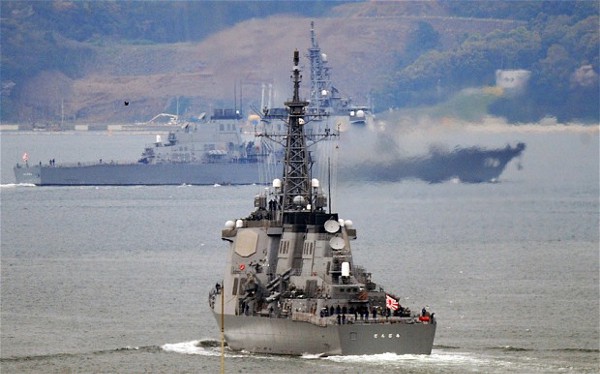
Japanese Maritime Self-Defense Force’s Aegis guided-missile destroyers, Kongo (front) and Chokai (rear), leaving their base in Sasebo, Nagasaki Prefecture to head out to sea. (AFP/GETTY)

Japanese Maritime Self-Defense Force’s Aegis guided-missile destroyers, Kongo (front) and Chokai (rear), leaving their base in Sasebo, Nagasaki Prefecture to head out to sea. (AFP/GETTY)

North Korea provides the most unpredictable threat to Japanese security. Continued missile and nuclear testing, as well as an overtly obstinate attitude towards international negotiation, have continued to isolate the Kim Jong-un regime. The most pressing Japanese concerns, with respect to North Korea, are the continued growth of the regime’s ballistic missile programs and its development of nuclear weapons technology. The increasing capabilities of North Korea have led to a significant focus on Japan’s ballistic missile defense (BMD) and regional defense cooperation. Furthermore, in April of 2014, the U.S. announced that it would send additional naval BMD assets to augment Japan’s current and future force.[4] The North Korean ballistic missile and nuclear programs have become such a regional concern that both Japan and South Korea (two countries with historically divisive differences) have shown interest in trilateral defense agreements with the U.S.

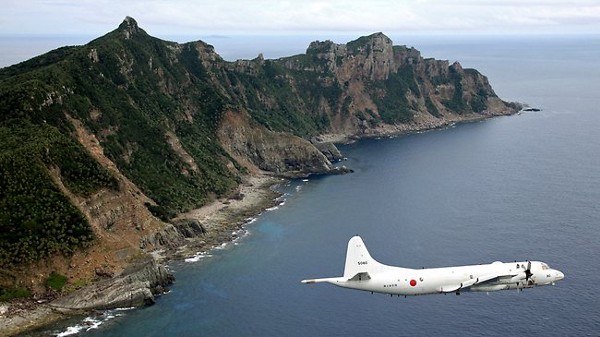
A Japanese Maritime Self-Defense Force’s P-3C patrols the Senkaku Islands. (AP)

A Japanese Maritime Self-Defense Force’s P-3C patrols the Senkaku Islands. (AP)

The publicized disputes over the Senkaku/Diaoyu Islands have recently highlighted the 1,000-year history of conflict between Japan and China. The Japanese defense white paper takes a significantly different tone in discussing China versus North Korea. Although it discusses “dangerous activities that could cause unintended consequences,” the paper also makes note of the current and expected growth of China on the economic and diplomatic fronts.[5] Of note, the mutually beneficial economic relationship between the two countries may serve as its own deterrent towards military force as China has become Japan’s number one trade partner.[6]

Finally, the 2014 white paper also highlights Russia as a potential threat within the region.[7] The recent Russian-Ukraine incidents serve as a backdrop to highlight a potentially aggressive player in the region.[8] Russian armed forces have maintained a presence in and around the disputed Kuril Islands since the end of World War II. Recently these forces completed an exercise in the islands involving air force, navy, and army personnel, prompting Prime Minister Abe’s response that deplored the activities as “utterly unacceptable for our country.”[9] Japan’s ability to provide follow-up unilateral action for that statement is questionable.

Article nine of the Japanese constitution states:

Aspiring sincerely to an international peace based on justice and order, the Japanese people forever renounce war as a sovereign right of the nation and the threat or use of force as means of settling international disputes.[10]
In order to accomplish the aim of the preceding paragraph, land, sea, and air forces, as well as other war potential, will never be maintained. The right of belligerency of the state will not be recognized.[11]

However, is that enough to deter Japan from future military build-up?

Japanese policy on military force has gradually crept away from an explicit interpretation of the phrases “use of force” and “will never be maintained.”

Japanese Ground Self-Defense Force troops and U.S. Marines stage a joint drill Wednesday involving MV-22 Osprey tilt-rotor transports at Camp Pendleton in California. (KYODO)

Japanese Ground Self-Defense Force troops and U.S. Marines stage a joint drill Wednesday involving MV-22 Osprey tilt-rotor transports at Camp Pendleton in California. (KYODO)

Japanese policy on military force has gradually crept away from an explicit interpretation of the phrases “use of force” and “will never be maintained.”[12] The Ministry of Defense utilizes Japan’s status as a sovereign nation and the inherent right of self-defense to justify maintaining military forces.[13] In their online description of constitutional interpretation, multiple references are made to using only the minimum amount of force required for the defense of Japan.[14] However, the ministry also goes so far as to highlight that an attack on a foreign ally may constitute a requirement of military response if such an attack severely threatens Japan and its people (a recent controversial change).[15] This interpretation of the Japanese constitution suggests a policy of collective self-defense, or that an attack on the United States (or theoretically any other ally) may trigger Japanese involvement if deemed severe enough to threaten Japanese security.

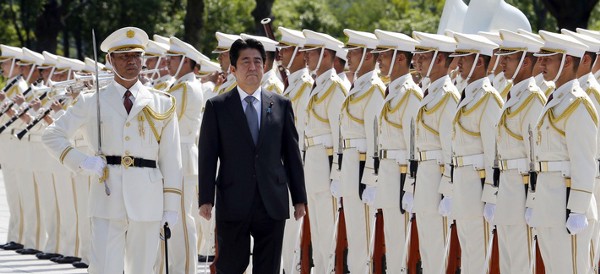
Japanese Prime Minister Shinzo Abe reviews an honor guard in a ceremony prior to his meeting with officers of the Japan Self Defense Forces, on Sept. 12, 2013. (Koji Sasahara/AP)

Japanese Prime Minister Shinzo Abe reviews an honor guard in a ceremony prior to his meeting with officers of the Japan Self Defense Forces, on Sept. 12, 2013. (Koji Sasahara/AP)

The new leadership of Japan has at least implemented some measures to back up their nationalistic views. On August 29, 2014, the Ministry of Defense submitted a fiscal year 2015 budgetary request that increased defense spending 3.5%.[16] This increase may appear substantial until compared with the percentage of government spending that has traditionally been allocated towards defense (around 5%).[17] When compared with potential adversary spending plans, this increase represents a small shift in the regional defense-spending outlook. In 2013, China spent approximately $118 billion on defense while Russia spent $88 billion.[18] During that same year, Japan spent $48 billion.[19] Through August 2014, Jane’s Online reported overall military strength numbers comparing Japan to China with a ratio of roughly 1 to 3.5 for submarines, 1 to 4.8 for surface combatants, and a 1 to 4.3 ratio for combat aircraft.[20-23] Although mass isn’t the end-all of military might, significant shifts in future resource allocation would be required for Japan to challenge this disadvantage on its own. But, as recent sequestration events in the U.S. have demonstrated, economic resources and public opinion can easily halt growth or drive aggressive reductions in a nation’s fighting force.

Economic Dependence

One-third of the world’s liquefied natural gas passes through the Straits of Malacca and into the South China Sea, with the bulk of it originating in the Persian Gulf. LNG also flows into the region from Southeast Asia and Oceania. Much of this impo…

One-third of the world’s liquefied natural gas passes through the Straits of Malacca and into the South China Sea, with the bulk of it originating in the Persian Gulf. LNG also flows into the region from Southeast Asia and Oceania. Much of this imported LNG is bound for Japan and South Korea. (CSIS)

As a nation of relatively small, mountainous islands, Japan is highly dependent on international trade. Currently, Japan produces less than 10% of its energy needs internally.[24]The Japanese also rely heavily on oil and liquid natural gas for their energy needs (this was 47% and 24%, respectively, of the country’s total 2012 consumption).[25] Oil imports primarily come from the Middle East (79%), and the majority of natural gas shipments arrive from Southeast Asia (49%) and the Middle East (29%).[26] The future of internal energy production for Japan does not look any more positive based on recovery from the 2011 Fukushima nuclear power plant disaster and the widespread anti-nuclear sentiment that it reinforced. The Japanese dependence on outside energy sources is likely to continue long into the future. Prior to the 2011 disaster, Japan’s plan for nuclear energy development peaked at providing 50% of the country’s requirements by 2030 (a respectable amount, but still leaving 50% to other sources).[27] Japan also imports approximately 60% of its population’s food requirements.[28] Of that, ASEAN countries provide approximately 16%, and China approximately 13% (the U.S. provides approximately 26%).[29] The vast majority of these trade requirements depend on routes through the East China, the Philippine, and South China Seas. Although the rise of China may seem like a single-sided threat towards these trade routes, other economic factors are at play.

In addition to providing passage for incoming commodities, the states of Maritime Asia also have deeply interdependent trade relations among themselves. China and ASEAN (Southeast Asia), China and Japan, and Japan and ASEAN states have robust trade …

In addition to providing passage for incoming commodities, the states of Maritime Asia also have deeply interdependent trade relations among themselves. China and ASEAN (Southeast Asia), China and Japan, and Japan and ASEAN states have robust trade relations. The China-ASEAN trade relationship is especially strong. (CSIS)

To provide the economic basis for $250 billion in energy imports and $60 billion in agricultural imports, Japan relies heavily on its key exports: cars, machinery, and electrical components.[30-32] Japan’s number one customer for its top three export products is China. Approximately 66% of Japanese exports to China go directly towards China’s manufacturing industry for creation of their own exports.[33] Conversely, many of the components used in Japan’s exports come directly from imports from China. Japan itself is China’s number three export country.[34]This economic interdependence between the two countries serves as a potential buffer against the breakout of hostilities.

Japan’s Aging Nation and Continued Pacifism

(Reuters)

Exacerbating the regional defense challenges faced by Japan are its current demographic trends. By 2050, Japan is expected to have a 15% decrease in population.[35] During that decrease, the median age is expected to grow from 45 to 53 with the proportion of the population at or above retirement age growing from 23% to 36.5%.[36] This trend will create a staggering dependency ratio (“the size of the ‘dependent’ population relative to the ‘working age’ population”) of .96.[37] In the year 2010, the Japanese dependency ratio was .57 (comparatively, the U.S. ratio was .49).[38] In 2014, the Japanese governmental budget allocated 31.8% towards social security (a percentage that has been on the rise over the last five years) compared to the 5% on defense spending mentioned earlier.[39] Although public pensions as a percentage of GDP are not expected to increase sharply in Japan, social security is likely to be a fierce competitor for government funding in the future. 69% of recently polled Japanese feel that either the government or their family should bear the brunt of taking care of them in retirement.[40] In a September poll, only 11% of the Japanese public hoped that the top priorities for Minister Abe’s cabinet would be security and diplomacy (compared to 32% looking for improvements in the economy and employment, and 22% vying for tax and social security reforms).[41] Despite the wishes of Prime Minister Abe, Japan’s demographic trend of an aging populace has a different priority than self-defense.

The current Japanese socio-political environment also does not appear to support widespread defense reform. In an August 2014 poll, 60.2% of the surveyed population opposed the idea of collective self-defense (an increase of nearly 6% from a month earlier).[42] Additionally, the level of public support for the Liberal Democratic Party (LDP) is highly suspect. Minister Abe and the LDP won landslide victories in the 2012 elections. However, many (including Abe himself) based the large win on the failures of the previous governing party versus true support behind the LDP.[43] Since the election, the LDP has depended on a coalition with the New Komeito party to ensuring a two-thirds majority of the lower Diet and the sway of governmental policy. Ironically, the New Komeito party leans towards pacifism. Recently it exercised its control within the coalition to force the LDP to revise wording of the collective self-defense proposal to avoid potentially enabling more liberal use of military force.[44]

Unless a major shift in global alliances or power occurs, the future of Japan’s military appears to (at best) remain similar to its current state: technologically current, but reliant upon foreign alliances to maintain competitive relevancy with regional rivals.

Conclusion

U.S. President Barack Obama (L) shakes hands with Japanese Prime Minister Shinzo Abe at the G20 Summit in St. Petersburg, Russia, Sept. 5, 2013. (Reuters)

U.S. President Barack Obama (L) shakes hands with Japanese Prime Minister Shinzo Abe at the G20 Summit in St. Petersburg, Russia, Sept. 5, 2013. (Reuters)

It is likely that some form of modernization will be required to keep the Japanese Self Defense Force technologically relevant in their regional environment. Modernization may arrive in the form of shared technology and increasing military sales (such as the planned purchase of F-35s from the U.S. or recent agreement to sell Soryu submarines to Australia). However, it is not cheap to maintain a military capable of rivaling many of the regional powers in northeast Asia. Growing social demands on the Japanese economy as its population ages will likely curb large-scale military growth. The emphasis on satisfying the internal needs of its society makes sense for a country where pacifism (or at least strong opposition to aggression in any form) exists as a binding fiber of post-World War II society. A continued reliance on defense alliances and outside support will likely be required to protect Japan’s vital interests, particularly in the case of North Korea and Russia. Although defense cooperation may serve as a possible preventative measure towards full-scale war with China, the more likely deterrent is Japan and China’s inter-dependence on trade. Unless a major shift in global alliances or power occurs, the future of Japan’s military appears to (at best) remain similar to its current state: technologically current, but reliant upon foreign alliances to maintain competitive relevancy with regional rivals.


Major Kevin Hicok is a USAF F-16 fighter pilot and weapons officer currently in attendance at the US Naval War College. The views expressed in this article are those of the author and do not reflect the official policy or position of the US Air Force, US Navy, the DoD, or the US Government. Twitter: @kevin_hicok.


Have a response or an idea for your own article? Follow the logo below, and you too can contribute to The Bridge:

Enjoy what you just read? Please help spread the word to new readers by sharing it on social media.


Notes:

[1]. Japan, Ministry of Defense, Defense of Japan 2014, August 5, 2014,http://www.mod.go.jp/e/publ/w_paper/2014.html.

[2]. Ibid.

[3]. Japan, Ministry of Defense, Defense of Japan 2014, August 5, 2014.http://www.mod.go.jp/e/publ/w_paper/2014.html.

[4]. Cheryl Pellerin, “United States Department of Defense,” Defense.gov News Article: Hagel: U.S. to Send 2 More Aegis Ships to Japan, April 06, 2014, accessed September 11, 2014,http://www.defense.gov/news/newsarticle.aspx?id=121992.

[5]. Japan, Ministry of Defense, Defense of Japan 2014, August 5, 2014,http://www.mod.go.jp/e/publ/w_paper/2014.html.

[6]. “China (CHN) Profile of Exports, Imports and Trade Partners,” Observatory of Economic Complexity, accessed September 22, 2014,http://atlas.media.mit.edu/profile/country/chn/.

[7]. Japan, Ministry of Defense, Defense of Japan 2014, August 5, 2014,http://www.mod.go.jp/e/publ/w_paper/2014.html.

[8]. Ibid.

[9]. Yuka Hayashi, “Japan Lodges ‘Strong Protest’ with Russia Over Military Exercise,” The Wall Street Journal, August 14, 2014, accessed September 12, 2014, http://online.wsj.com/articles/japan-lodges-strong-protest-with-russia-over-military-exercise-1407998329.

[10]. It should be noted that the wording of the Japanese Constitution was highly subject to United States influence in the post-WWII environment.

[11]. Constitution of Japan, Ch. 2, Art. 9.

[12]. Ibid.

[13]. Japan, Ministry of Defense, Fundamental Concepts of National Defense,accessed September 12, 2014,http://www.mod.go.jp/e/d_act/d_policy/dp01.html.

[14]. Ibid.

[15]. Ibid.

[16]. Banyan, “Tooling Up,” The Economist (blog), September 1, 2014, accessed September 13, 2014,http://www.economist.com/blogs/banyan/2014/09/japans-military-spending.

[17]. “Highlights of the Budget for FY2014,” Ministry of Finance Japan: Budget, December 24, 2013, http://www.mof.go.jp/english/budget/budget/index.html.

[18]. Military Spending and Armament, report (Stockholm International Peace Research Institute, 2014),http://www.sipri.org/research/armaments/milex/milex_database/milex_database.

[19]. Ibid.

[20]. “Japan — Navy,” IHS, September 1, 2014, accessed September 13, 2014,https://janes-ihscom.usnwc.idm.oclc.org/CustomPages/Janes/DisplayPage.aspx?DocType=Reference&ItemId=+++1303192&Pubabbrev=CNA.

[21]. “China — Navy,” IHS, September 1, 2014, accessed September 13, 2014,https://janes-ihscom.usnwc.idm.oclc.org/CustomPages/Janes/DisplayPage.aspx?DocType=Reference&ItemId=+++1303146&Pubabbrev=CNA.

[22]. “Japan — Air Force,” HIS, September 1, 2014, accessed September 13, 2014, https://janes-ihs-com.usnwc.idm.oclc.org/CustomPages/Janes/DisplayPage.aspx?DocType=Reference&ItemId=+++1303191&Pubabbrev=CNA.

[23]. “China — Air Force,” IHS, September 1, 2014, accessed September 13, 2014, https://janes-ihs-com.usnwc.idm.oclc.org/CustomPages/Janes/DisplayPage.aspx?DocType=Reference&ItemId=+++1303145&Pubabbrev=CNA.

[24]. “Japan,” U.S. Energy Information Administration — EIA — Independent Statistics and Analysis, July 31, 2014, accessed September 08, 2014,http://www.eia.gov/countries/cab.cfm?fips=JA.

[25]. Ibid.

[26]. Ibid.

[27]. Ibid.

[28]. “Japan: Trade,” USDA Economic Research Service, August 7, 2014, accessed September 09, 2014,http://www.ers.usda.gov/topics/international-markets-trade/countries-regions/japan/trade.aspx#.VA9Q4UvcCaw.

[29]. Ibid.

[30]. Ibid.

[31]. “Japan,” U.S. Energy Information Administration — EIA — Independent Statistics and Analysis, July 31, 2014, accessed September 08, 2014,http://www.eia.gov/countries/cab.cfm?fips=JA.

[32]. “Japan (JPN) Profile of Exports, Imports and Trade Partners,” The Observatory of Economic Complexity, accessed September 21, 2014,http://atlas.media.mit.edu/profile/country/jpn/.

[33]. Richard Katz, “Why Chinese-Japanese Economic Relations Are Improving,” Foreign Affairs, December 30, 2013, accessed September 21, 2014, http://www.foreignaffairs.com/articles/140615/richard-katz/why-chinese-japanese-economic-relations-are-improving.

[34]. “China (CHN) Profile of Exports, Imports and Trade Partners,” Observatory of Economic Complexity, accessed September 22, 2014,http://atlas.media.mit.edu/profile/country/chn/.

[35]. Attitudes About Aging: A Global Perspective, report (Pew Research Center, 2014), accessed September 12, 2014,http://www.pewglobal.org/2014/01/30/chapter-2-aging-in-the-u-s-and-other-countries-2010-to-2050/.

[36]. Ibid.

[37]. Ibid.

[38]. Ibid.

[39]. “Highlights of the Budget for FY2014,” Ministry of Finance Japan: Budget, December 24, 2013.http://www.mof.go.jp/english/budget/budget/fy2014/01.pdf.

[40]. Attitudes About Aging: A Global Perspective, report (Pew Research Center, 2014), accessed September 12, 2014,http://www.pewglobal.org/2014/01/30/chapter-2-aging-in-the-u-s-and-other-countries-2010-to-2050/.

[41]. “64% Approval Rating for New Cabinet,” The Japan News, September 5, 2014, accessed September 12, 2014, http://the-japan-news.com/news/article/0001547443.

[42]. “84% of Public Says Explanation of Collective Defense Decision Unclear: Poll,” Japan Times RSS, August 3, 2014, accessed September 12, 2014,http://www.japantimes.co.jp/news/2014/08/03/national/84-public-says-explanation-collective-defense-decision-unclear-poll/?utm_source=rss#.VBMYc0vcCay.

[43]. “UPDATE: Abe’s LDP Dominates Election; Noda Resigns after DPJ Humiliation — AJW by The Asahi Shimbun,” AJW by The Asahi Shimbun RSS, December 17, 2012, accessed September 12, 2014,http://ajw.asahi.com/article/behind_news/politics/AJ201212170006.

[44]. “MAJOR SECURITY SHIFT: New Komeito Agrees to Revised Collective Self-defense Proposal,” AJW by The Asahi Shimbun, June 25, 2014, accessed September 12, 2014, http://ajw.asahi.com/article/ behind_news/politics/AJ201406250049.

So You Don't Have a Mentor

A Few Thoughts for Walking the Lonely Road

The time has come to take the next step in your career. Behind you lies a string of accomplishments and a legacy that would be the envy of any leader (or not). In front of you the destination is clearly visible in the distance. But the road ahead is narrow, winding, and shrouded in uncertainty. Courageously you step off into the unknown, walking the path of your future where you have never tread before. You have an idea of where you want to go. You have a road map and maybe you have taken a swing at planning the trip yourself. But do you have a guide? Do you have a mentor?

Sometimes the answer is an emphatic NO, or worse, the more ambiguous NOT REALLY. It’s not your fault, just a condition of the circumstances you find yourself in. Perhaps your primary sounding board has moved on to another post. Maybe their new job keeps them from staying in touch, and they are not the sort who reaches out. Or you may have taken the near-heretical step of switching branches, leaving the service, or choosing the Harvard Strategist Program over a berth with Project Warrior. You feel lost, uncertain, and alone. So what are you going to do about it?

Self-pity is a backwards step on the road to the future. Focus instead on self development and actively seeking a mentor are positive steps that will jump start your journey.

If the answer is to sulk and drag your feet, then it could be that no amount of mentoring can get you to where you want to go. How many qualified leaders simply give up and either A) get out of the military spouting anti-service rhetoric, or B) stay in simply for the pay all the while filling a valuable Modified Table of Organization and Equipment (MTOE) slot and taking no action to improve themselves or the organization? The first thing to do is make a decision to not be like so many who have squandered their potential in an endless cycle of melancholy. Self-pity is a backwards step on the road to the future. Focus instead on self development and actively seeking a mentor are positive steps that will jump start your journey.

Startups.Co.Uk/Andy Chew

Startups.Co.Uk/Andy Chew

You do not know what you do not know, but there are resources to help light the way—start reading. Reading will sharpen your mind and prepare you for almost anything. The resources for reading in the digital age are truly tremendous. Ideas on what to read can come from an all encompassing source, such as the Chief of Staff’s reading list or from a more focused venue such as the Basic Strategic Arts Program’s reading list, or a series on a particular part of history. Then of course there are the ever applicable doctrinal and conceptual publications that many claim to read but few follow through with. If all that is too much, there is always the option to read something relevant once a week that would still put you ahead. Pick works that are relevant to your profession and your career desires, and maybe a few works purely for pleasure, and plow in with gusto.

Writing is a way to record your personal experiences and leave a record of your thoughts and emotions on a variety of topics while practicing a craft of vital importance.

Writing is a way to record your personal experiences and leave a record of your thoughts and emotions on a variety of topics while practicing a craft of vital importance. To write, you simply have to sit down at a keyboard or pick up paper and pen. Do not hesitate to seek out ways to put your writing out there for review and critique by society. Medium.com is, of course, a great place to self-publish and invite the feedback of others. Forums such as the Military Writer’s Guild or the Veteran’s Writing Project are terrific ways to have your writing assessed, critiqued, and presented in a low-threat environment. Some avenues for professional publication with a strong potential for professional feedback and notice are Armed Forces Journal or your service magazine. There are numerous writing competitions to choose from, such as the U.S. Army Combined Arms Center or U.S. Naval Institute’s annual writing competitions, where you can possibly be published in a professional journal and earn a little extra cash. Regardless of your venue, be sure to edit your writing, and invite others to assist — learn your weaknesses and polish your technique. It matters not however if your writing is never published — the sheer act of writing is itself a panacea.

Seek a mentor in unorthodox ways. Learn to reach out to others — sometimes the best advice comes from someone you interact with everyday but have never looked to for guidance. Go to lunch with people in your office. Host a low-key gathering at your home or at a popular watering hole. Invite your friends, but do not hesitate to invite acquaintances or more experienced individuals you do not know personally. A mentor does not have to be your supervisor, or someone you once worked for. It can easily be a subordinate or peer who has their own unique insight and experiences. Mentorship should transcend professional boundaries. Do not waste the opportunity to pick the brain of the sergeant major with 25 years of experience, or the specialist with a master’s degree. Even if they do not have direct knowledge of your career path, they can provide unique perspectives that will enrich your own journey.

Keep your service records, résumé, and curriculum vitae up to date and ready to present.

A mentor does not even have to be someone you have met in person. Just as the internet is an invaluable tool for reading and writing, it is infinitely useful for reaching out to others. Believe it or not, you can connect with someone on Facebook, Twitter, or LinkedIn. Scrub your profile(s), make sure it is professional and an embodiment of the image you want to present to the world. Keep your service records, résumé, and curriculum vitae up to date and ready to present. If you are intimidated about reaching out, ask others to assist you. The military is a small place and odds are you know someone who knows someone who can make an introduction. You may not hear back right away because exceptional mentors are usually exceptional workers and leaders, and are likely very busy. But do not be discouraged, the best mentors realize that part of their duty is to be good stewards of the profession. If you take the time to reach out to them, they will respond to you in kind.

As you seek and find your mentor(s) do not be so focused on yourself that you neglect opportunities to mentor others. Like someone who grew up never knowing a parent and vows to be a better parent themselves, you can be a better mentor to others. There are subordinates and peers who maybe in the same situation as you — full of talent but lacking a direction or facing a new career path all alone. Reach out to them, foster their growth, encourage their self development. You will be surprised how much you learn yourself from being a mentor.

As you take the next step in your career, do not be discouraged if you lack a mentor. It is a temporary malady if you wish it to be so. Use the time for reflection, self improvement, and increasing your value to your profession. Reach out to likely mentors — the worst anyone can do is say no, and you will be better for the attempt. Be a mentor to others and leave your organization better than you found it. Your time need not be wasted, and your journey need not be lonely. So you don’t have a mentor — do something about it.


Nathan Wike is an officer in the U.S. Army, and an associate member of the Military Writer’s Guild. The opinions expressed are his alone and do not reflect those of the U.S. Army, the Department of Defense, or the U.S. Government.


Have a response or an idea for your own article? Follow the logo below, and you too can contribute to The Bridge:

Enjoy what you just read? Please help spread the word to new readers by sharing it on social media.

Which Way Lies Salvation?

A Discussion on Dishonesty in the Military Profession

Recently two U.S. Army War College professors published an incisive, well-researched study entitled “Lying to Ourselves: Dishonesty in the Army Profession.” The title instantly conjures images of an Army immersed in sin, where a soldier cannot be trusted to speak the truth. The study itself generated attention grabbing headlines from widely read publications such as the Washington PostCNN, as well as Army Times, which bemoaned the corruption of the Army officer corps, on which the study is based. This in turn led to a flurry of internet activity as currently serving and retired service members of all branches and ranks (all having read the study no doubt) lined up to comment on the depravity of the Army’s officers, the Army in general, and that the study’s conclusions should surprise no one. Largely absent have been calls for moderation or an official statement regarding the conclusions drawn by the authors. For a formal study by one of the military’s premiere institutions, the lack of a response is perhaps the most alarming reaction of all.

Foremost it is necessary to point out that this is a study meant for the consideration of the entire military. As stated by the authors:

While the phenomenon we are addressing afflicts the entire U.S. military, we focus on the U.S. Army because it is the institution with which we are most familiar (as professors at the [U.S. Army War College]). While the military profession can be broadly conceptualized to include anyone who serves in the Department of Defense (DoD), we give particular attention to the experiences of the Army officer corps. The officer corps is a bellwether for the military. [1]

This study is not an indictment of the Army officer corps. It is a clarion call to the military and its overseers that a fundamental value of the service, honor, has eroded and change is needed for it to be revitalized.

In this study, the Army officer corps serves as a focus group for the entire Department of Defense — though several U.S. Marine Corps officers were also interviewed for the study, as mentioned on page six. The authors acknowledge on page one that the study comes at time when ethical failings are occurring across the uniformed military, throughout the ranks of both officer and enlisted. This study is not an indictment of the Army officer corps. It is a clarion call to the military and its overseers that a fundamental value of the service, honor, has eroded and change is needed for it to be revitalized.

If you have ever sat through a block of mandatory training or death by power point style briefs, filled out a story board, signed a unit finance report, wrote and evaluation, sat through a training meeting or command and staff, assessed the end of a campaign for your superiors, etc. this study will resonate. While you may not be guilty of any sort of dishonesty per se, certainly you can see where it is possible or even likely for others to get lost in the deluge of requirements and expectations. Furthermore, you must appreciate the immense pressure to report information that keeps with higher headquarter’s expectations. It maybe that you have seen the consequences of someone reporting the “wrong” but correct information and found them unfair but not unexpected. Considering all that, you can perhaps understand,though not condone, a soldier, sailor, airman, marine, non-commissioned officer, or officer’s propensity to “pencil whip,” “hand wave,” or “fudge” the numbers.

So the phrase “…officers (leaders), after repeated exposure to the overwhelming demands and the associated need to put their honor on the line to verify compliance, have become ethically numb” (Gerras and Wong 2015, ix) among all the quotable passages, hits like a thunderbolt. It should cause a moment of reflection in anyone who reads it. Why are satirical news sources like The Duffel Blog, comic strips like Terminal Lance, or humorists like Doctrine Manso popular and their messages so poignant and relatable? Why are service members so eager to speak out on forums and blogs across the internet (sometimes with less than desired results) or to flock to organizations like theDefense Entrepreneurs Forum? Is the force ethically numb? Has a leader’s signature or their word become commodities to be traded for favor and advancement? Have I been part of the problem? How can this problem be fixed?

To claim there is no problem is to espouse willful ignorance and ignore the gathering storm.

Fair questions all, but the last two are the questions that should be getting asked throughout the Department of Defense. To claim there is no problem is to espouse willful ignorance and ignore the gathering storm. Drs. Gerras and Wong end their study with several recommendations and acknowledge at the beginning that even discussing the issue will be awkward and uncomfortable. Whose burden is most heavy for implementing the study’s recommendations, or finding other, better solutions? Clearly change needs to happen, but what direction will it come from — which way lies salvation, up or down?

“Brutus Falling on His Sword” imprint by Geoffrey Whitney, Emblema CXIX via A Choice of Emblems.(1586)

“Brutus Falling on His Sword” imprint by Geoffrey Whitney, Emblema CXIX via A Choice of Emblems.(1586)

For the change to be driven from the bottom up, it requires the simple choice from a critical mass of leaders within the operational military who decide to be absolutely truthful on every report, evaluation, or requirement. A sudden drop in Unit Status Report numbers, a sharp rise in unfulfilled deployment requirements, or unexpected flat-line of promotion rates could not help but be noticed by the powers that be. The requirements will not go away overnight, so it would be necessary to consciously prioritize training tasks, disregard redundant requirements, and exhibit the personal courage to write a truthful evaluation supported by astute counselings. Such a trend would need to be sustained until it caused change. Those who implement this plan however would have to be prepared to answer some very tough questions, and suffer the consequences of being honest. In essence, a generation of junior leaders would have to refuse any distortion of the truth and possibly put their careers in jeopardy to keep their honor intact and revitalize the reputation of the military, as oxymoronic as it sounds.

For change to come from the top down first requires senior leaders to acknowledge the problem(s) and make fixing them a public priority. Next they must question and be skeptical of the information that is reported to them — if it seems too good to be true, it probably is. The culture of how information is received must change— rejecting information one wants to hear versus accepting information one needs to hear. The Department of Defense would have to initiate a review of its requirements to determine what is superfluous, outdated, or unnecessary for a military of the 21st Century and then change the doctrine and testify for changes to laws. This may directly affect the legacy, or even reason for existence of some senior individuals. In essence, senior leaders of today would have to make some tough decisions, and commit to addressing the issues and concerns throughout the force with scant regard for outside interests, institutional bias, or even hallowed traditions.

The problem is vast, but it is not insurmountable. Drs. Gerras and Wong’s study is not a shroud meant to cover the force in darkness. It is a beacon, like a lighthouse in a storm — one which we ignore at our peril. Though it maybe difficult to face, the issues identified compromise the fundamental values on which the military is built. Change can either be grassroots or in a stepwise fashion, driven from the bottom or the top, but change must come. It should not require a certain demographic to selflessly sacrifice themselves to bring honor back to the force when it never should have been abandoned. It is time for leaders of every rank, from every branch of service to aggressively lead the military to a more practical, honorable future and truly embody the values that are held so dear.


Nathan Wike is an officer in the U.S. Army, and an associate member of the Military Writer’s Guild. The opinions expressed are his alone, and do not reflect those of the U.S. Army, the Department of Defense, or the U.S. Government.


Have a response or an idea for your own article? Follow the logo below, and you too can contribute to The Bridge:

Enjoy what you just read? Please help spread the word to new readers by sharing it on social media.


Notes:

[1] Gerras, Stephen J, and Leonard Wong. Lying to Ourselves: Dishonesty in the Army Profession. Strategic Studies Institute, United States Army War College, Carlisle Barracks: U.S. Army War College Press, 2015.

Correct Answers and #Profession

Last week the Army War College released a study about military officers lying on a regular basis [1]. These lies include everything from misreporting training status to inflating performance reports. But, how much of this is blatant lying versus simply providing the “correct” answer?

Providing the “correct answer” is something that begins the first day of basic training, and it becomes an institutional norm. For instance, how many times has an entire squad of basic trainees replied, “YES DRILL SERGEANT,” to a question posed by their drill sergeant? This is the “correct” answer. The correct answer isn’t “No,” or “Yeah,” or “I don’t remember.”

U.S. Air Force Academy Form “O-Dash-96"

U.S. Air Force Academy Form “O-Dash-96"

In my own experience, I found that basic training reinforces particular behavior and norms. For instance, new (basic) cadets at the Air Force Academy are given a survey after their first or second meal at the school. Officially, its an Air Force Form O-96, and contains six simple questions about the meal. The cadre instructs the basic cadets to fill out this survey. How was the food service? How was the attitude of the waiters? How was the waiter service? How were the beverages? What size were the portions? And finally, how was the meal? Not knowing the cadet system, as a young basic cadet, I answered the questions truthfully and honestly. How was the service? I thought it was slow! What was the portion size? I thought it was oversized. How was the meal? I thought it was unsatisfactory. I found out very quickly that these were not the “correct” answers. The correct answers (in order of the questions) were: fast, neat, average, friendly, good, good. Every cadet learned that these were the answers to the six questions on the form. It had to be filled out in this way. No other way was acceptable. This simple list of six answers is an institutional norm, a meme, which transcends every Air Force Academy class. But, this sort of correct behavior goes beyond basic training and tradition-building exercises, it can be found in most facets of military life. The “correct answer” is not so much the answer to the question, as it is a way of teaching conformity, uniformity, and mental discipline. Despite being deceptive, these are all characteristics of a well-trained military.

…the lessons of basic training don’t clearly elucidate the dichotomy between the truthful answer, and the “correct” answer, which may instill a culture that finds it acceptable to provide the “correct” answer all of the time.

Now, the lessons of basic training don’t clearly elucidate the dichotomy between the truthful answer, and the “correct” answer, which may instill a culture that finds it acceptable to provide the “correct” answer all of the time. But, this issue isn’t confined to the military alone. Large, complex, institutions are beset with internal systems, procedures, and layers of bureaucracy. Because of this, often the “correct” answer trumps the “truth.” How many times in my life have I given the “correct” answers versus the truth? It goes beyond procedure and formalities; we actually see this inconsistency all the time in our daily lives. For instance, I was on the phone with my bank recently and they wanted to know the color of my car (my security question). Well, I thought, I have two cars — one is black and one is blue. But, after much discussion, I found out that this is not the “correct” answer. The correct answer is silver, which was the color of the car I had when I created that account. But, this answer is not the truth, hence, the contradiction. But, the very point of the question is not to find out the color of my car, just like the point of the survey was not to find out about Basic Cadet Maye’s opinion of the meal. The point of the security question was to validate my identity. The point of the survey was to indoctrinate and train.

Oftentimes the “correct” answer saves you time and energy, and oftentimes it’s a matter of priorities. Providing the “correct” answer helps you focus on the mission you deem to be the most important for your people. That is not to say that the “correct” answer is always the best answer. But, it in a culture that routinely trains people to provide the correct answer, it can be difficult to distinguish the difference between the two.


Diane Maye is a former Air Force officer, defense industry professional, and academic. She is a PhD candidate in Political Science at George Mason University. The views expressed in this article are those of the author and do not reflect the official position of the US Government or the Department of Defense.


Have a response or an idea for your own article? Follow the logo below, and you too can contribute to The Bridge:

Enjoy what you just read? Please help spread the word to new readers by sharing it on social media.


Notes:

[1] “Lying to Ourselves: Dishonesty in the Army Profession,” by Leonard Wong and Stephen Gerras, 2015, Strategic Studies Institute, Available from:http://www.strategicstudiesinstitute.army.mil/pubs/display.cfm?pubID=1250

Asking the Right Questions

A Junior Officer's Perspective On Making the Most of Professional Development

Australian Army Major Claire O’Neill recently published a compelling article charging junior officers to take the reins of their professional development. As I read the article, in the background the movie I, Robot was playing and something stood out to me with regard to this subject. Will Smith is on the hunt for a scientist’s murderer; with a holographic recording of this scientist to guide him. This hologram would prompt Smith to ask questions that would help him uncover further clues. Every time Smith would ask such a question the hologram would respond with “That, Detective is the right question.”

As I read O’Neill’s charge to junior officers, myself included, I felt daunted by it. I’ve had the privilege of serving my country for a little less than four years, but am still unaware of the vast amount of opportunities afforded to military members to further their professional development. Furthermore, it would be incorrect if I said I knew where to even begin looking for them. After posting some thoughts on twitter in response to the article and the conversation that ensued; I began thinking about what the “right questions” should be for young officers.

As the former Director of Operations of my squadron once told me, the most dangerous thing you can hear from a lieutenant is “in my experience”. It is true statement about young officers yet standing in contrast in every unit are officers that have that experience. These are our senior captains to lieutenant colonels who fill those vital first line leadership positions and have the most influence over young officers’ development. Yet due to the current operational tempo and the ever increasing amount of taskings from above, I see my leadership’s time and resources being eaten away; leaving little time for mentorship or professional development. So what are the right questions we can ask to open that door and how do we follow through to make us more educated and informed junior officers?

What’s your background?

Unless the officer in question is your squadron or battalion commander, chances are they don’t come with a published biography of their military career. Due to the vast amount of schools, assignments, fellowships, staff positions or other career options, officers can have a varied and unique background. Some of those opportunities are easily identifiable by the presence of an Air Force Weapons School patch or an Army Ranger tab, but programs such as the Olmstead Scholars, SASS, or SAMS fellowships are not. The easiest way to find out is by asking a simple question such as “what’s your background?” or “what was your last assignment?” These questions allow the respondent an open platform to tell you about their career, where they have been and what they have done. I have yet to meet a military member that doesn’t have a condensed timeline of their career memorized. This simple question allows one to learn about the unique opportunities or maybe just personal perspectives, which are often the most powerful. Whether you learn about a new opportunity or just about their previous assignment, you walk away from the conversation with more knowledge than you started with.

How did you get to that opportunity?

Once you have found out about a program, it’s important to figure out how you can set yourself up for such an opportunity. There are usually prerequisites or preferred experience that is needed to make one competitive. Figuring out these things can allow us to advocate at the appropriate time for special training or the next assignment; this is one of my biggest takeaways from Major O’Neill’s post. Commanders can have hundreds of people assigned to them and it is not possible for them to know the ambitions or goals of every member of their command.

What if you aren’t interested in that opportunity? One day some of us (junior officers) will be those squadron/battalion commanders and as such handed the responsibility of leading and grooming the next generation of military leaders. Leaders have the responsibility to place members where they not only will personally flourish but advance the military as a whole. Many of these special assignments or schools have been developed over time to produce officers with specialized knowledge and skills that makes our military force as a whole better. U.S. citizens have spent millions of dollars and years of time investing in military members, I can think of no worse outcome than squandering an officer’s talents due to the ignorance of opportunities that would develop them further.

How did the opportunity benefit you?

This question has a two part answer first it allows you to learn what the person learned from it and secondly show what further opportunities opened up. How a particular opportunity affected a person or what they learned from it should be the ultimate goal of these questions. Professional military education should not be a box we just look to check, nor should we look for the most prestigious box. We should evaluate our goals and how we can use this experience to benefit the military. Furthermore, understanding what opportunities opened up or closed because of it is also important. There are many opportunities out there that I would jump at the chance to attend however they wouldn’t line up with my own goals for my future in the military. We have a finite time in the military to take advantage of and therefore need to be aware of how taking a one to three year assignment will affect us upon in the future.

In closing, for junior officers, our own career development is our responsibility first and foremost. It is incumbent upon us to seek out those opportunities and figure out how to make them happen. We all know that this isn’t a democracy and unfortunately we always don’t get a vote in such matters, however, I firmly believe that being proactive and advocating for our own career development can make a difference. Otherwise, we just become one of thousands of boats freely being tossed around in an ocean of the personnel system; grab a paddle and start rowing towards where you want to be.

To senior officers and leaders, we need your guidance; tell us about your experiences. Professional development is a two way street, there are dozens of other questions I would like to ask but haven’t thought of yet. Help. Fostering that dialogue whether through in-depth briefings or over lunch will pay dividends by creating educated junior officers with long term goals that they can work towards obtaining.


Dan Ryan is an U.S. Air Force officer. He is an Associate Member of the Military Writers Guild. The views expressed in this article are the author’s alone, and do not reflect the official position of the U.S. Government, the Department of Defense, or the U.S. Air Force.


Have a response or an idea for your own article? Follow the logo below, and you too can contribute to The Bridge:

Enjoy what you just read? Please help spread the word to new readers by sharing it on social media.

Duty and Perseverance

Duty and Perseverance

Duty and perseverance are necessary traits for all kinds of leaders—civilian and military alike—but older notions will only lead to further peril. Henceforth, “duty” should be seen as “getting the job done right” and “perseverance” should be “pushing forward as long as it works...and, if not, go back and try again.” These are categorically better than today’s notions of “just do the job” (duty) and “pushing forward regardless” (perseverance).

The Dictator, dimE, and Africa

The Dictator, dimE, and Africa

Robert Mugabe — the 90-year-old despot, long time leader of Zimbabwe, and recently selected African Union chairman — takes every opportunity he can to deride the U.S. He has spoken out against the ‘imperialist’ U.S. throughout Africa and on the stage of the UN. The quintessential autocratic dictator remains a pesky thorn in our side. For many, the fact that he remains in power represents a failure of U.S. policy. While his existence may not be palatable to the western world writ large, a well-developed U.S strategy has limited his nefarious behavior and caused his influence to dwindle. He has been reduced to a silly old man spending his remaining years criticizing what he calls American imperialism. U.S. policy towards Zimbabwe, with no military force, and very little assets, has neutralized him. In an age of limited resources, U.S. policy towards Zimbabwe provides a blueprint for containing rogue states.

Don’t Expect #Professional Status in Civil Society

Don’t Expect #Professional Status in Civil Society

While many in uniform have earned the title of “professional” through commitment to excellence, high ethical standards, and service in defense of the nation, more work has to be done to convince those outside the service. As professionals, we must teach children, friends, and other Americans about military professionalism. We should continue to walk the path of the warrior-scholar and adopt an attitude of excellence in this profession.

Knowing and Not Knowing: The Intangible Nature of War

Knowing and Not Knowing: The Intangible Nature of War

The Boy Soldier tells us all we need to know of war. He intrinsically knows, as all soldiers do, exactly what is about to happen. Yet the boy, and every other soldier from time immemorial, could not possibly know what shape their experience would take. How war would change them, and change under them. Horses replaced by machinery. Open trenches rendered useless by artillery. Static defenses circumvented by maneuver warfare. The world’s sole superpower maimed one man at a time by homemade bombs. This is war: universal and unique. This is Dunsinane.

“New Model” Mentoring

“New Model” Mentoring

It began as a few Army strategists gathering around a backyard fire pit with drinks and a few cigars. This was my initiation into two key elements of strategy—scotch and cigars. As I traveled around the world, into and out of multiple conflict, and through various jobs, two things remained — scotch and cigars.

A Case for A Sustainable U.S. Grand Strategy: Retirement Without Disengagement for a Superpower

A Case for A Sustainable U.S. Grand Strategy: Retirement Without Disengagement for a Superpower

...the discussion of U.S. grand strategy by both the neocons such as Robert Kagan and liberals such as David Rothkopf seem to be bereft of proper geostrategic contextualization due to fervent dogmatism, and is out of touch with today’s geopolitical realities. Part of the absence of nuanced contextualization can be understood in light of the fact U.S. foreign policy and its grand strategy are grounded in the ahistoric inclinations of its citizens.

Fighting the Islamic State of Iraq and the Levant

My Take: Authorization for Use of Military Force


The debate regarding an Authorization for Use of Military Force (AUMF) against the Islamic State of Iraq and the Levant (ISIL) is in the forefront of the media this week. Since I began blogging in September of last year, I have written an assessment of the threat ISIL poses to the United States, suggested that foreign policy regarding ISIL be focused on behavior vice group name, and advocated for Congress to establish a strategic planning requirement when the men and women of our Armed Forces are introduced into hostilities. Below is my AUMF for ISIL, reflecting ideas established and refined in previous blog posts, overlayed onto how I think the U.S. should participate in this fight.

Below is my AUMF for ISIL, reflecting ideas established and refined in previous blog posts, overlayed onto how I think the U.S. should participate in this fight.

To authorize the use of the United States Armed Forces against the violent extremist groups and individuals seeking to establish an independent state within the territorial limits of Iraq and Syria.

Whereas the violent extremist groups and individuals seeking to establish an independent state within the territorial limits of Iraq and Syria are committing daily acts of barbarity, pose a threat to the United States and the international community, and to support United Nations Security Council Resolutions 2169 (2014) and 2170 (2014), therefore be it resolved by the Senate and House of Representatives of the United States of America in Congress assembled:

JOINT RESOLUTION

To authorize use of the United States Armed Forces against the violent extremist groups and individuals seeking to establish an independent state within the territorial limits of Iraq and Syria.

SECTION 1. SHORT TITLE

This joint resolution may be cited as the ‘‘Authorization for Use of Military Force against the Violent Extremist Groups and Individuals Seeking to Establish an Independent State within the Territorial Limits of Iraq and Syria.”

SECTION 2. REPEAL OF AUTHORIZATION FOR USE OF MILITARY FORCE AGAINST IRAQ

The Authorization for Use of Military Force Against Iraq Resolution of 2002 (Public Law 107–243; 116 Stat. 1498; 50 U.S.C. 1541 note) is hereby repealed.

SECTION 3. AUTHORIZATION FOR USE OF THE UNITED STATES ARMED FORCES

(a) AUTHORIZATION. The President is authorized, as part of a multinational coalition, subject to the limitations in subsection (c), to use the United States Armed Forces against the violent extremist groups and individuals seeking to establish an independent state within the territorial limits of Iraq and Syria.

(b) EXPIRATION. The authorization in this section shall expire on the date that is three years after the date of the enactment of this joint resolution.

(c) LIMITATIONS.

(1) The authority granted in subsection (a) does not authorize use of the United States Armed Forces in direct ground combat in except as necessary for the protection or rescue of United States military members and executive branch employees and contractors, or United States citizens, from imminent danger posed by the violent extremist groups and individuals seeking to establish an independent state within the territorial limits of Iraq and Syria.

(2) The authority granted in subsection (a) does not authorize the United States Armed Forces to accompany any force or individual, on the ground, engaged in direct ground combat against the violent extremist groups and individuals seeking to establish an independent state within the territorial limits of Iraq and Syria.

(3) The authority granted in subsection (a) does not authorize the physical presence of the United States Armed Forces inside Syria except to conduct offensive air operations against the violent extremist groups and individuals seeking to establish an independent state within the territorial limits of Iraq and Syria or to rescue isolated personnel involved in activities against the same.

(d) WAR POWERS RESOLUTION REQUIREMENTS.

(1) Consistent with section 8(a)(1) of the War Powers Resolution (50 U.S.C. 1547(a)(1)), Congress declares that this section is intended to constitute specific statutory authorization within the meaning of 5(b) of the War Powers Resolution (50 U.S.C. 1544(b)) within the limits of the authorization established under this section.

(2) APPLICABILITY OF OTHER REQUIREMENTS. Nothing in this resolution supersedes any requirement of the War Powers Resolution (50 U.S.C. 1541 et seq.).

SECTION 4. REPORTS

(a) PERIODIC REPORT. The President shall report to Congress at least once every 60 days on specific actions taken pursuant to this authorization.

(b) COMPREHENSIVE STRATEGY. Not later than 30 days after the date of the enactment of this joint resolution, the President shall submit to Congress an unclassified report, which may include a classified annex, on the comprehensive strategy to address the threat posed by the violent extremist groups and individuals seeking to establish an independent state within the territorial limits of Iraq and Syria. This comprehensive strategy shall be presented in a manner similar to the agency strategic planning requirements established in section 306 of the GPRA Modernization Act of 2010 (Public Law 111–352).

SECTION 5. DEFINITIONS

(a) Violent Extremist means someone who uses violence to further ideas that are very far from what most people consider correct or reasonable.

(b) Direct Ground Combat is engaging an enemy on the ground with individual and crew served weapons while being exposed to hostile fire and to a high probability of direct physical contact with the hostile force’s personnel.

(c) Isolated Personnel are United States military members and executive branch employees and contractors, United States citizens, or multinational coalition personnel who are separated from their unit (as an individual or a group) while participating in an activity against groups and individuals using violent extremism to establish an independent state within the territorial limits of Iraq and Syria, and are, or may be, in a situation where they must survive, evade, resist, or escape.

SECTION 6. APPLICABILITY

The President’s authority to use the United States Armed Forces against the violent extremist groups and individuals seeking to establish an independent state within the territorial limits of Iraq and Syria is wholly contained within this joint resolution.


Phil Walter has served in the military, the intelligence community, and the inter-agency. The views expressed here are those of the author alone and do not contain information of an official nature. He tweets @philwalter1058 and blogs at www.philwalter1058.com.


Have a response or an idea for your own article? Follow the logo below, and you too can contribute to The Bridge:

Enjoy what you just read? Please help spread the word to new readers by sharing it on social media.

Orde Wingate and Combat Leadership

Orde Wingate and Combat Leadership

Major General Orde Wingate was the most controversial British commander of the Second World War, and can split opinion seventy years after his death, not least every time something new is published about him. This is unsurprising: a man who ate six raw onions per day, ordered all his officers to eat at least one and who conducted press conferences in the nude while scrubbing himself with a wire brush is bound to leave an impression. 

The Military is not the Sole #Profession on the Battlefield

The Military is not the Sole #Profession on the Battlefield

The framework of the military as a profession heightens the existential nature of the identity and therefore presents a heightened challenge when eventually the uniform is retired. Now the individual must answer to his or her self as one. Who am I post my profession? The military is not alone in this challenge. It has a most unlikely counterpart: the humanitarian aid worker who also serves in war.

Nelson Mandela as a Strategist

I

This note comes in response to a request for observations on the efficacy or otherwise of non-violent strategies. The arguments for strategies that work without resort to violence are self-evident: taking up violence against a stronger opponent often leads to a bloody crackdown; even successful violence can be brutalising and comes with a high human cost; it is much easier to achieve reconciliation if no violence has been used. There is also a moral side to non-violence, reflecting the pacifist origins of some key proponents. The tendency more recently has been to take a more pragmatic approach, and demonstrate that non-violence can really “work.” This view got a boost with the early days of the Arab Spring, although sadly that boost looks less secure now.

We can accept that a non-violent strategy should be followed when facing a non-violent opponent. The challenge comes when facing a strong state apparatus ready to resort to violence to protect its position. In these circumstances following a path of non-violence can be both futile and dangerous. Rather than identify the circumstances in which such a strategy can nonetheless succeed I want to offer a different approach here, which is to accept that in violent situations a readiness to resort to violence in response is an unavoidable part of the equation. There are often competing factions within the same political movement, each pushing a different strategy. A decisive rejection of one strategy may result in splits and dissension.

So the use of violence, as with non-violence, has to be judged with regard to its political effects, which means building bridges with potential allies, isolating opponents and identifying paths forward to a negotiated resolution of a conflict. To accept a role for violence does not necessarily mean pushing a conflict to a bloody conclusion. In this regard Nelson Mandela’s approach to the role of violence in strategy is instructive. He explicitly abandoned non-violence yet managed to orchestrate a relatively peaceful transition to majority rule in South Africa.

The comparison with Martin Luther King is also instructive. In the late 1950s both King and Mandela were rising stars in political movements influenced by Gandhi, dedicated to non-violent struggle against racial oppression. Both eventually could claim some success and saw this marked by the awards of the Nobel Peace Prize. Yet there was an important difference. King never deviated from the path of non-violence though he (like Gandhi) died a violent death, assassinated in 1968. Mandela died peacefully as a revered international leader, yet by 1960 he had turned to armed struggle.

March on Washington, Aug 28, 1963

March on Washington, Aug 28, 1963

King gained his leadership role in part as an extension of his religious position as a Baptist Minister and then had an organisation — the Southern Christian Leadership Conference — created around him. Mandela had to make his way within an established political party — the African National Congress — in which there were a number of strands of opinion. King had a target audience in the US Government who in the end could push aside the Jim Crow laws imposed by the Southern white establishment. Mandela had a much harder task in persuading the Nationalists to relinquish their power. The international community might put pressure on the South African whites but they could not force them to abandon Apartheid. Lastly, during the late 1950s King was chalking up some tangible successes, starting with the 1955 Montgomery bus boycott. Mandela could only see the Apartheid laws tightening, backed by increasing violence.

by acting with dignity and restraint against authorities for whom brutality appeared as a default mode they made their cause appear nobler

For King non-violence was a moral imperative, but its adoption depended on two important strategic advantages. First, against a well-armed opponent it was prudent. In a straight fight his people were likely to lose. Second, by acting with dignity and restraint against authorities for whom brutality appeared as a default mode they made their cause appear nobler. The methods depended on mass mobilisation, with strikes, boycotts and demonstrations — both to show widespread popular support and provoke the authorities. It was often remarked that King’s strategy worked best when there was a brutal local sheriff to provoke. In this respect, as critics observed, the success of the civil rights movement depended on violence, except that rather than inflicting violence it involved presenting peaceful people as victims.

II

King came to non-violence during the course of his early struggles. Mandela inherited it. Gandhi’s first experiments with non-violent civil disobedience had occurred while he was a lawyer in South Africa. His legacy in the country remained strong. The head of the African National Congress, Chief Albert Lutuli was an explicit proponent of non-violent methods. On this basis he was awarded the 1961 Nobel Peace prize. By this time Mandela had abandoned this approach. As an activist he had not questioned the non-violent approach. A far bigger issue for him initially was whether the ANC should be a Black Nationalist organization or should be prepared to forge a popular front with Indians and whites, including communists. In 1951 Mandela, previously a Black Nationalist, did a complete U-turn and accepted that Africans must work with others.

Mandela, however, was aware that white South Africa was more than a small settler community but a large section of the population that would eventually have to be reconciled with majority rule.

The refusal of the ANC to adopt an exclusive approach led to a breakaway movement — the Pan-African Congress. The PAC was more in tune with the anti-colonial movements — and governments — elsewhere in Africa. Mandela, however, was aware that white South Africa was more than a small settler community but a large section of the population that would eventually have to be reconciled with majority rule. This readiness to work with others was a constant in his strategic approach, as was his commitment, from this point, to a democratic and non-racial state.

Yet he also concluded that the ANC must go beyond non-violent civil disobedience, especially in conditions where that was becoming harder to organise and dangerous to execute. In the fevered atmosphere after the March 1960 Sharpeville massacre, when 69 Africans were killed demonstrating against the pass laws and then the ANC and PAC were both banned, any radical group that was reluctant to accept armed struggle of some sort risked being left behind. A number of groups, often without a clear institutional identity, began to meet and conspire. Although the ANC was still officially non-violent, Mandela was the first to go out on a limb publicly. He said that if the government intent was “to crush by naked force our nonviolent struggle, we have to reconsider our tactics. In my mind we are closing a chapter on this question of a nonviolent policy”.

An unlocated photo taken in South Africa in the 1950s shows supporters of the African National Congress (ANC) gathering as part of a civil disobedience campaign to protest the apartheid regime of racial segregation | AFP/Getty Images

An unlocated photo taken in South Africa in the 1950s shows supporters of the African National Congress (ANC) gathering as part of a civil disobedience campaign to protest the apartheid regime of racial segregation | AFP/Getty Images

At his trial in 1964 Mandela explained that one reason why he felt that the ANC had to abandon strict non-violence was to control the violence:

“Unless responsible leadership was given to canalise and control the feelings of our people, there would be outbreaks of terrorism which would produce an intensity of bitterness and hostility between the various races of this country which is not produced even by war.”

To stay ahead of the movement the ANC had to follow the trend. It was about keeping control of the struggle as much as coercing the government. This is not unusual. If the ANC had not done anything the field would have been left open for the PAC or any number of new groups.

By this time it now seems to be the case that Mandela had joined the South African Communist Party and was serving on its central committee. This was always denied for political reasons and remains a bit murky. Recent research tends to confirm his role, and also that the leadership of the party decided during that year to adopt a policy of armed struggle. At the end of 1960 the Central Committee was instructed “to devise a Plan of Action that would involve the use of economic sabotage”. In June 1961 he raised the issue at the ANC Executive and persuaded Chief Luthuli that this was now inevitable. In effect the movement was to be divided into two — a political party with a military wing. The mainstream leadership had to distance itself from any military activity. Thus what came to be called Umkhonto we Sizwe, Zulu for “Spear of the Nation”, known by its abbreviation MK, was to be a separate and independent organ, linked to ANC and under overall ANC control but autonomous. The government was warned that if it did not take steps toward constitutional reform and increase political rights there would be retaliation. MK launched its first guerrilla attacks against government installations on 16 December 1961 with 57 bombings. The plan was to attack economic and government targets while, as much as possible, avoiding loss of life. The presumption was that if these more modest tactics failed then the next step would be to move to guerrilla warfare and terrorism.

Mandela sought a controlled form of violence, to ensure that it served political demands and did not become all-consuming in itself. This explains the initial focus on economic sabotage. Two of those closest to Mandela, Joe Slovo and Walter Sisulu, observed that: “Our mandate was to wage acts of violence against the state — precisely what form those acts would take was yet to be decided. Our intention was to begin with what was least violent to individuals but most damaging to the state.”

“I, who had never been a soldier, who had never fought in battle, who had never fired a gun at an enemy, had been given the task of starting an army.”

It is clear that Mandela had no idea how to lead an armed struggle. “I, who had never been a soldier, who had never fought in battle, who had never fired a gun at an enemy, had been given the task of starting an army.” He needed to act quickly if the ANC was going to exert leadership though the advice from the Chinese and North Vietnamese was that armed struggle took time and appropriate conditions, and that these were probably not in place. Here, not uniquely, Mandela took comfort from the recent Cuban revolution. This was already creating its own mythology about how a relatively small force of brave men — the foco — could itself create the conditions for insurrection without having to wait until they appeared on their own accord. There was at the time some optimism that it was only a matter of time before the edifice of apartheid began to collapse. Colonialism was crumbling in the face of one liberation struggle after another. The regime’s hold on power was assumed to be fragile.

Mandela did all he could. He not only looked at Cuba but also the Boer War, and the tactics of Jewish fighters against the British in Palestine the mid-1940s. (Remember that his white comrades in this struggle were disproportionately Jewish and some had experience in Israel). He read about China. As he thought about targets he examined South Africa’s infrastructure and industrial organisations, its transportation system and communications. He also got training from Algerians. So he learnt how to use weapons and set off explosives. The course was supposed to last six months but after only two he was told to return to South Africa to get things moving.

In 1962 Mandela spent time in Morocco and Algeria where he received military training. He also raised money from countries like Egypt, Ethiopia and Tunisia during travels in the Maghreb region in 61–62.

In 1962 Mandela spent time in Morocco and Algeria where he received military training. He also raised money from countries like Egypt, Ethiopia and Tunisia during travels in the Maghreb region in 61–62.

When we read Mandela’s own account of his revolutionary education he appears as an ingénue, excited at meeting people who had been successful in their struggles. At any rate Mandela’s campaign as a revolutionary leader did not last long. The plan was to go for He was arrested on 5 August 1962. There are different reasons for why he was quickly arrested — some blame the CIA but Mandelablames himself for leaving too many clues. It all now looks rushed and amateurish.

The Rivonia trial began on 9 October 1963 with Mandela and his comrades charged with four counts of sabotage and conspiracy to violently overthrow the government. The case was thrown out, but charges reformulated. Witnesses presented from December until February 1964. Mandela and the accused admitted sabotage but denied that they had ever agreed to initiate guerrilla war against the government. They used the trial to highlight their political cause. On 12 June 1964 Mandela and two of his co-accused were found guilty on all four charges, but sentenced to life imprisonment rather than death.

It is at this point worth pausing and contemplate Mandela’s reputation had the expected death penalty been implemented. He would now be remembered as yet another leader cut down in his prime, another Lumumba or Che Guevara, a romantic quasi-Marxist whose enthusiasm outweighed his capacity.

III

Instead, as a result of his trial Mandela had an international as well as a national profile. While clearly the victim of an unjust system he was not actually dead. He was not even the leader of the ANC but clearly a leader in waiting. This was understood at the time — in a way prison would protect him until the time was ripe and he could be released to play the statesmanlike role for which he had been preparing himself. Nobody knew it would take 27 years. Over that period he made no public appearances or speeches. Initially he was barely able to communicate at all. Nobody — other than his closest associates — knew what his views were. As the years passed it was not clear whether he would have much of value to say — did he understand what was going on within South Africa, the political currents at play? How did he relate to a much more radical and bitter younger generation? So over time he became a symbol of a past injustice but also an enigmatic future opportunity.

The most consistent part of his strategy was his belief in coalitions and the goal of a democratic and non-racial South Africa.

Meanwhile, as is often the case when groups of dissidents are gathered in prison, even when they are from opposing factions, they tend to forge new groupings. The prisoners at Robbin Island educated each other and debated topics. Mandela studied Afrikaans — initially to gain respect from his warder. It became another weapon in his armoury. In 1967 prison conditions improved and by 1975 his status had been raised and he had more visitors, studying for LLB and writing his autobiography. By now he was relatively more moderate — critical of the racism as he saw it of the black consciousness movement and of their criticism of anti-apartheid whites. The most consistent part of his strategy was his belief in coalitions and the goal of a democratic and non-racial South Africa.

In 1982, along with other ANC leaders he was moved to Pollsmoor Prison. By now the country was becoming more violent, and the international sanctions campaign was building up. Companies were finding it hard to justify investments in South Africa. In February 1985 President Botha offered him a release from prison if he ‘”unconditionally rejected violence as a political weapon”. Mandela spurned the offer, releasing a statement through his daughter Zindzi stating “What freedom am I being offered while the organisation of the people remains banned? Only free men can negotiate. A prisoner cannot enter into contracts.”

This remained his position, and shows how he understood that the violence did give the ANC a degree of leverage in the situation. He was by now looking for a way forward. In 1985 Mandela after surgery on an enlarged prostate gland and in new solitary quarters on the ground floor at Pollsmoor, he reached an important conclusion. His description of it constitutes a remarkable piece of strategic reasoning and is worth quoting in full from his memoir:

“My solitude gave me a certain liberty, and I resolved to use it to do something I had been pondering for a long while: begin discussions with the government. I had concluded that the time had come when the struggle could best be pushed forward through negotiations. If we did not start a dialogue soon, both sides would be plunged into a dark night of oppression, violence, and war…It simply did not make sense for both sides to lose thousands if not millions of lives in a conflict that was unnecessary. They [the government] must have known this as well. It was time to talk. This would be extremely sensitive. Both sides regarded discussions as a sign of weakness and betrayal. Neither would come to the table until the other made significant concessions…Someone from our side needed to take the first step, and my new isolation gave me both the freedom to do so and the assurance, at least for a while, of the confidentiality of my efforts. I chose to tell no one of what I was about to do. Not my colleagues upstairs or those in Lusaka. The ANC is a collective, but the government had made collectivity in this case impossible. I did not have the security or the time to discuss these issues with my organization. I knew that my colleagues upstairs would condemn my proposal, and that would kill my initiative even before it was born. There are times when a leader must move out ahead of his flock, go off in a new direction, confident that he is leading his people the right way. Finally, my isolation furnished my organization with an excuse in case matters went awry: the old man was alone and completely cut off, and his actions were taken by him as an individual, not a representative of the ANC.”

This deserves to be read as a classic of negotiating strategy. It has a sense of ripe time — a zero-sum conflict is turning into a non-zero sum, in which both can lose or both can win, in this case according to whether the violence can be controlled. The barrier to an agreement is seen to be getting talks started because both sides have come to regard talks as “a sign of weakness and betrayal.” He saw his unique position as one who could take a lead, because he had excuses for not gaining approval from his ANC colleagues. At the same time this lack of approval meant that he could tell the government that he could not make unreasonable concessions and, if the effort failed, could be readily repudiated without damaging the ANC. This strategy worked because Mandela was ready to risk being denounced as a traitor to the cause for which he had devoted his life.

It took almost five years to get to the desired result. Nothing came of this initially except that he now had a contact in the government — Minister of Justice Kobie Coetsee. He saw this contact as an olive branch. From this point on it became a question of how proper negotiations might begin, which took another two years, after which it took yet another two before there were real breakthroughs. Note that when in 1988 an offer was made by the government to release political prisoners and legalise the ANC on condition that it permanently renounced violence, broke links with the Communist Party and did not insist on majority rule, Mandela rejected these conditions. He would only end the armed struggle when the government renounced violence.

He would only end the armed struggle when the government renounced violence.

It is always dangerous to draw general lessons from specific cases — whether the American civil rights movement or the ANC. The Mandela case does show, however, that once non-violence has been abandoned it does not mean that the only option is all-out war. Mandela always understood the limits to violence and sought to contain its effects, but he never doubted that it was an extra source of pressure on an illegitimate government.


Dr. Lawrence Freedman is Emeritus Professor of War Studies King’s College London. His latest book is Strategy: A History.


Have a response or an idea for your own article? Follow the logo below, and you too can contribute to The Bridge:

Enjoy what you just read? Please help spread the word to new readers by sharing it on social media.

After Regime Change

After Regime Change

The most impactful aspects of this play were not the masterful ties to our most recent experiences. Throughout the play, Greig also wove in the conflation of personal and national interests, the impact of war on land, people, and language, and the metamorphosis of soldiers in war — which is not always a wholly negative journey.

An Enduring Framework for United States National Security

An Enduring Framework for United States National Security

The success of this enduring framework in guiding national security activities across multiple Presidential administrations hangs ultimately on the recognition and acceptance of its value by the Executive Branch, Congress, and the citizens of the United States. The reward is freedom and democracy in the United States for generations to come. Failure means total defeat at the hands of the Opposition. The execution of national security activities under this enduring framework will require ingenuity, sacrifice, and the tenacity to persevere in a free society where there is never total victory, since freedom and democracy are always in the process of being attained.