
A Historical Perspective on the so-called “Profession of Arms”
An on-going discussion at the Strategy Bridge on the topic of the Army as a profession got me thinking about the general idea of the “profession of arms.” Naturally, I immediately did two things: 1) Looked in the mirror and asked, “Do you even profession, bro?” and 2) Thought of historical precedents, as I always do when posed a quandary. Because of course I want to say that I’m a professional; as an Army officer, it’s like the kiss of death to my career if someone calls me unprofessional in an evaluation. And what would that mean for everyone’s favorite buzzphrase, “Officer Professional Development?” If we’re not professionals, then how do we do OPD (I don’t think most people do it, but that’s another story)?
Bottom line, the Army preaches professionalism ad nauseam but seldom bothers to ask the question of what professional warfighting organizations have looked like in the past. Which leads me to ask…
Most ancient and early-modern wars were fought with unskilled warriors, who relied on mass and fear to overpower their enemies.
What does a professional warfighting organization look like? Well, man has gone to war since the…um…pretty much always, according to archaeologists and historians. Most ancient and early-modern wars were fought with unskilled warriors, who relied on mass and fear to overpower their enemies. The real transition is when a society appoints a certain section of the population to learn war and practice it, for the general good. There have been several instances in history where these professional armies have developed. First off, we have…
Sparta
On the Grecian islands, the city-states developed tiny armies based around the phalanx formation (lots of dudes with pikes and shields forming a tight mass), where warfighting became phalanxes pushing each other around the battlefield until honor was fulfilled, and then they’d go and polish off a few amphorae of wine over the few guys who managed to get themselves killed. Sparta really messed this up for everyone by essentially creating a slave-based economy to support a class of warriors who brought killing into fashion again. Their tactics were designed to destroy the enemy’s phalanx and turn it into a death trap. The mark of a professional soldier is training, and man, did Spartans train. Not only did they train, they built a culture around being good at killing people. The problem became that the other city-states caught onto this idea, too and professional armies began popping up all over the place. Warrior-culture became the vogue (not unlike all things Spartan these days, except for the whole slave thing) and Sparta got out-manned and overrun.

Not pictured: The abuse of children and mass slavery. But sure, call your platoon the “Spartans.”
The whole thing didn’t end well for the Grecian world, as when you make a name as the toughest kid in the neighborhood, all the other tough kids will come gunning for you.
Rome
The next kid on the block to up the ante on professional warfighting was Rome. Rome basically took the Spartan model, added combined arms, the idea of a Republic (ideals beyond the warrior for the warrior to fight for), a set period of enlistment, and a pension. Worked out pretty well for them; Roman legionaries were some of the best soldiers ever seen on the planet, as evidenced by an empire that ran from Britain to Persia. They had organized training, a robust non-commissioned officer corps (the sign of any good army), and a developed force structure (legions). Legionaries could serve their twenty years and retire to a piece of land in the newly conquered territories. Or they could die in battle versus these crazy Germans who kept attacking the frontier. Yup, over-expansion killed the Roman Empire even as its legions fought each other in civil wars. Not a pretty way to go.

"I can’t wait to get my twenty year papyrus…"
Medieval Warfare
So after the Roman Empire fell, warfare veered towards the dude who brought more dudes on horses to the fight. It was the era of knights in shining armor, or, more accurately, knights in really heavy armor on big, armored horses, who would plow right through the enemy, causing massive blunt force trauma, decapitations, etc. Not the prettiest era ever. But for hundreds of years, the mounted horseman ruled the battlefield. Now horses and armor aren't cheap, nor is fighting on horseback easy, so a new class of warriors developed. Knights gained prestige through combat, and pledged their loyalty to the monarch, or lord, or whomever would toss them the biggest bag of gold. Ethics were attempted through the chivalric code, but that usually went out the window at the first drop of a coin. Knights became landed, because to have plentiful horses, you must have plentiful land. This tied medieval warriors down to one place and allowed for the great tradition of feudalism to begin. Knights were professional soldiers to the extent that their entire lives were essentially lived under arms, or at least, that was the original point. They would eventually become an upper class elite society, who would be shocked to meet the next level of professional soldier…
Swiss Mercenaries and the Landsknechte
By the 1500s, the pike and the crossbow had pretty much relegated knights to a supporting combat role. Monarchs had to protect their horsemen, because knights were doggone expensive and losing one on the battlefield took time and money to replace. In fact, cost was becoming an issue for everyone. The little Ice Age and the Plague had really done a number on Europe’s population. Leaders still wanted to fight each other but weren't sure they had the population to support war and the economy at the same time. Italy and Spain solved this problem by hiring German (Landsknecht) and Swiss mercenaries to fight their wars for them. These guys were good. Well, at war at least.

Landsknechte relied on massive two-handed swords, pikes, and beautiful music to rout their enemies.
While essentially immoral and dissolute (“rape, pillage, and plunder” was a phrase they kinda coined), they excelled on the battlefield. They turned war into their full-time profession. All they did in life was go to war for the man with the biggest pocketbook. And for the monarch, it was usually more than worth it. German and Swiss mercenaries could destroy enemy conscript or volunteer armies more than five times their own size, through superior tactics, technology, firepower, and through sheer bravado. European leaders began to rely on mercenary armies because they appreciated the devastating power that professional soldiers could project. In fact, they began raising their own professional armies. German mercenaries eventually defeated the Swiss, through the use of firearms, and would dominate the merc scene into the 1700s. The idea of German invincibility would last until…
Napoleon Bonaparte
Napoleon burst a lot of bubbles when he came on the scene in 1795. Granted, many pre-existing notions had already been shattered by Revolutionary France’s shocking ideas of warfare. 17th and 18th century to that point warfare had been characterized by small, professional armies. These armies trained hard, fought hard, and were almost universally despised by the people they protected. Standing armies were incredibly expensive and were often viewed as tools of the state. Which they essentially were.
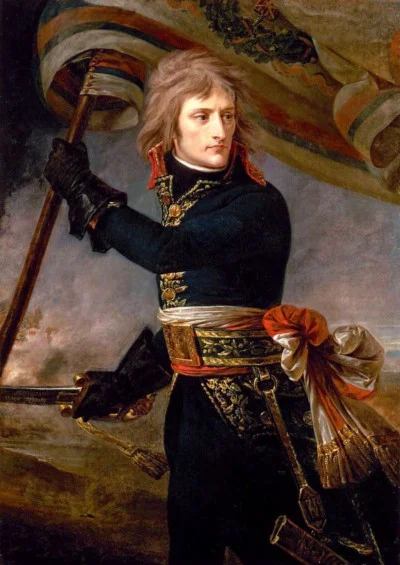
He gets extra style points for the hair.
However, in the 200 years of war between 1580–1780, professional soldiers had almost always been the victors when they went up against militias or levees. This was why almost every single nation-state had developed a moderate to large standing army by 1780. Frederick the Great of Prussia had taken professional soldiering to a whole new level by implementing the general staff system, standard artillery calibers, and professional military education. The small yet mighty Prussian army had smashed the larger French armies over and over during the Seven Years War (1754–1763), leading to an aura of invincibility.
Inspired by American ideals of liberty, equality, and exuberant capitalism, the French people overthrew their government and declared themselves a democracy.
Enter the French Revolution. Inspired by American ideals of liberty, equality, and exuberant capitalism, the French people overthrew their government and declared themselves a democracy. French leaders also noticed how volunteer soldiers in the American Army had managed to stave off the professionals from Britain and Hess (German mercs). They took the idea one step further and created mass conscription, with a twist: a cause to fight for. The French Revolutionary armies won battle after battle against their neighbors, through the use of sheer manpower. Massive 300,000 man French armies would literally overpower the largest army that Austria or Spain could produce, which caused a crisis of faith for other European countries: they could continue to use very expensive professionals (and incur the time and cost it took to replace losses) or they could expose their people to democratic ideals and enlist them into their ranks.
Europe was already reeling from this idea when Napoleon showed up in Italy in 1797 and proceeded to destroy the Austrian armies in detail. His tactics and techniques would be studied and emulated for the next eighteen years, as war became the profession of Europe. He took conscript armies, trained them, instilled pride in them, and then turned them loose against the professionals of Europe (i.e., Prussia) and blew them away. Such was his impact on the profession of arms that he is still studied to this day. Even in…
The U.S. Army
Remember that bit about professional armies being unpopular? Yeah, the new United States hated the thought of a standing army so much that the U.S. Army after the American Revolution consisted of a few hundred troops at West Point and another thousand in the Ohio Country. It was far from a professional organization. America decried the large, professional armies of Europe, blaming them for the constant wars and bankruptcy there. Instead, we would rely on the militia. The idea was that militia units would be called into Federal service if an enemy threatened, negating the need for a large regular Army. The first trial for the militia was the War of 1812. They failed epicly. Apparently, just giving a man a gun and pointing him towards the enemy does not make him a soldier. Also, militia proved reluctant to invade Canada repeatedly, a favorite tactic of the early War Department.

Sir, do we really go rolling along, or is that just a metaphor for the transience of life?” “Shut up and fetch my damn horse.
America decried the large, professional armies of Europe, blaming them for the constant wars and bankruptcy there.
While the aura of the staunch, untrained militiaman remained after the war, the War Department recognized that in order for the volunteer force to actually work, they would need training prior to going to war. Rather than call up the militia, the President would issue a call for volunteers. These volunteers would undergo several months of training before going off to war. Training became standardized through the use of drill manuals (doctrine) and professional officers, many of them West Point graduates (most of whom left the service after four years to go get rich working for the railroads), were put in the volunteer ranks. This practice began in the Mexican-American War and continued through the Civil War and Spanish-American War. It was incredibly successful. The regular Army remained small, never marshaling more than 30,000 men in the ranks until after 1900. Indeed, the idea of a large regular Army was still novel after World War II.
World War II brought about a change to American thought on large armies, as we adapted to our new place in world politics. A large regular force was required to counter the growing Soviet Union. Whereas the Army had before relied on National Guard divisions to serve as the basis for large-scale mobilizations, they now moved the Guard to an operational reserve to back-fill or augment active duty units. With this change came a growing need for better military education and doctrine.
Most soldiers cannot say that their sole occupation for their entire lives is the administration of violence.
So. The burning question: is the current U.S. Army a profession? From a historical standpoint, I am going to have to say that we are not. Yes, there are some few that stay in twenty to thirty years and make a career out of it. But for the vast majority of soldiers, the Army is a place that they pass through on their way to the rest of their civilian lives. Most soldiers cannot say that their sole occupation for their entire lives is the administration of violence. The one exception I would make is the Special Operations Forces community, where they embrace a lifestyle that is embued with the administration of violence and its members tend to serve for longer periods.
As we confront the future of the Army’s force structure modeling, we need to ensure that we don’t lose sight of the professional over the bureaucratic.
However, I do believe that as a whole, the Army inculcates the important aspects of a profession: values, traditions, training, and culture. These traits often make those who pass through the Army better people and more apt to succeed in their civilian lives. On the other hand, the Army has also developed a bureaucracy, which oftentimes overburdens the professional aspect of Army life with administrative humdrum and special projects. As we confront the future of the Army’s force structure modeling, we need to ensure that we don’t lose sight of the professional over the bureaucratic.
Angry Staff Officer is a first lieutenant in the Army National Guard. He commissioned as an engineer officer after spending time as an enlisted infantryman. He has done one tour in Afghanistan as part of U.S. and Coalition retrograde operations. With a BA and an MA in history, he currently serves as a full-time Army Historian. The opinions expressed are his alone, and do not reflect those of the U.S. Army, the Department of Defense, or the U.S. Government.
Have a response or an idea for your own article? Follow the logo below, and you too can contribute to The Bridge:

Enjoy what you just read? Please help spread the word to new readers by sharing it on social media.