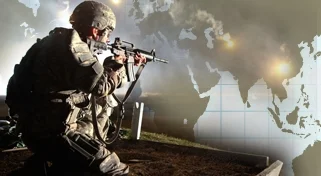
The reality is that we value considering war in a certain way: the Clausewitzian way. Just like other values, people can disagree, but they should recognize that they are disagreeing based on value and not fact...Arguments about the definition of war are always, in some sense, efforts to shape, constrain, or channel violence and power, but this makes it all the more important to consider whether we should think of the nature of war as Clausewitz does. To which I answer, most definitively, yes, because if not Clausewitz, then whom?

#Monday Musings: Simon Anglim
Reflections on #Leadership: Investing in People
That next generation of leaders who will decide the fate of thousands on the battlefield almost certainly stands in our ranks today. The most valuable thing we can do now is to invest our lives in them, mentor, develop, and counsel them so that when history calls, they will stand ready to do their duty. If we expect to have Eisenhowers and Pattons on tomorrow’s battlefields, we must begin by creating a cadre of Fox Conners today from the leaders currently in our ranks.
Old Culture and New Mission in the U.S. Army
Max Weber & Groucho Marx Walk Into A Bar: #Reviewing Victor in the Rubble
Simply, Victor in the Rubble is a delight. It produces that same sense of glee that comes from opening an MRE to find a pop tart perfectly whole rather than smashed into a gazillion crumbles. Alex Finley, a former CIA officer, has crafted a magical satire of the Intelligence Community post-9/11, Iraq, and the 2004 intelligence reforms.
ISIS and the Thirty Years' War
Raqaa is not Munster, Obama is not Waldeck, and the Sunni-Shia face-off is not the Thirty Years’ War. But the comparisons are seductive for a reason, as they help explain a highly complex set of events (like the Arab Spring, the rise of ISIS, the fight in Iraq and Syria and the execution of a Shia cleric) in terms that we know—or think we know. Put another way, historical analogies are useful (and the Thirty Years’ War analogy is particularly useful), but only so long as we get the history right—when we understand that the Thirty Years’ War had nothing to do with God. It was about power. And that’s true today, in the Middle East.
#Monday Musings: Chris Zeitz
Reflections on #Leadership: Mission Command in the Information Age
Leaders must accustom themselves to the uncertain and the ambiguous. They must train themselves and their subordinates to fight equally well across the entire spectrum of conflict. They must be prepared to dominate any battlefield through decisive action at the critical point, even without the benefit of technology or constant oversight. Leaders at all levels must honestly and deliberately exercise mission command at all times or they, their units, and the mission will pay the price when it truly counts
The Institutional Level of War
The capacity of the United States military to fund and field an institutional force is an asymmetric advantage over enemies and adversaries around the globe...The development and advancement of knowledge necessary to improve the force is not a distraction from the operational elements in the current fight. By recognizing the value of the institutional level of war and the contributions of leaders practicing the institutional art, the United States will maintain this asymmetric advantage for decades to come.
#Reviewing Blood Year: Islamic State and the Failures of the War on Terror
The bottom line is that the rise of ISIS has exposed the weakness of a strategic approach, which, for too long, focused just on neutralizing terrorist plots and killing or capturing senior terrorist leaders. This approach looked and often felt, as if it was proactive—taking the fight to the enemy. But in reality, as the defeats of 2014-15 have shown, it was too narrowly focused to succeed.
The Timelessness of Leadership and Innovation
Innovation and leadership converge on this point: crafting environments and cultures in which the desire to improve outweighs the desire to stick with old habits. Because innovation and leadership have this in common, leaders shouldn’t think of innovation as something they do in addition to their real jobs. Innovation is leadership.
#Monday Musings: Ray Kimball
Leading into the Abyss? A Reflection on Strategic Failure & Great #Leadership
Our soldiers, officers, and civilians have faced the most intense fighting since Korea, and they have endured the stresses admirably (with remarkably few mistakes given the corrupting nature of war). Nor do I fundamentally disagree with how leadership theory has developed from these experiences; works such as Team of Teams by Stan McCrystal are already helping develop military leaders fitter for the future challenges of war. The problem is that all these remarkable feats of leadership have ultimately been tarnished, infected if you will, by one thing: the dramatic absence of strategy in the Western world since September 11th, 2001.
#Essays on War: Heroes Among Us
It’s not true that your life flashes before your eyes when faced with death. For me it was the books I’d read and the characters that had left an impression on my soul.It’s not true that your life flashes before your eyes when faced with death. For me it was the books I’d read and the characters that had left an impression on my soul.
Recruiting the Best: the American Military and the Millennial Generation
Millennials are on track to make up nearly fifty percent of the workforce by 2020. That is to say, they represent the future of the U.S. military. While the military should not change its core character or values to accommodate Millennials, it should recognize their views of the world differ from those of past generations. While Millennials present some new training and leadership challenges (getting them off their phones, for example), they also offer a way for the military to advance into the modern world at the ground level.
#Reviewing A Passion for Leadership
From the autumn of his lifetime in public service, Gates offers a final lesson for reformers. When the ideas for change stop flowing, leave. “The reality of reforming bureaucracies is that when a leader thinks he is done, he probably is done.” This is a straightforward statement, but its implications are radical: leadership is reform, and reform should be constant.
Mission Command #Leadership and the U.S. Army
Mission command is more than a philosophy of command. It represents a culture where mutual trust and the concomitant willingness to accept prudent risk govern. It comes with an expectation that commanders respect their subordinates’ judgment and issue orders that focus on intent rather than tasks. Mission command relies on a shared understanding (of the environment and expectations) that enables every member of the team to exercise disciplined initiative. When done well, mission command is the result of effective leadership.
#Monday Musings: Nathan Finney
Institutional #Learning: A Diagnosis of Australian Army Education, Training, and Doctrine
The Australian Army needs a more agile system that is able to anticipate change and continuously adapt to the new generation of soldiers in its ranks, developments in the strategic environment, and new methods of learning that leverage technology. The possession of such an evolved system will better ensure that the soldiers and officers of the Army remain prepared for future operational challenges.
Women on the Battlefield: Data, Science, and the Law
Anyone who hasn’t been trapped under a rock over the past few years has heard innumerable comments on the Secretary of Defense’s decision to admit women into combat career fields, and the build-up leading to this decision—the Marine Corps’ large-scale integration experiment, the Army’s adventures with females in Ranger training, etc. Most of these commentaries miss the mark in one way or another—some are little more than feelings and prejudice cloaked as professional opinion—and few begin where they should, with first principles and the law. Only with these foundations can we evaluate what the services have done in meeting the requirements laid before them.